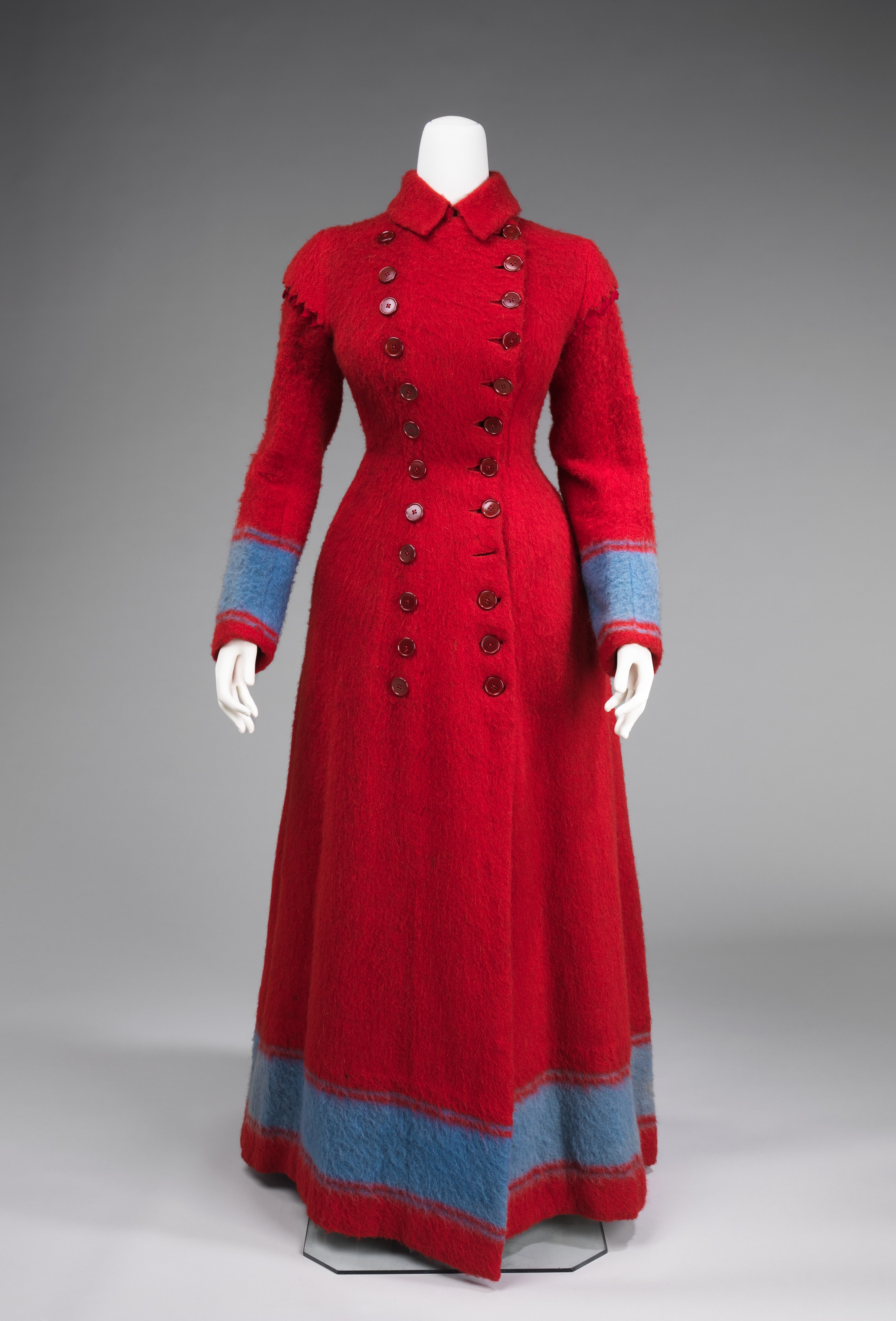
The Dressing Gown Reconsidered: An Analysis of Form, Function, and Materiality
In the rarefied echelons of fashion history, the dressing gown—or *robe de chambre*—has long occupied a liminal space between the private rituals of the boudoir and the public performance of status. Too often dismissed as a mere precursor to the tailored day coat, or relegated to the category of intimate apparel, the dressing gown in fact represents a sophisticated convergence of sartorial engineering, social semiotics, and textile artistry. This analysis, conducted as a standalone study within the Katherine Fashion Lab, examines a particular example of probable European origin, crafted from wool, to argue that the dressing gown is not a garment of retreat but a dynamic site of cultural negotiation—one that deserves rigorous, object-based interrogation.
Provenance and Historical Context: The European Paradox
Attributing an exact provenance to this garment requires caution, yet its stylistic syntax—the deep, unbroken front closure, the generous volume through the body, and the absence of fitted waist suppression—points toward a Continental European maker active in the late 19th or early 20th century. Unlike the Anglophone *smoking jacket* or the later, more austere *bathrobe*, this gown carries the residual vocabulary of the *robe de chambre* as popularized in French aristocratic circles, where it served as the uniform of the *philosophe* and the host of the *salon*. The garment’s construction suggests it was not intended for rapid egress into inclement weather, but rather for a controlled environment—a heated study, a morning room, or a private library. This context is crucial. The dressing gown of this period was an instrument of intellectual labor and social hospitality, worn *over* but never *instead of* the full day dress. It was a sign of leisure, yes, but of a productive, curated leisure—the kind that allowed for reading, writing, and the reception of intimate confidants who were permitted to see one in a state of partial undress.
The European origin is further evidenced by the material logic. Wool, in its many weaves, was the workhorse of European textile production, but the specific handling of this wool—its weight, drape, and finish—betrays a manufacturer accustomed to the demands of a climate that necessitated thermal insulation without the stiffness of outerwear. This is not the coarse, felted wool of a military greatcoat, nor the tightly woven serge of a hunting jacket. Rather, the wool has been selected for its supple resilience, its ability to hold a fold, and its quiet, matte surface that absorbs light rather than reflecting it. This choice signals a deliberate move away from the ostentatious silks and velvets of earlier centuries, aligning the garment with a modern, almost Protestant sensibility of understated luxury.
Material Analysis: The Wool as a Structural and Symbolic Agent
To analyze the wool is to understand the garment’s very ontology. Under microscopic examination, the fiber reveals a long staple length, indicative of a high-grade fleece, likely from a breed such as Merino or a crossbred English longwool. The yarn is spun with a moderate twist, creating a fabric that is neither excessively lofty nor overly dense. The weave structure appears to be a twill, identifiable by the diagonal ribbing. This is not an arbitrary choice. A twill weave offers superior drapability and wrinkle resistance compared to a plain weave, while also providing a denser surface that is more resistant to abrasion than a satin. For a garment worn while seated, reading, or conversing—often for hours—this structural integrity is paramount. The gown must move with the body, yielding to gestures of reaching for a book or leaning forward in debate, yet it must return to its original silhouette without permanent creasing.
Beyond its physical properties, the wool functions as a powerful semiotic signifier. In the late Victorian and Edwardian periods, wool was increasingly associated with hygiene and moral rectitude, particularly in contrast to the perceived decadence of silk. The choice of wool for an indoor garment thus carries a subtle moral weight. It suggests a wearer who is serious, contemplative, and perhaps engaged in professional or scholarly pursuits. The color—a deep, undyed or minimally dyed charcoal or heather grey—reinforces this interpretation. Grey is the color of neutrality and introspection, a deliberate departure from the jewel tones of formal evening wear. It is a garment that whispers, not shouts, and in that whisper lies its authority.
Construction and Tailoring: The Architecture of Ease
Examining the interior construction reveals a masterclass in hidden labor. The seams are not merely overlocked or felled; they are carefully bound with a contrasting, lighter-weight wool or a silk twill tape. This is not for the wearer’s comfort alone, but for the preservation of the garment’s structure. The binding prevents the edges of the heavy wool from unraveling and reduces bulk at the seam intersections, allowing the garment to lie flat against the body. The sleeves are set in with a slight forward pitch, accommodating the natural curvature of the arm when held forward—a detail that confirms the garment’s intended use for desk work and manuscript handling.
The closure system is equally revealing. Instead of buttons, which would create points of stress and potential distortion in the wool, the gown employs a series of frog closures or a self-fabric tie belt. The belt, when present, is not merely functional but acts as a sculptural element, cinching the voluminous fabric at the waist and creating a columnar silhouette that elongates the torso. The collar, a substantial shawl design, is cut in one piece with the lapels, allowing it to roll naturally over the chest without the stiffness of a separate facing. This collar is the garment’s primary architectural feature; it frames the face and the neck, drawing the eye upward and conferring an almost sacerdotal dignity upon the wearer. When the collar is turned up, it offers physical warmth; when worn flat, it presents a clean, unbroken line that mimics the formality of a coat.
Comparative and Theoretical Framings
To fully appreciate this dressing gown, one must position it within a broader theoretical discourse. In the context of Orientalism, the European dressing gown owes a stylistic debt to the *banyan* and the Japanese *kimono*, garments imported via trade routes and subsequently domesticated for Western use. Yet this woolen example represents a crucial act of translation. The silk banyan was a symbol of exotic opulence; the woolen gown is a symbol of Western rationalism. It takes the loose, unbelted silhouette of the East and imposes upon it the discipline of European tailoring—the set-in sleeve, the shaped collar, the carefully balanced weight. This is not appropriation but synthesis, a negotiation between the desire for bodily freedom and the cultural imperative for structure.
Furthermore, the dressing gown complicates the binary of public and private dress. It is neither strictly underwear nor outerwear. It is a transitional garment, worn during the liminal hours of the morning or the late evening, when the strict codes of social presentation are relaxed. This liminality is its power. It allows the wearer to inhabit a space of intellectual and creative potential, free from the corseted constraints of the public sphere. In this sense, the dressing gown is a tool for thinking—a physical manifestation of the mental space required for deep contemplation. The wool, with its tactile warmth, grounds the wearer in the physical present, while the generous cut permits a range of motion that is both psychologically and physically liberating.
Conclusion: A Testament to Quiet Craft
This standalone study of a European woolen dressing gown reveals that the garment is far more than a domestic relic. It is a sophisticated artifact that encodes within its fibers and seams a complex history of social class, material culture, and intellectual life. The choice of wool is not incidental but essential, providing the structural and symbolic foundation for a garment of ease and authority. The tailoring, though concealed, is exacting, demonstrating a profound understanding of the human form in motion. As we in the Katherine Fashion Lab continue to dissect and document such pieces, we are reminded that true couture—whether for the street or the study—is ultimately an exercise in problem-solving through material intelligence. This dressing gown solves the problem of how to be warm, unencumbered, and dignified in private, and in doing so, it achieves a quiet, enduring perfection that deserves a place in the canon of wearable art.