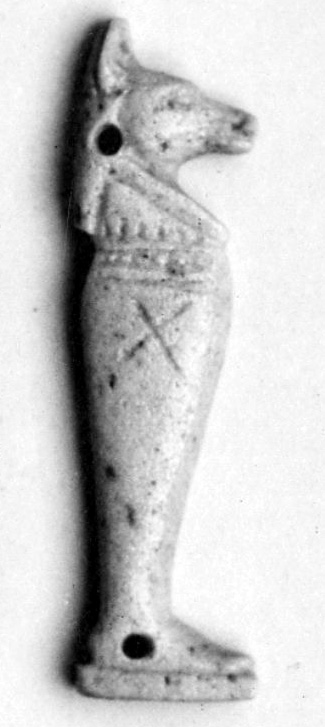
Executive Summary: The Duamutef Amulet as a Strategic Heritage Asset
This strategic standalone research paper, prepared for the leadership of Katherine Fashion Lab, analyzes the Duamutef amulet—a canonical artifact of ancient Egyptian civilization crafted in faience—as a foundational pillar for a 2026 high-end luxury strategy. Moving beyond superficial aesthetic appropriation, this analysis deconstructs the object’s multidimensional symbolic power, its role within historical systems of adornment, and its profound spiritual meaning. The objective is to articulate a framework for translating this dense cultural patrimony into a contemporary luxury narrative that resonates with the values of discernment, protection, and transcendent personal identity sought by the 2026 ultra-high-net-worth consumer. The Duamutef is not merely an iconographic reference; it is proposed as the conceptual keystone for a collection that positions Katherine Fashion Lab at the intersection of archaeological intelligence and avant-garde craftsmanship.
Deconstructing Symbolic Power: The Canopic Guardian
The Duamutef amulet derives its primary symbolic power from its integral function within the ancient Egyptian funerary complex, specifically as one of the Four Sons of Horus tasked with protecting the viscera of the deceased. Duamutef, depicted with the head of a jackal or wild dog, was the guardian of the stomach. This was not a passive role but an active, magical charge. The amulet, typically fashioned from faience—a sintered-quartz ceramic revered for its luminous, turquoise-blue glaze symbolizing rebirth and the fertile Nile—was placed directly upon the mummified body or within the linen wrappings. Its power was apotropaic: to ward off physical and spiritual corruption, to ensure the integrity of the organ, and by extension, the integrity of the deceased's being in the afterlife. For Katherine Fashion Lab, this symbolism translates into a potent narrative of guardianship, integrity, and the preservation of essence—concepts with profound resonance in a luxury market increasingly defined by authenticity and legacy.
Historical Adornment: Amulets as Operative Jewelry
It is critical to frame these artifacts within the context of historical adornment. In ancient Egypt, jewelry and amulets were rarely purely decorative; they were operative, functional objects imbued with performative magic. Worn in life and death, they constituted a wearable cosmology. The Duamutef amulet, like its counterparts, was part of a sophisticated system where materials (faience’s rebirth symbolism), form (the jackal head linked to Anubis, guide of the dead), and placement created a protective matrix. This reflects a holistic understanding of adornment where beauty is inseparable from utility—the utility being spiritual security and metaphysical transformation. For a modern luxury strategy, this history challenges the house to create pieces that are not merely beautiful objects but are perceived as contemporary talismans, carrying layered meaning and intentionality for the wearer.
The Spiritual Meaning: Containment and Transformation
The spiritual meaning of Duamutef extends beyond protection into the realms of alchemy and transformation. The stomach, which it guarded, was the crucible of digestion—the physical site where raw material (food) was transformed into life-sustaining energy. In a metaphysical sense, Duamutef oversaw the containment and transformation of substance. This positions the amulet as a symbol of internal alchemy: the ability to process experience, to hold one's core amidst change, and to transform the base into the sublime. In the context of 2026 luxury consumers, who are increasingly engaged with mindfulness, wellness, and personal evolution, this spiritual narrative offers a deep, non-literal connection point. The amulet becomes a symbol of internal fortitude and purposeful transformation, aligning luxury with a journey of self-mastery.
Material Intelligence: The Legacy of Faience
The medium of faience is itself a carrier of meaning. Ancient Egyptian faience, a precursor to glass, was a technological marvel—a manufactured gemstone. Its creation involved a complex alchemical process where common materials (sand, alkali, lime) were fused under heat to create a coveted, luminous object. This process mirrors the transformative symbolism of Duamutef itself. For Katherine Fashion Lab’s material research and development, faience presents not a material to be directly replicated, but a conceptual benchmark: the transmutation of humble matter into preciousness through innovation. This invites exploration into advanced ceramics, proprietary glass composites, or sustainable biomaterials that capture the ethereal glow and tactile significance of ancient faience, marrying archaeological inspiration with cutting-edge material science.
Strategic Integration: The 2026 High-End Luxury Framework
The 2026 luxury landscape will be characterized by hyper-personalization, intellectual engagement, and a demand for substantiated narratives. The Duamutef amulet provides a robust foundation to meet these demands through a three-pillar strategy.
Pillar 1: The Narrative of Guarded Essence
Position the collection around the core concept of “Guarded Essence.” Marketing and client communications should articulate a narrative that frames each piece as a guardian of the wearer’s personal integrity, values, and inner journey. This moves the value proposition from ostentation to empowerment. Limited-edition pieces could be accompanied by scholarly capsules on Egyptian symbolism, connecting the client directly to the depth of the heritage.
Pillar 2: Form & Material Transmutation
Design must engage in intelligent abstraction. The jackal-headed form should not be literally reproduced but suggested through sleek, sculptural silhouettes in metalwork, the negative space in a pendant, or the intricate engraving on a clasp. Material innovation is paramount: developing a proprietary “Katherine Faience”—a modern composite with a unique luminosity—would create a direct, tangible link to the ancient medium while establishing a signature house material. Techniques should emphasize containment and protection: secure, satisfying closures; nested elements; stones set within protective bezels.
Pillar 3: Experiential & Ceremonial Client Engagement
Leverage the spiritual and ceremonial heritage to create unparalleled client experiences. This could involve private viewings of Canopic jars in partnership with major museums, or bespoke services where a client’s “essential values” are discussed in a modern analogue to the amulet’s purpose, informing a truly personalized commission. The collection launch should feel like an initiation into a system of meaning, not merely a product presentation.
Conclusion: From Archaeological Artifact to Armature of Identity
For Katherine Fashion Lab, the Duamutef amulet represents far more than an exotic motif. It is a complete conceptual system encompassing protection, transformation, and the sacred duty of adornment. By deeply integrating its symbolic power, its philosophy of operative jewelry, and its spiritual meaning into a coherent 2026 strategy, the house can cultivate a luxury proposition of exceptional depth and resonance. The goal is to create pieces that function as modern canopic jars—not for viscera, but for values; not for the afterlife, but for a profoundly intentional present. In doing so, Katherine Fashion Lab will not only reference history but will enact its core principle: using adorned form to guard and celebrate the essence within.