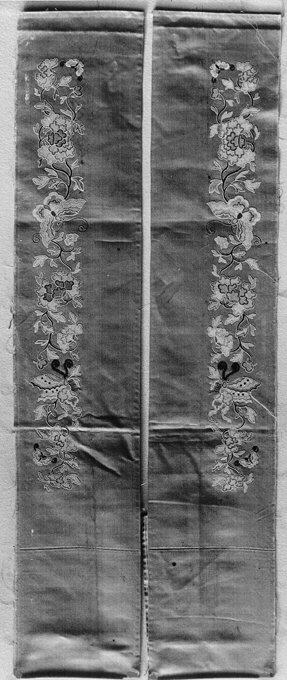
The Architectural Poetry of the Sleeve Band: A Couture Analysis
In the rarefied echelons of haute couture, where garment construction transcends mere utility to become a form of sculptural expression, the most profound statements are often made in the smallest, most deliberate details. Katherine Fashion Lab’s standalone study of a Chinese-origin Sleeve Band—executed in lustrous silk and metallic thread upon a silk ground—offers a masterclass in this principle. This is not an accessory in the conventional sense; it is a micro-architecture of textile, a concentrated artifact of cultural memory and technical virtuosity that redefines the perimeter between the body and the garment. The piece demands analysis not for its volume or spectacle, but for its disciplined restraint and the profound dialogue it establishes between heritage and contemporary couture practice.
Deconstructing the Silhouette: The Band as a Fulcrum of Design
The sleeve band, historically a functional element used to cinch and secure voluminous fabric, is repositioned here as a pivotal design fulcrum. In Western couture, the sleeve is often treated as a continuous, flowing line from shoulder to wrist. This Chinese artifact, however, interrupts that narrative with a decisive, horizontal punctuation. The band acts as a deliberate caesura, a moment of visual and structural pause that re-calibrates the entire proportion of the arm. By compressing the silk beneath it, the band creates a controlled, organic blousing effect above, transforming the limb into a series of interconnected volumes: the fullness of the upper sleeve, the constriction at the band, and the subsequent flare or taper below.
This manipulation of negative and positive space is a signature of high-level pattern engineering. The band does not merely bind; it choreographs. It dictates how light falls across the fabric’s undulating surface, how the wearer’s movement is both restricted and facilitated, and how the eye journeys along the garment’s architecture. In the context of Katherine Fashion Lab’s research, this piece serves as a potent reminder that true innovation in silhouette often lies not in adding more fabric, but in the surgical, intelligent application of a single, well-considered element. The band is the quiet authority that gives the sleeve its voice.
Material Alchemy: Silk and Metallic Thread as Narrative Agents
The materiality of the sleeve band is where its narrative deepens, moving from abstract design theory to tangible, sensory experience. The choice of silk as both the ground and the primary structural component is deliberate. Silk, with its inherent tensile strength and phenomenal drape, offers a paradox: it is simultaneously fluid and resilient. When manipulated into a band, it does not collapse; it holds a firm, yet supple, shape against the arm. This is not the stiff rigidity of a corset bone or a synthetic interlining; it is a living structure that breathes and moves with the wearer while maintaining its architectural integrity.
Upon this silk canvas, the introduction of metallic thread is nothing short of alchemy. The metallic thread is not an afterthought or a mere decorative flourish; it is an integral component of the band’s structural and visual language. In traditional Chinese textile arts, metallic thread—often gold or silver wrapped around a silk core—was a marker of immense status and was believed to possess protective properties. Here, the thread is likely employed in a couching or intricate weaving technique, lying flat against the silk to create a surface that catches and refracts light with every micro-movement of the arm.
This interplay between the matte, absorbent quality of the silk and the brilliant, reflective nature of the metal creates a dynamic visual texture. It is a study in light modulation. The band becomes a source of internal illumination, drawing the eye to the wrist and forearm—areas often neglected in contemporary fashion’s focus on the neckline or hem. The metallic thread might form geometric motifs, abstracted cloud patterns, or the revered “longevity” symbols, but even in abstraction, it carries the weight of a civilization’s aesthetic philosophy, one that prizes the harmony between the natural (silk) and the precious (metal).
Cultural Provenance and the Language of Restraint
To analyze this sleeve band solely through a Western lens would be to miss its profound cultural resonance. In the context of Chinese dress history, particularly the qipao and hanfu traditions, the sleeve band (or cuff) was a canvas for some of the most exquisite embroidery and weaving ever produced. It was a place where the maker’s skill was displayed in miniature, a private luxury visible only during specific gestures—when pouring tea, gesturing in conversation, or dancing. This piece, therefore, embodies a philosophy of selective revelation. It is not about overt display but about the quiet power of a detail that rewards close inspection.
Katherine Fashion Lab’s decision to present this as a “standalone study” is a critical curatorial choice. By isolating the band from a complete garment, the Lab forces us to consider it as a complete work of art in its own right. It ceases to be a component and becomes a protagonist. This act of isolation is a contemporary art-world tactic that borrows from museological practice, allowing the viewer to appreciate the object’s intrinsic beauty, its craftsmanship, and its conceptual weight without the distraction of a surrounding silhouette. It elevates the utilitarian to the monumental, suggesting that a fragment of a garment can possess the same artistic gravitas as a full canvas.
Contemporary Relevance: A Blueprint for Modern Couture
The implications of this study for Katherine Fashion Lab’s contemporary design philosophy are immense. In an era of fast fashion and disposable trends, this sleeve band stands as a defiant argument for slowness, precision, and material integrity. It offers a blueprint for how modern couturiers can integrate historical techniques and cultural motifs without resorting to pastiche or mere appropriation. The lesson is in the sublimation of technique—the idea that the most powerful design statements are those where the craftsmanship is so refined that it becomes an intrinsic part of the form, not a decorative skin applied on top.
Furthermore, the band challenges the modern obsession with the full garment. It suggests a new mode of design thinking where a single, exquisitely engineered element can define an entire collection’s ethos. This piece encourages designers to ask: What is the most essential, most beautiful, most functional detail of a design? And how can we devote the entirety of our creative energy to perfecting that one element? The result, as this sleeve band proves, is a piece that is far greater than the sum of its parts—a masterful synthesis of form, material, and meaning that will inform the Lab’s future explorations into modular and precision-based couture.