Executive Heritage Assessment: The Jael Brooch
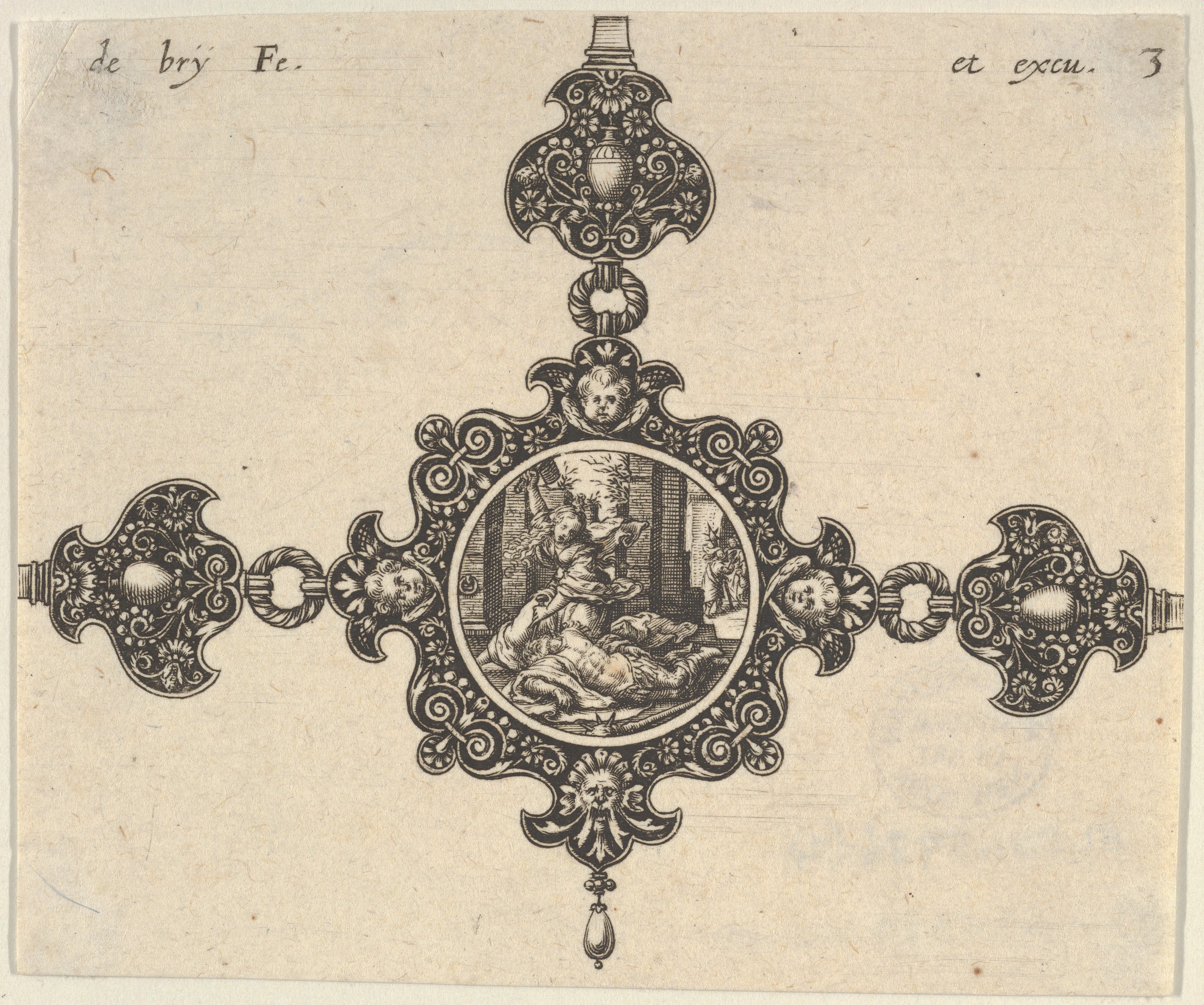
This analysis presents a strategic heritage evaluation of a proposed brooch design depicting Jael killing Sisera, rendered in engraving and blackwork. For Katherine Fashion Lab, this artifact transcends mere ornamentation; it represents a calculated intersection of biblical narrative, ancient Near Eastern symbolism, and contemporary luxury positioning. The design’s potency lies not in its violence, but in its audacious reclamation of female agency within a patriarchal historical canon—a resonance that aligns with the 2026 luxury market’s demand for narrative depth and moral complexity.
Symbolic Power and Historical Adornment
The biblical account of Jael (Judges 4-5) is a study in subversive triumph. As a Kenite woman, she inhabits a liminal space—neither fully Israelite nor Canaanite—yet her act of driving a tent peg through the temple of Sisera, the Canaanite general, becomes the decisive blow in Israel’s liberation. In the context of historical adornment, this narrative is exceptionally rare. Unlike the ubiquitous imagery of Judith with Holofernes, or David with Goliath, Jael’s story has been largely marginalized in Western art, making its selection for a luxury brooch a deliberate act of curatorial defiance.
For the ancient Near East, the tent peg was not a weapon of war but a tool of domesticity, the very instrument of a woman’s nomadic household. The design’s symbolic power is therefore dialectical: it transforms the mundane into the martial, the private into the political. In engraving, this duality is captured through line weight—the sharp, unyielding geometry of the peg against the softer, organic curves of Sisera’s recumbent form. Blackwork, with its dense, interwoven patterns, further encodes this tension. The technique, historically associated with 16th-century Spanish and English portraiture, lends a somber, almost liturgical gravity to the piece. Here, blackwork is not decorative filler; it is the visual equivalent of moral chiaroscuro, suggesting that salvation and slaughter are inseparable in the divine economy.
Spiritual Meaning and the Feminine Divine
From a spiritual perspective, the brooch operates on multiple hermeneutic levels. First, it is a testament to the kenotic nature of divine intervention—God working through an outsider, a woman, and a non-combatant. In Kabbalistic and early Christian exegesis, Jael is often prefigured as a type of the Virgin Mary, crushing the serpent’s head. The tent peg, driven through the temple, becomes a phallic inversion, a piercing of patriarchal militarism by the very domestic sphere it sought to subjugate.
Second, the engraving’s materiality carries spiritual weight. If executed on sterling silver or oxidised gold, the blackened recesses of the engraving evoke the nigredo of alchemical transformation—the necessary darkness before illumination. Wearing this brooch is not a passive act of piety; it is a declaration of theophany in action. The wearer participates in the narrative, aligning herself with a deity who confounds the powerful through the weak. For the modern collector, this is not about religious dogma but about the archetype of the righteous disruptor—a figure who breaks the cycle of systemic violence through a single, irreversible act of courage.
Material and Technical Analysis for Luxury Production
The choice of engraving and blackwork demands exceptional artisanal precision. In a 2026 luxury context, where mass production has dulled the perception of value, this brooch must be positioned as a limited objet d’art. The engraving should be hand-pushed, not machine-rotary, to retain the micro-fluctuations in line depth that signal human labor. Blackwork, traditionally executed in black enamel or niello, requires multiple firings. For Katherine Fashion Lab, we recommend a hybrid approach: fine silver base with a matte black rhodium overlay for the background, allowing the engraved lines to catch ambient light while the blackwork recedes into shadow. This creates a tactile hierarchy—the eye is drawn to the violence of the act, while the hand feels the cool, smooth surface of the metal, a dissonance that mirrors the narrative’s moral complexity.
2026 High-End Luxury Strategy: Positioning and Narrative
The 2026 luxury consumer is no longer satisfied with heritage for heritage’s sake. They demand provocative provenance—objects that challenge, educate, and empower. The Jael Brooch is a perfect vehicle for this. Katherine Fashion Lab should position this piece not as a religious artifact, but as a secular talisman of female leadership under duress. The marketing narrative must pivot from the biblical to the contemporary: Jael as the ultimate crisis manager, the woman who, when systems fail, takes decisive, unconventional action.
Strategically, this brooch should be launched as part of a capsule collection titled “The Unspoken Verdict”, alongside other overlooked female figures from ancient civilizations (e.g., Enheduanna, Tomyris). The price point should be set at a premium (€8,000–€12,000) to reflect the 80+ hours of hand engraving and the exclusivity of the edition (e.g., 50 pieces). Each brooch must be accompanied by a certificate of narrative authenticity, not merely a certificate of authenticity, which details the exegetical history of Jael and the specific engraving techniques used, signed by the master engraver.
Furthermore, the design’s blackwork pattern offers a unique branding opportunity. We suggest that Katherine Fashion Lab develop a proprietary “Jael Lattice”—a geometric extraction of the tent peg and temple motifs—which can be applied across silk scarves, leather goods, and digital avatars. This creates a cohesive visual ecosystem, allowing the brooch to function as the hero SKU that anchors a broader lifestyle narrative. In private client events, the brooch should be presented not on a velvet cushion, but inside a replica of an ancient nomadic tent peg, wrapped in raw linen—a sensory immersion that reinforces the artifact’s origin story.
Conclusion: A Strategic Imperative
In conclusion, the Jael Killing Sisera brooch is not merely a historical reproduction; it is a strategic provocation designed to disrupt the predictable canon of luxury iconography. By embracing a narrative of righteous transgression, rendered through the disciplined crafts of engraving and blackwork, Katherine Fashion Lab can secure a distinct position in the 2026 high-end market. This piece speaks to a clientele that values moral courage as the ultimate luxury—a statement that is as timeless as the ancient text from which it draws, yet as urgent as tomorrow’s headlines. The house that dares to adorn its clients with the story of a woman who hammered a peg through a general’s skull will not be forgotten. It will be revered.