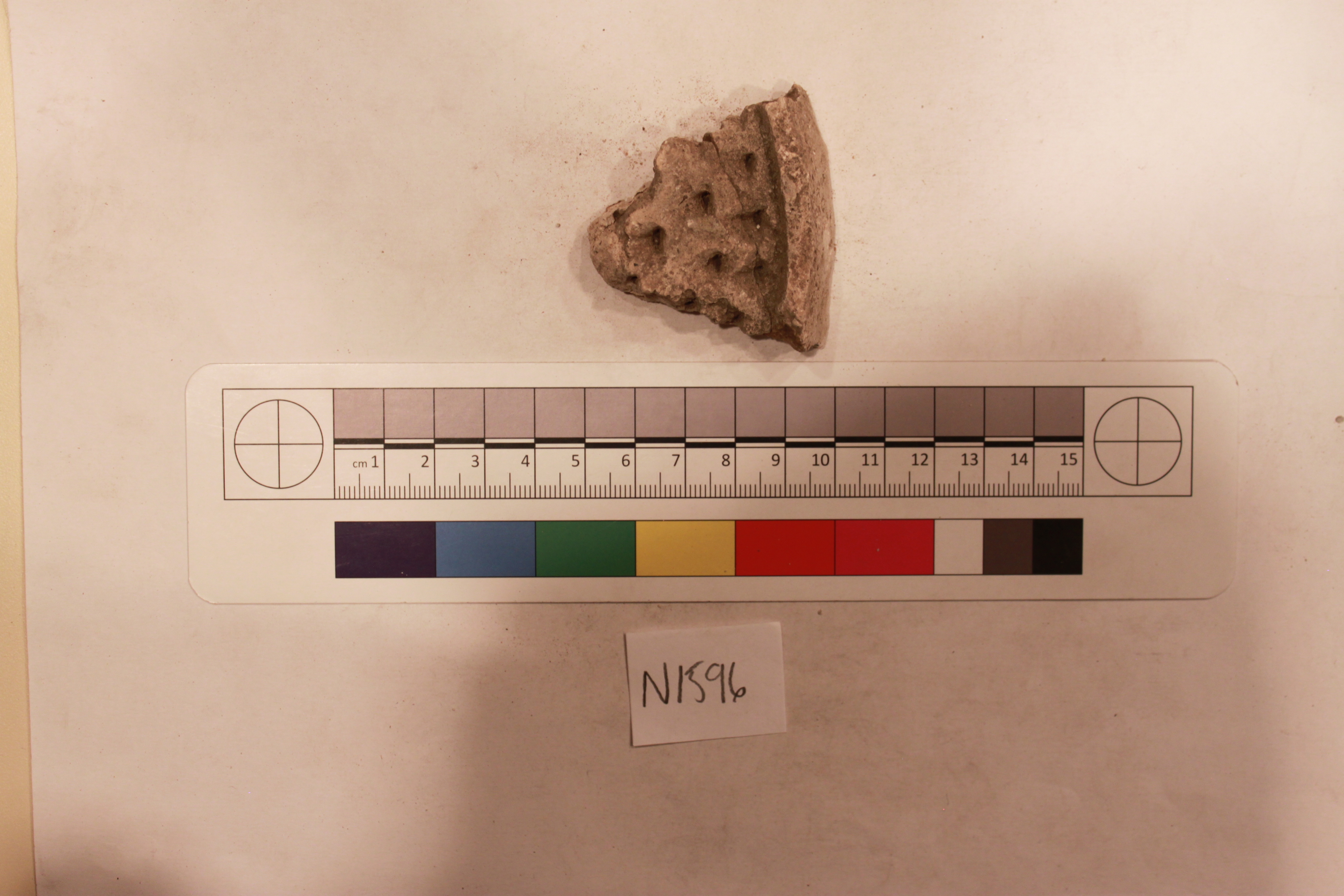
The Tactile Lexicon of Time: A Couture Analysis of the Stucco Fragment
In the rarefied echelons of haute couture, where fabric is but a whisper and silhouette a declaration, the true métier of the house lies in its ability to translate the intangible into the tangible. At Katherine Fashion Lab, this translation is not merely an act of creation but an act of profound archaeological excavation—a sifting through the strata of human aesthetics to unearth forms that resonate with our contemporary psyche. The subject of this analysis, a carved Stucco Fragment of Global Heritage origin, is not a textile, nor a garment, nor a piece of jewelry in the traditional sense. It is, however, a masterclass in the foundational principles that govern our most avant-garde collections: the manipulation of volume, the poetry of negative space, and the narrative power of surface degradation.
To dismiss stucco as mere architectural mortar is to misunderstand its historical gravitas. From the intricate reliefs of Sassanian palaces to the delicate ornamentation of Mughal cenotaphs and the baroque exuberance of European ceilings, stucco has served as the medium through which civilizations have articulated their cosmological and temporal power. This particular fragment, excised from its original architectural context and presented as a standalone study, offers a unique opportunity. It is no longer a subordinate element of a grander scheme; it is the scheme itself. In this isolation, the fragment achieves the status of a primary text, its every undulation and fracture a legible glyph in a forgotten language of form.
Deconstructing the Silhouette: Volume and the Architecture of the Body
The couturier's first gaze upon this fragment is not one of nostalgia but of structural analysis. The carved relief presents a topography of high peaks and deep valleys, a dramatic play of light and shadow that we in the atelier refer to as the sculptural gradient. The artisan’s hand, guided by a vision now lost to time, has coaxed from a formless mass a series of rhythmic protrusions and recessions. This is the essence of volume architecturale. In our contemporary practice, we seek to replicate this effect not with chisel and trowel, but with engineered tulle, horsehair canvas, and meticulously pressed organza. When we construct a sculpted peplum or a structured bustier, we are engaging in the same dialogue with mass that the ancient carver did. The fragment teaches us that true volume is not about adding material but about the strategic removal of it to create an optical density. The negative space—the carved indentations—becomes as crucial to the garment's presence as the positive protrusions, dictating how the fabric falls, catches the light, and ultimately, how it moves against the human form.
Consider the fragment's edge, where the carving abruptly ceases, leaving a raw, jagged border. This is not a flaw but a critical design element we term the unfinished terminus. In a couture context, this translates to our deliberate use of raw hems, exposed seam allowances, and deconstructed linings. The fragment's abrupt ending suggests a narrative that continues beyond the physical object, an infinite loop of creation. This philosophy challenges the traditional notion of the garment as a closed, finite system. Instead, it posits the garment as a fragment itself—a moment captured in the continuous flow of the wearer's life, incomplete without their kinetic energy to animate it.
The Surface as Narrative: Patina and the Chronology of Touch
If the silhouette is the skeleton of couture, then the surface is its skin, and the skin of this stucco fragment is a chronicle of time itself. The patina—that delicate accretion of dust, soot, and micro-abrasions—is not a degradation of the object but its ultimate refinement. It is the physical manifestation of centuries of environmental dialogue, a silent testimony to the gaze of countless viewers and the passage of countless seasons. In our lab, we pursue an analogous effect through our proprietary fabric treatments. We distress silks with pumice, overdye velvets with tea and iron oxides, and employ laser-cutting techniques to simulate the erratic fissures found in the fragment’s surface. This is not a fetishization of decay but an acknowledgment that a garment’s history—real or constructed—imbues it with an unquantifiable depth. A pristine, untouched surface is a blank page; a patinated one is a poem.
The micro-topography of the fragment reveals the artist's tool marks, each a vestigial fingerprint of the creator. In haute couture, we celebrate this manual signature. The slight asymmetry of a hand-stitched seam, the irregularity of a hand-rolled hem, the unique tension of a hand-tied knot—these are the contemporary equivalents of the carver’s strokes. They are the imperfections that prove the object was made by human hands, not merely manufactured by machine. This fragment, therefore, serves as a powerful counter-narrative to the sterile perfection of fast fashion. It validates our commitment to the fait-main (handmade) process, reminding us that the value of a creation lies not in its flawless replication but in its singular, tactile evidence of human intention.
Material Alchemy: From Mortar to Muse
The materiality of stucco—a composite of lime, sand, and water—is deceptively humble. Yet, in the hands of a master, it is transformed into a medium of immense expressive potential. This alchemy is the core of Katherine Fashion Lab’s material philosophy. We are not bound by the traditional lexicon of luxury fabrics. We are interested in the transformative potential of all materials. The stucco fragment challenges us to look beyond the intrinsic value of silk or cashmere and to consider the conceptual value of a material’s origin and manipulation. Just as the stucco artist elevated a utilitarian building material to an art form, we seek to elevate unconventional materials—recycled plastics, industrial felts, bio-fabricated leathers—into objects of desire and contemplation.
The fragment’s weight is also a point of consideration. Its physical heaviness is in stark opposition to the ethereal lightness often associated with high fashion. Yet, this density conveys a sense of gravity and gravitas. In our collections, we explore this paradox through the use of heavy, liquid-like jerseys that drape with the weight of water, or dense, compacted wools that stand away from the body with architectural rigidity. The fragment teaches us that weight is a form of presence. A garment that carries a certain physical heft can command a room with the same authority as a carved relief that has dominated a sacred space for millennia. The wearer, in essence, becomes the architecture, and the garment, the ornate frieze that defines their dominion.
Ultimately, this Stucco Fragment is not an artifact of the past but a blueprint for the future of our design language. It is a testament to the cyclical nature of aesthetics, proving that the most innovative expressions are often born from a deep, respectful dialogue with our most ancient creative instincts. By studying its form, its surface, and its material essence, we at Katherine Fashion Lab are not merely creating clothes; we are curating fragments of a new heritage, one stitch, one carve, one moment of patina at a time. The lab is not a factory; it is an archaeological site of the future, and this fragment is our most potent muse.