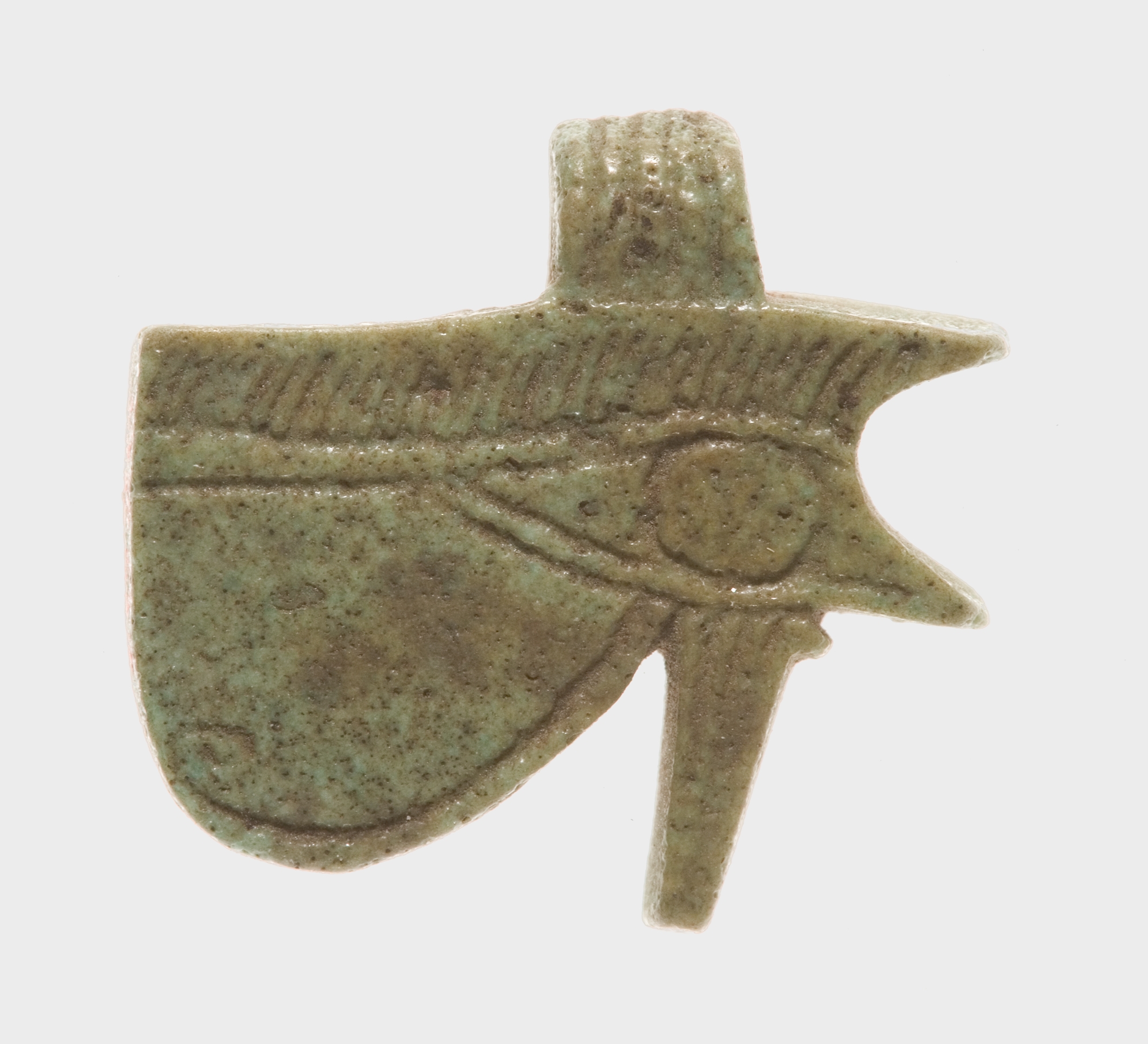
The Wedjat Eye Amulet: Symbolic Power and the Architecture of Protection in Modern Luxury
The Wedjat eye, also known as the Eye of Horus, represents one of the most sophisticated semiotic systems in the history of adornment. Originating in the Predynastic period of ancient Egypt and reaching canonical form during the Old Kingdom (circa 2686–2181 BCE), this symbol transcends mere decorative function. For Katherine Fashion Lab, the Wedjat eye amulet offers a profound strategic template—a convergence of mythic mathematics, prophylactic spirituality, and material prestige that speaks directly to the 2026 luxury consumer’s desire for meaning-laden objects. This analysis deconstructs the amulet’s layered heritage and translates its core principles into a high-end fashion strategy predicated on protection, precision, and perceptual power.
Historical Adornment and Material Significance
The Wedjat eye amulet, typically rendered in faience—a self-glazing, silica-based ceramic that produces a brilliant turquoise or deep blue sheen—was not an object of passive beauty. In ancient Egyptian material culture, faience was considered a substitute for lapis lazuli and turquoise, stones associated with the sun’s rebirth and celestial waters. The material’s luminous quality was believed to capture and reflect divine light, transforming the wearer into a living vessel of solar energy. Strategically, this material choice established a hierarchy of value: the amulet’s power was contingent upon its chromatic intensity and surface perfection, not its rarity in the geological sense. This principle—that perceived value derives from crafted luminosity rather than raw material scarcity—remains a foundational tenet for contemporary luxury houses seeking to differentiate through artisanal technique.
Archaeological evidence places Wedjat amulets in burial contexts, on mummy wrappings, and within jewelry assemblages worn by both elite men and women. The amulet’s placement was deliberate—over the thoracic cavity, near the throat, or at the wrist—positions that maximized contact with the body’s vital energy centers. This historical practice of strategic placement offers a direct analog to modern jewelry ergonomics, where the intersection of skin, metal, and gemstone creates a charged micro-environment. For Katherine Fashion Lab, the lesson is clear: the physical site of adornment is as critical as the symbol itself.
Symbolic Power and Spiritual Mechanics
The Wedjat eye’s symbolic architecture is rooted in the Osiris myth, wherein Horus loses his left eye in a cosmic struggle with Set, only to have it restored by Thoth, the god of wisdom and writing. The restored eye—the “sound” or “whole” one—became a symbol of healing, regeneration, and royal authority. Yet its power is not merely narrative; it is encoded in mathematics. The ancient Egyptians fractionally divided the Wedjat eye into six parts, each corresponding to a specific sense or aspect of human perception: smell (1/2), sight (1/4), thought (1/8), hearing (1/16), taste (1/32), and touch (1/64). When summed, these fractions total 63/64, with the remaining 1/64 believed to be supplied by Thoth’s magical wisdom. This deliberate incompleteness is not a flaw but a theological statement: human perception is inherently partial, and divine intervention completes the whole.
For a luxury brand, this symbolic system offers a rigorous framework for product storytelling. The Wedjat eye does not promise absolute invulnerability; rather, it acknowledges vulnerability and offers a mechanism for restoration and vigilance. In a 2026 market saturated with overt displays of power, the Wedjat eye’s quiet assertion of protective wisdom resonates more deeply than aggressive branding. It positions the wearer as discerning, spiritually literate, and aware of life’s inherent fragmentation—yet equipped with an amulet that bridges the gap between the mundane and the divine.
Spiritual Meaning as Experiential Luxury
Contemporary luxury consumers are increasingly seeking what sociologists term “experiential transcendence”—objects that facilitate a shift in consciousness or provide a sense of ritual containment. The Wedjat eye amulet, worn daily or during significant rites, functioned as a portable talisman that recalibrated the wearer’s psychological state. Its blue-green glaze was associated with the primordial waters of Nun, the chaotic yet generative substance from which creation emerged. To wear the Wedjat was to carry a fragment of cosmic order against the entropy of mortal existence.
Katherine Fashion Lab can operationalize this spiritual dimension by designing collections that emphasize ritual interaction. Consider a modular pendant system where the Wedjat eye is paired with a detachable scarab or ankh, allowing the wearer to customize their protective narrative. The act of selecting, assembling, and donning the amulet becomes a micro-ritual, echoing the ancient Egyptian practice of consecrating jewelry through specific prayers and gestures. This elevates the product from a static object to a dynamic participant in the wearer’s daily life, fostering deep emotional attachment and repeat engagement.
2026 High-End Luxury Strategy: The Protective Code
As we project into 2026, the luxury market is defined by several converging macro-trends: a retreat from overt logos toward semiotic subtlety, a heightened demand for provenance and artisanal authenticity, and an increasing consumer focus on psychological resilience in a volatile geopolitical climate. The Wedjat eye amulet, strategically reimagined, addresses all three vectors with exceptional precision.
Semiotic Subtlety and the “Invisible Shield”
The Wedjat eye is not a universally recognized symbol in Western markets, unlike the cross or the evil eye. This relative obscurity is an asset. It allows Katherine Fashion Lab to cultivate an insider aesthetic—a code shared between the brand and its discerning clientele. The amulet can be rendered in miniature, perhaps as a discreet clasp on a leather cord or as a hidden engraving inside a signet ring. The luxury here resides in the knowledge of the symbol’s meaning, not its immediate legibility. This approach directly counters logo fatigue and positions the brand as a purveyor of encrypted heritage.
Artisanal Authenticity and Material Innovation
Ancient faience was produced through a complex process of quartz sintering and alkaline glazing, a technique that required extraordinary kiln control. For 2026, Katherine Fashion Lab should commission a limited series of Wedjat amulets in contemporary “high-tech faience”—a composite of fine porcelain and vitreous enamel that replicates the original’s luminous depth while offering superior durability. Each piece would be hand-finished by master artisans, with slight variations in glaze tone serving as a certificate of human intervention. This strategy aligns with the luxury sector’s pivot toward “slow goods” and provides a compelling counter-narrative to mass-produced smart accessories.
Psychological Resilience and the Luxury of Protection
The most potent strategic lever for 2026 is the Wedjat eye’s function as a psychological anchor. In an era of digital surveillance, environmental anxiety, and economic uncertainty, the amulet offers a tangible locus of control. Katherine Fashion Lab can market this not as superstition but as “applied symbolic therapy”—a wearable reminder of one’s own perceptual completeness. Marketing collateral should emphasize the 63/64 principle, framing the amulet as a tool for acknowledging imperfection while trusting in unseen wisdom. This narrative appeals to high-net-worth individuals who are accustomed to managing risk but seek a more poetic dimension to their resilience toolkit.
Conclusion: The Wedjat Eye as a Strategic Blueprint
The Wedjat eye amulet is not a relic; it is a living system of meaning that has survived four millennia because it addresses a universal human need: the desire for wholeness in a fragmented world. For Katherine Fashion Lab, the strategic imperative is not to copy the artifact but to decode its operational principles—material luminosity, mathematical precision, narrative depth, and ritual utility. By translating these principles into a 2026 luxury offering, the brand can create objects that are not merely worn but inhabited. The Wedjat eye’s true power lies in its ability to transform the wearer’s internal state, and that transformative capacity is the ultimate luxury. As the ancient Egyptians knew, the most valuable accessory is not the one that decorates the body, but the one that fortifies the soul.