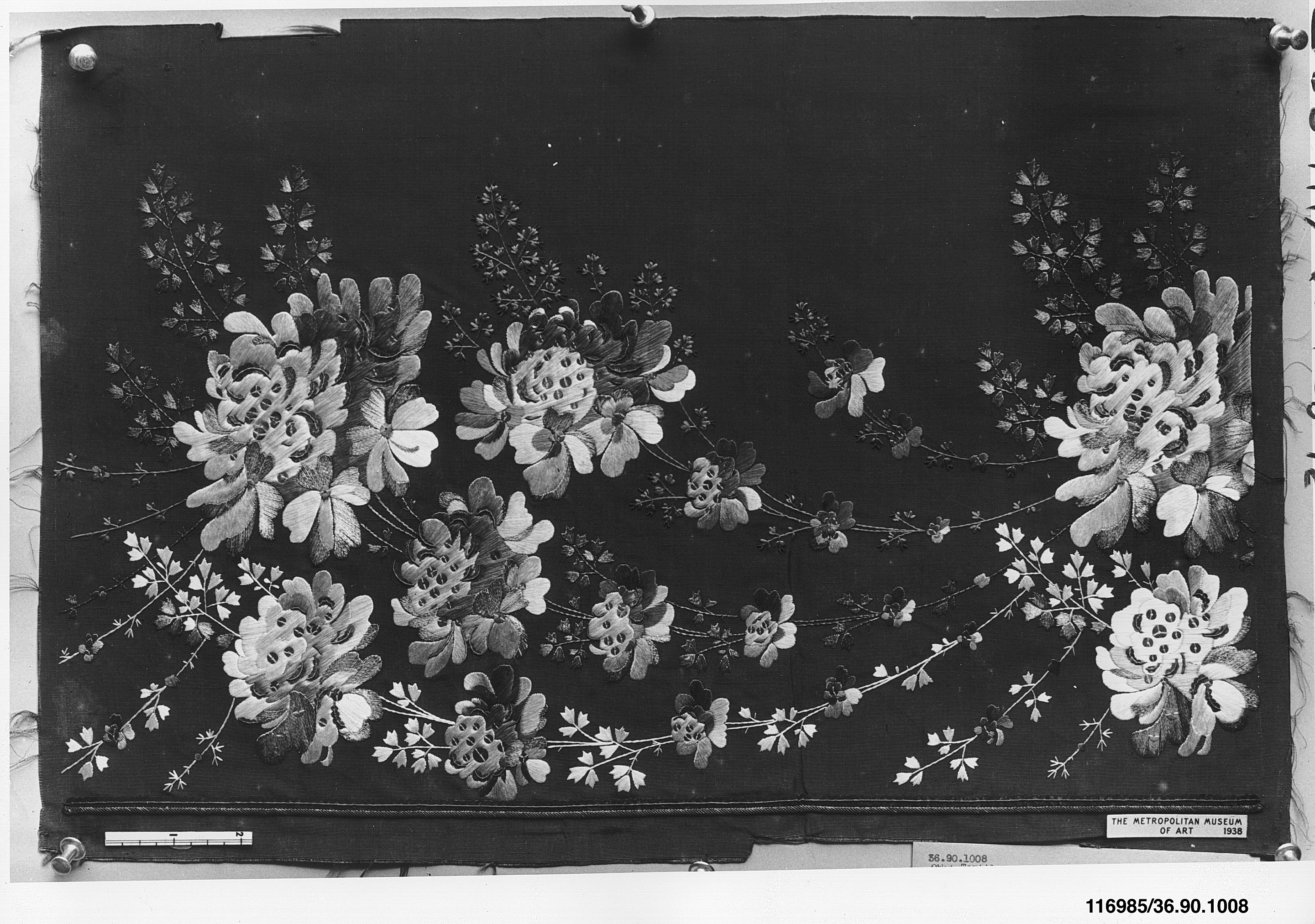
The Border as Architecture: A Study in Global Heritage at Katherine Fashion Lab
In the rarefied atmosphere of haute couture, where innovation is often mistaken for novelty, Katherine Fashion Lab’s standalone study, “Dress Border,” presents a compelling counter-narrative. This is not a garment in the conventional sense—a body-covering silhouette—but rather a conceptual and material investigation into the very edges that define dress. Crafted from silk and metal thread on a silk ground, and drawing from a lexicon of Global Heritage, the piece elevates the humble border from a decorative afterthought to the primary structural and philosophical agent of the work. It is a masterclass in restraint, a meditation on liminality, and a profound re-reading of how we perceive the interface between the human form and the textile that adorns it.
Deconstructing the Periphery: Border as Primary Structure
Traditionally, the border is a frame—a finite line that contains and concludes a larger composition. In “Dress Border,” Katherine Fashion Lab inverts this hierarchy. Here, the border is not the conclusion; it is the thesis. The work dispenses with the expansive central field of fabric, focusing instead on the dense, intricate zones that would typically mark a hem, a neckline, or a cuff. By isolating these zones and presenting them as a standalone study, the Lab forces the viewer to confront the border’s intrinsic structural logic. The border is no longer a passive boundary but an active, load-bearing element of the garment’s conceptual architecture. It becomes the primary site of meaning, a concentrated locus where material, technique, and cultural memory converge with an intensity that a full garment might dissipate.
This curatorial decision is intellectually daring. It strips away the distractions of silhouette and volume, compelling an examination of the smallest, most repetitive gestures in textile construction. The result is a work that feels both monumental and intimate—monumental in its conceptual ambition, intimate in its meticulous execution. The border, in this context, functions as a kind of structural exoskeleton, suggesting that the strength and identity of a garment reside not in its broad expanses but in its precise, engineered edges. This is a radical proposition, one that aligns with contemporary fashion theory that questions the primacy of the whole over its constituent parts.
Material Dialectics: Silk and Metal in Conversation
The materiality of “Dress Border” is its most immediate and visceral language. The choice of silk and metal thread on a silk ground is not merely opulent; it is deeply communicative. Silk, with its inherent fluidity, luminosity, and organic origin, speaks to the body’s softness, its transient nature, and a long history of luxury that spans from the ancient Chinese courts to the European ateliers. It is a material of gentle, yielding strength. Metal thread, conversely, introduces a rigid, architectural, and almost industrial counterpoint. It is a material of permanence, reflection, and hardness—a stark contrast to silk’s pliability.
The dialectical tension between these two materials creates a rich textural and visual polyphony. The metal thread, often a fine filament of gold or silver wrapped around a silk core, is not used to overwhelm the silk but to articulate it. It traces patterns, defines edges, and catches the light in sharp, deliberate glints against the softer, diffused sheen of the silk. This is not a clash but a conversation—a negotiation between the ephemeral and the eternal. The metal thread acts as the skeletal frame that gives the fluid silk its definitive structure, while the silk softens the metallic rigidity, creating a hybrid materiality that is neither fully organic nor fully synthetic. This interplay speaks to the modern condition—the constant negotiation between our natural, embodied selves and the technological, constructed world we inhabit.
A Cartography of Global Heritage
The design vocabulary of “Dress Border” is a sophisticated, scholarly survey of Global Heritage. Rather than sampling or appropriating specific motifs, Katherine Fashion Lab synthesizes the underlying principles of border construction from disparate cultures, creating a universal language of edge ornamentation. One can discern the geometric precision and rhythmic repetition of Central Asian suzani embroidery, the dense, all-over patterning of Eastern European folk hems, and the delicate, linear elegance of East Asian band weaving. The motifs are abstracted, reduced to their essential geometric and rhythmic components—zigzags, chevrons, stepped pyramids, and interlocking lines—that appear across civilizations as markers of protection, status, and identity.
This is not a pastiche. It is a curatorial act of cultural triangulation. The Lab’s research is evident in the confident handling of scale and proportion. Wide, dominant bands are counterbalanced by fine, hairline threads. Dense, metallic clusters are offset by open, airy silk weaves. The work acknowledges that borders have historically served as the most potent carriers of cultural identity, often outlasting the central garment in the archaeological record. By isolating and re-contextualizing these elements, the Lab creates a new, unified heritage—one that speaks to a globalized world where cultural boundaries are increasingly fluid, yet where the desire for rootedness and identity remains paramount. The border becomes a metaphor for the negotiation of self within a multicultural landscape.
Technical Virtuosity and the Art of Precision
From a technical standpoint, “Dress Border” is a tour de force of artisanal skill. The execution demands an almost obsessive level of precision. The metal threads, which are often brittle and prone to kinking, must be manipulated with extraordinary care. The tension must be perfect—tight enough to define the pattern and create the desired relief, yet loose enough to prevent the silk ground from puckering. The result is a surface that appears almost machined in its perfection, yet retains the subtle, human irregularities that are the hallmark of true haute couture. Each stitch is a decision, each pass of the thread a commitment.
This technical mastery serves the conceptual framework. The piece is not merely about the idea of the border; it is about the act of bordering—the physical, labor-intensive process of creating a definitive edge. The repetitive motion of the embroiderer’s hand, the careful counting of threads, the deliberate insertion of the needle—these are all performative acts that imbue the object with a sense of time and dedication. In an era of fast fashion and digital reproduction, “Dress Border” stands as a defiant testament to the value of slow, considered, and intelligent making. It asks us to reconsider the relationship between labor and value, between the hand and the machine, and between the concept and its material realization.
Conclusion: A New Frontier in Couture
Katherine Fashion Lab’s “Dress Border” is far more than a technical exercise or a decorative object. It is a philosophical proposition that challenges our understanding of what constitutes a garment. By shifting focus from the center to the periphery, from the mass to the edge, the Lab reveals the profound potential of the liminal. The work functions as a standalone study in the truest sense—a self-contained, deeply researched, and brilliantly executed argument about the power of boundaries.
It is a piece that demands contemplation, not just observation. It rewards the viewer who is willing to look closely, to trace the path of the metal thread, and to consider the cultural echoes embedded in its patterns. In its synthesis of global traditions, its masterful materiality, and its rigorous conceptual framework, “Dress Border” cements Katherine Fashion Lab’s position as a leader in intellectual, forward-thinking couture. It is a powerful reminder that in fashion, as in architecture, the most enduring and meaningful statements are often found at the very edge of things, where one structure ends and another—the world, the body, the self—begins. This is not a border that closes; it is a border that opens a new frontier of possibility.