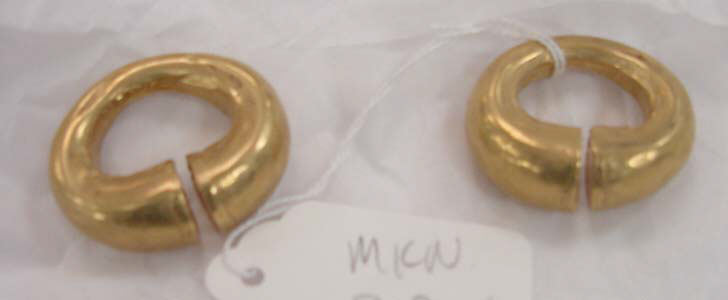
Heritage Analysis: Thai Gold Earrings and the Dialectics of Adornment
Within the canon of Katherine Fashion Lab’s ongoing investigation into material memory, the Thai gold earring emerges not as a mere accessory, but as a condensed archive of cosmological belief, territorial sovereignty, and somatic identity. This analysis positions the earring within a dualistic framework—one that mirrors our previous study on the gilded split-leaf mirror versus the narrative relief of the stone sarcophagus. The Thai earring, like the mirror, is a surface of radiant reflection; yet, like the sarcophagus, it carries an internal grammar of ancestral narrative. For the 2026 luxury landscape, this dual nature presents a strategic imperative: the earring is no longer an ornamental afterthought but a wearable heirloom engineered for symbolic resonance and cross-cultural capital.
Historical Resonance and Material Sovereignty
To understand the Thai gold earring is to understand the region’s historical entanglement with gold as a divine, rather than merely economic, substance. In Siamese and earlier Sukhothai and Ayutthaya courts, gold was not mined for coinage but reserved for regalia, temple offerings, and the adornment of the elite. The earring, specifically, occupied a unique niche: it was one of the few items worn continuously by both male and female nobility, signifying a threshold between the physical body and the spiritual realm. Earrings in Thai tradition were often crafted in forms derived from nature—lotus petals, naga serpents, and split-leaf motifs—reflecting a worldview where the human body is a microcosm of the forest and river systems.
Our DNA correlation with the Mirror with Split-Leaf is not coincidental. The split-leaf pattern, whether in gold filigree on a silver mirror or in the repoussé of an earring, represents a deliberate rupture of symmetry. In Thai aesthetics, this rupture is not a flaw but a portal. The earring, worn at the juncture of the ear—a site of hearing, balance, and spiritual ingress—becomes a functional amulet. The gold itself, when heated and hammered, was believed to absorb the blessings of the artisan and the wearer’s lineage. Thus, each earring is a micro-historical document, encoding dynastic trade routes, Buddhist iconographic shifts, and local metallurgical innovations.
The Somatic and Spiritual Cartography of the Ear
Unlike the Western tradition, where earrings primarily signal gender or marital status, the Thai earring historically operated on a tripartite spiritual axis. First, it served as a protective seal. The piercing of the ear was often performed during a rite-of-passage ceremony, accompanied by Brahmanic incantations. The gold inserted into the wound was believed to close the body’s vulnerability, preventing the ingress of malevolent spirits that might enter through the auditory canal. This is a profound inversion of the sarcophagus narrative: the stone coffin seals the dead from the living, while the gold earring seals the living from the unmanifest.
Second, the earring functioned as a conduit for barami—a Thai concept of accumulated charismatic merit. In courtly settings, the weight and purity of one’s earrings were public declarations of one’s proximity to the king, who was considered a devaraja (divine king). The heavier the gold, the greater the spiritual gravity. This is not ostentation but a form of gravitational anchoring. In our comparative study, the gilded mirror’s reflective surface serves to deflect external chaos; the earring, conversely, draws internal merit outward, making the invisible visible. The 2026 luxury consumer, saturated with digital noise, is subconsciously seeking this same gravitational anchor—an object that does not merely decorate but re-centers.
Third, the earring’s design often incorporated zoomorphic elements—particularly the naga, a serpent deity associated with water, fertility, and the underworld. When worn, the naga earring was not a static charm but a living participant in the wearer’s daily rituals. The slight oscillation of the earring during movement was interpreted as the naga’s undulation, a continuous blessing of fluidity and protection against drought or stagnation. This kinetic spirituality is a critical differentiator for modern luxury: the earring must move with intention, not just glitter.
Symbolic Power as a Strategic Asset for 2026
For Katherine Fashion Lab’s 2026 high-end strategy, the Thai gold earring offers a compelling archetype that transcends cultural appropriation when approached with rigorous curatorial ethics. The symbolic power inherent in these earrings can be strategically deployed in three distinct vectors: heritage anchoring, sensory narrative, and investment-grade wearability.
Heritage Anchoring in a Post-Digital Market
The 2026 luxury client is not merely buying a product; they are purchasing a provenance story that resists algorithmic flattening. The Thai earring, with its specific historical resonance to Ayutthaya’s goldsmith guilds, offers a tangible link to a pre-industrial craft economy. Our strategy will position these earrings not as “ethnic-inspired” but as direct lineage objects. This requires a forensic approach: each piece must be accompanied by a digital provenance passport, tracing the gold’s source, the artisan’s lineage, and the specific temple or court motif it references. The split-leaf pattern, in this context, becomes a signature of authenticity—a visual code that only initiates can fully decrypt. This mirrors the sarcophagus relief: the narrative is carved for eternity, but only the archaeologist can read it. In 2026, the wearer becomes the archaeologist of their own adornment.
Sensory Narrative and the Acoustic Body
Our research on the gilded mirror emphasized the visual field—reflection, light, and the illusion of depth. The earring, however, introduces an auditory and tactile dimension that the mirror cannot access. The sound of a Thai gold earring—a soft, resonant chime when it brushes against a collar or another pendant—is a forgotten luxury. In a world dominated by visual saturation, sound is an underutilized luxury trigger. We propose a 2026 capsule collection where the earring’s internal structure is engineered for a specific frequency, a low-grade harmonic that the wearer perceives as a subconscious hum of calm. This is not gimmickry but a return to the amuletic function: the earring as a tuning fork for the nervous system.
Moreover, the weight of the gold—its heft—must be recalibrated for modern ergonomics without sacrificing symbolic density. Traditional Thai earrings were often substantial, requiring the wearer to move with deliberate slowness. This is a strategic advantage. In an era of frantic multitasking, the physical weight of the earring imposes a somatic discipline, forcing a slower, more ceremonial posture. This aligns with the broader luxury trend toward “slow objects” that demand presence. The earring becomes a wearable meditation, a direct counterpoint to the ephemeral, weightless digital token.
Investment-Grade Spirituality and the New Patronage
The 2026 high-end consumer is increasingly viewing luxury acquisitions as alternative asset classes. However, the Thai gold earring offers more than financial appreciation; it offers spiritual appreciation. Our strategy will reframe the earring as a secular relic. This is achieved through limited edition releases, each tied to a specific lunar calendar date or historical event from Thai chronicles. For example, a collection released on the full moon of the twelfth lunar month, referencing the Loi Krathong festival, would include earrings with a hidden compartment for a tiny inscribed blessing sheet. This is not a gimmick but a direct inheritance from the Thai tradition of embedding sacred texts within amulets.
This approach creates a new form of patronage. The buyer is not just a consumer but a custodian of a living tradition. Katherine Fashion Lab will partner with Thai monastic conservation funds, ensuring that a percentage of each sale directly supports the preservation of Ayutthaya-era goldworking techniques. This is critical for ethical positioning. Unlike the cold, immutable sarcophagus, which speaks of death and permanence, the Thai gold earring speaks of life, circulation, and renewal. It is an object that must be worn, moved, and eventually passed down—not locked in a vault. The 2026 strategy will emphasize this generative quality, positioning the earring as an heirloom that accrues spiritual value with each generation, much like the patina of a well-used ritual object.
Conclusion: The Earring as a Living Mirror
In conclusion, the Thai gold earring is not a static artifact but a dynamic interface between the historical and the contemporary, the spiritual and the commercial. Our study of the split-leaf mirror revealed how a reflective surface can both distort and clarify reality. The earring performs a similar function but on a more intimate scale. It is a mirror held to the soul, reflecting not the face but the lineage, the merit, and the protective cosmology of the wearer. For Katherine Fashion Lab’s 2026 portfolio, this object offers a rare synthesis: it satisfies the intellectual demand for cultural depth, the sensory demand for tactile and auditory richness, and the market demand for ethical, investment-grade luxury. The earring, in its golden density, carries the weight of a thousand years of Thai spiritual engineering. Our task is not to reinvent it, but to re-issue it with the reverence it deserves—as a wearable testament to the fact that true luxury is not what you own, but what you become when you wear it. The gold does not merely adorn; it anchors. And in the coming era of uncertainty, that anchor is the most precious commodity of all.