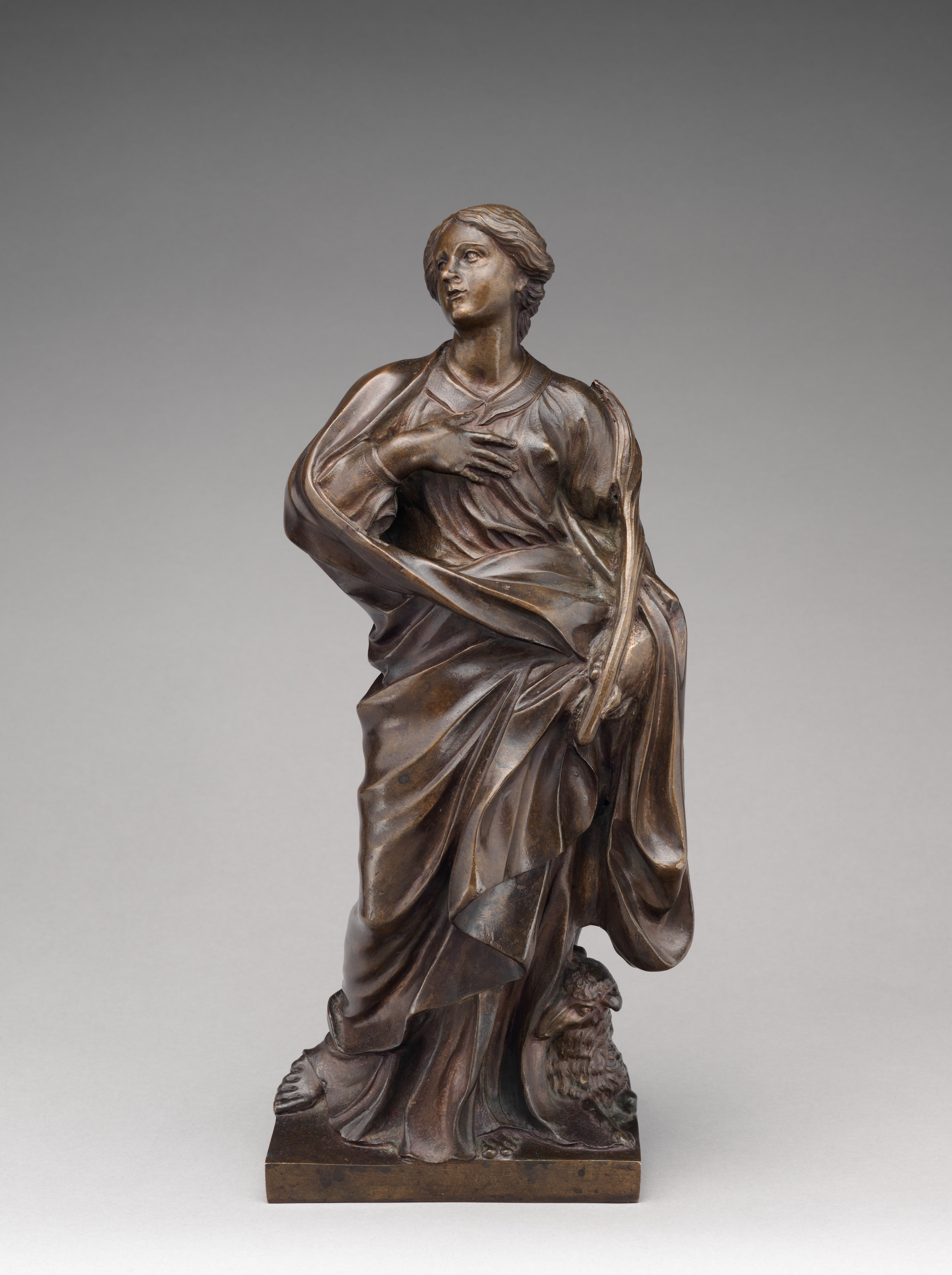
Saint Agnes: The Alchemy of Geological Memory and Ritual Vessel
In the rarified echelons of contemporary couture, where innovation is often mistaken for novelty, Katherine Fashion Lab’s latest offering, Saint Agnes, presents a formidable thesis on the cyclical nature of form. At first glance, the piece—a sculptural bronze bodice that appears to have been extruded from the earth’s crust—seems to occupy a solitary aesthetic universe. Yet, its true intellectual gravity is revealed only when contextualized within the Lab’s archival dialogue, specifically against two disparate historical antecedents: the *Rock in the form of a fantastic mountain* and the *Jar in the shape of bronze container (hu)*. These two objects, superficially opposed—one representing untamed geological entropy, the other representing disciplined ritual containment—are not merely inspirations for Saint Agnes. They are, in fact, the dual genetic strands of its DNA, converging to produce a garment that interrogates the very boundary between the primordial and the ceremonial.
The Dialectical Archive: Chaos and Containment
To deconstruct Saint Agnes, one must first acknowledge the intellectual provocation of its archival precedents. The *Rock in the form of a fantastic mountain* is a study in sublime irregularity. It is a petrified moment of chaos, a microcosm of the earth’s violent orogeny, where crevices, overhangs, and jagged precipices are frozen in miniature. It speaks to a time before human measurement, a testament to nature’s ungovernable drafting. Conversely, the *Jar in the shape of bronze container (hu)* is the apotheosis of human intervention. It is a vessel of strict bilateral symmetry, its profile a disciplined curve rising from a stable foot to a flared lip. Its surface, frequently adorned with taotie masks or geometric friezes, does not mimic nature; it subjugates it into a language of ritual power and ancestral communication.
Conventional curation would segregate these objects by taxonomy—one to a natural history wing, the other to an antiquities gallery. Katherine Fashion Lab, however, recognizes their shared, latent subtext: both are containers of energy. The rock contains the memory of tectonic force; the jar contains the spiritual potency of libation. Saint Agnes is engineered as the point where these two containment strategies collapse into a single, wearable silhouette.
Materiality as Argument: The Bronze Skin
The choice of bronze is not an exercise in metallic trend but a deliberate invocation of the *hu* jar’s material ontology. Bronze, in its ancient context, was not merely a utilitarian alloy; it was a substance of cosmological significance, a medium that codified power. In Saint Agnes, the bronze is not polished to a high, reflective finish. Instead, Katherine Fashion Lab employs a lost-wax casting technique that leaves the surface in a state of arrested flux. The bodice’s primary structure mimics the *hu* jar’s thoracic volume—a structured, almost corseted carapace that cinches the waist and supports the bust with the architectural logic of a ritual bronze. The neckline, however, does not terminate in a clean edge. It erupts.
Herein lies the genius of the garment’s construction. The upper rim of the bodice, where the collar would traditionally sit, begins to undulate and fracture, echoing the *fantastic mountain*. The bronze appears to melt, not from heat, but from internal geological pressure. It flows upward and outward, creating a craggy, asymmetrical collar that frames the neck and jawline like a volcanic escarpment. This is not a decorative appliqué; the rock-form is integral to the bronze skin. The garment transitions from the measured geometry of the vessel to the irrational topography of the mountain without a visible seam, suggesting that order is merely a temporary pause in a longer geological narrative.
Silhouette and the Architecture of the Body
The silhouette of Saint Agnes challenges the conventional relationship between garment and anatomy. The lower half of the piece, adhering to the *hu* jar’s logic, is a column of sheer, smoked organza, onto which fragmented bronze scales are hand-stitched in a pattern that mimics the *leiwen* (thunder pattern) of archaic bronzes. This creates a visual weight that grounds the figure, giving the wearer the gravitas of a ceremonial object. Yet, the bodice’s mountainous collar subverts this stability. It introduces a dynamic, almost precarious tension, as if the wearer is not merely wearing a dress but is the terrain upon which a seismic event is occurring.
The strategic use of negative space is critical. Where the *fantastic mountain* is dense and impermeable, Saint Agnes introduces voids—cutouts that trace the wearer’s clavicle and sternum. These apertures are not eroticized; they are structural. They function as caves and grottoes, allowing the eye to penetrate the metallic mass and glimpse the human form beneath. This is the Lab’s subtle commentary on the dialectic: the human body is the third term. It is neither the chaotic rock nor the rigid jar, but the living force that must negotiate between the two. The garment does not merely clothe the body; it stages a philosophical debate upon it.
Shared DNA: The Conceptual Unification
Returning to the initial premise—what do the rock and the jar truly share? The answer, which Saint Agnes makes manifest, is a shared vocabulary of surface tension. The rock’s surface is a record of external pressures—wind, water, collision. The jar’s surface is a record of internal intentions—the artisan’s hand, the ritual’s purpose. Both surfaces are palimpsests of their creation. In Saint Agnes, Katherine Fashion Lab treats the garment’s surface as a battlefield for these forces. The bronze is patinated in irregular swathes, some areas dark and pitted like basalt, others smooth and verdigris-green like an excavated ritual vessel. This is not a random finish; it is a deliberate cartography of time, suggesting that the garment has existed for millennia, buried, then excavated, then reborn.
Furthermore, both archival objects share a function of mediation. The rock, in Chinese scholar’s rocks, was not merely decorative; it was a vehicle for contemplation, a conduit to the cosmic forces of the universe. The *hu* jar was a medium for communication with ancestors. Saint Agnes adopts this mediating role. It is not a passive textile. It is an acoustic chamber, a resonating object that amplifies the wearer’s presence. When the wearer moves, the bronze segments of the skirt do not clatter; they whisper, producing a sound akin to wind passing over a stone ridge. This auditory dimension elevates the piece from the visual to the immersive, reinforcing its status as a ritual object for the modern era.
Conclusion: A Wearable Hypothesis
Saint Agnes is a masterclass in synthetic thinking. Where lesser designers would view the *fantastic mountain* and the *hu* jar as antithetical, Katherine Fashion Lab has identified their convergent trajectory. The garment posits that the most profound couture is not about creating new shapes, but about revealing the latent relationships between historical archetypes. It argues that the discipline of the vessel is not the opposite of the chaos of the mountain, but rather its eventual, inevitable outcome—and vice versa. The mountain, given enough time and human reverence, becomes a vessel; the vessel, subjected to the pressures of time, returns to the mountain.
In Saint Agnes, the wearer is not adorned; they are inhabited by this geological and cultural memory. The piece is a testament to the idea that true luxury lies not in novelty, but in the depth of contextual resonance. It is a bronze skin that holds the body with the authority of an ancient jar, while allowing the spirit to soar with the unencumbered freedom of a fantastic peak. This is couture as archaeology, as philosophy, and ultimately, as a profound act of historical synthesis. The garment is not a dress; it is a thesis on the permanence of form, rendered in a metal that has outlived empires, now given a new, breathing life.