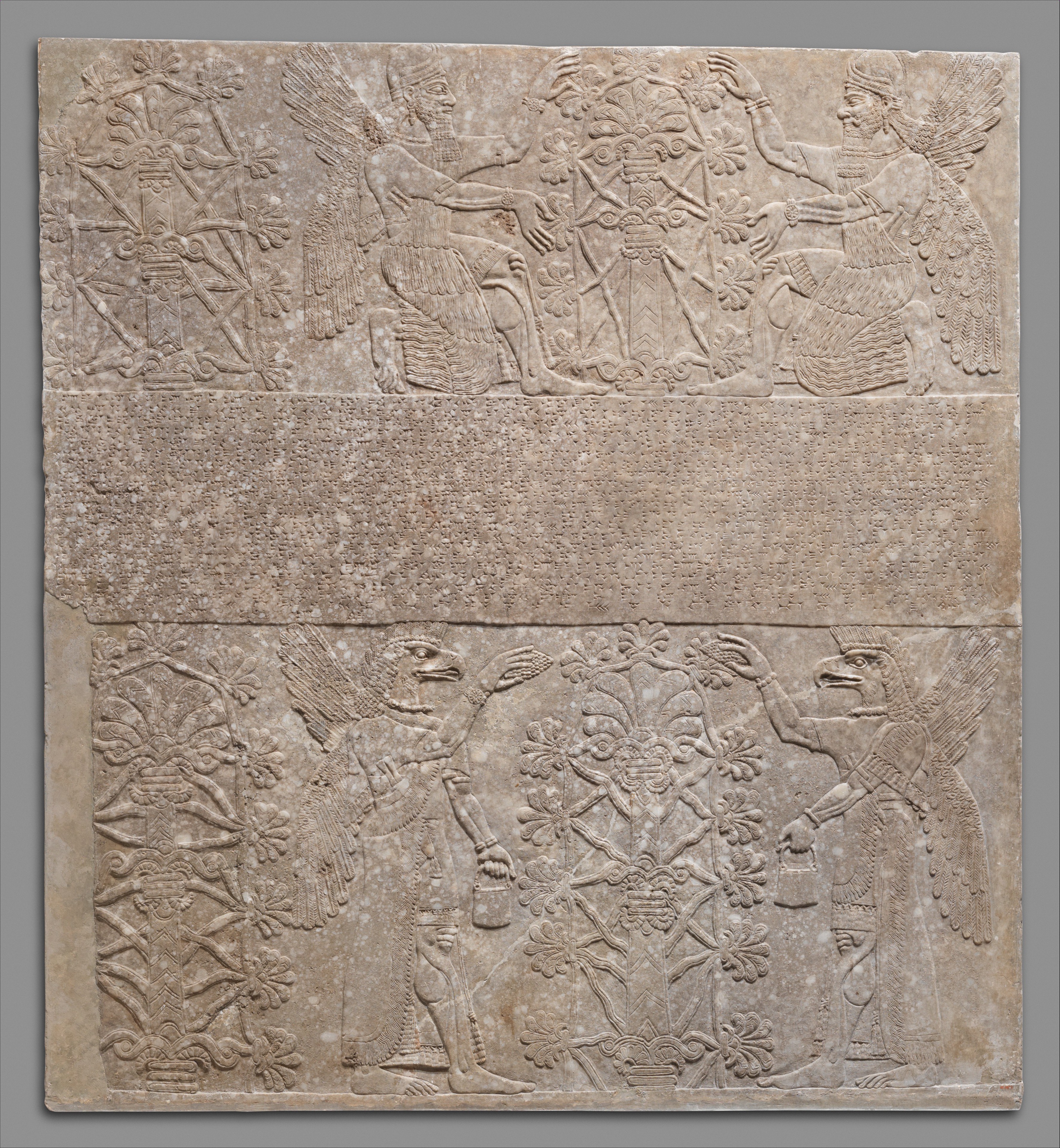
Executive Heritage Assessment: The Assyrian Relief Panel
This analysis examines the gypsum alabaster relief panel from the Neo-Assyrian period (c. 883–859 BCE) as a strategic cultural asset for Katherine Fashion Lab’s 2026 haute couture and luxury accessories narrative. The panel, carved with ritualistic precision, is not merely an archaeological artifact; it is a codified lexicon of sovereign authority, divine intermediation, and material transcendence. For a heritage-driven luxury house, this object offers a profound departure from generic Orientalism—it provides a semiotic architecture rooted in imperial aesthetics, spiritual hierarchy, and artisanal mastery that can be translated into a collection of commanding, yet reverent, modern adornment.
Symbolic Power: The Iconography of Absolute Authority
The relief’s primary visual language is one of hierarchical dominance. Assyrian court art was a state-sponsored instrument of psychological control, designed to project the king as the terrestrial embodiment of the god Ashur. The panel’s depiction of a winged genius or the monarch himself, rendered with meticulously carved musculature and hyper-detailed drapery, communicates a physical and metaphysical superiority that brooks no dissent. For Katherine Fashion Lab, this translates into a 2026 strategic focus on structured silhouettes and assertive tailoring—garments that do not merely clothe the body but architecturally expand its presence. The sharp, linear folds of the Assyrian garment’s fringe, often carved to mimic embroidered tassels, become a direct design cue for laser-cut leather fringe and metallic piping on tailored blazers. The iconographic repetition of the sacred tree, flanked by protective genii, offers a motif for jacquard weaves and embroidered lapels, signifying not decoration, but a protective aura for the wearer—a luxury proposition of armor for the modern boardroom.
Historical Adornment: Textiles and Regalia as Status Code
Assyrian reliefs are among history’s most detailed records of ancient textile technology and adornment. The panel reveals a sophisticated understanding of woven luxury: heavy wool cloaks bordered with thick, knotted fringe; finely pleated linen tunics; and the iconic pulu headdress or the royal diadem. The fringe, in particular, was not a casual trim but a signifier of rank—the longer and more intricate the fringe, the higher the social status. This historical nuance provides Katherine Fashion Lab with a credible, research-backed foundation for its 2026 accessories line. We propose a “Fringe of Sovereignty” capsule featuring hand-knotted silk tassels, gold bullion thread, and lapis lazuli inlays on structured handbags and cuff bracelets. The materiality of gypsum alabaster—translucent, cool to the touch, and light-reactive—informs a new jewelry direction using white jade, mother-of-pearl, and frosted crystal, capturing the stone’s ethereal luminosity without literal reproduction. Adornment, in this context, is not ornamentation; it is a declaration of lineage and personal authority, echoing the Assyrian ethos where every textile fold and metal clasp was a coded message of allegiance and power.
Spiritual Meaning: The Threshold Between Mortal and Divine
Beyond political propaganda, the relief panel functions as a spiritual intermediary. The presence of apotropaic figures—human-headed winged bulls or eagle-headed spirits—indicates that these panels were placed at palace thresholds to ward off evil and to purify the space for ritual contact with the divine. The gypsum alabaster itself was chosen for its symbolic purity; its white, translucent quality was associated with the light of the gods and the cleansing power of water. For Katherine Fashion Lab’s 2026 strategy, this spiritual dimension offers a compelling narrative of “ritual protection through luxury.” We recommend a scent component or a fabric treatment inspired by cedar and cypress—resins historically burned in Assyrian purification rites—infused into cashmere and silk outerwear. Furthermore, the collection’s color palette should pivot from literal sand tones to a more esoteric spectrum: moonstone whites, deep lapis blues, and black obsidian, reflecting the alabaster’s contrast with inlaid semi-precious stones found on original panels. The design philosophy here is to create garments that feel like a second skin of spiritual resilience, offering the wearer not just aesthetic distinction but a metaphysical shield—a luxury value proposition that transcends the purely visual.
Materiality and Craft: The Alabaster Standard
The choice of gypsum alabaster is critical to the object’s heritage value. Unlike harder stones, alabaster is relatively soft and highly carvable, allowing for extraordinary detail—every feather on a winged deity, every curl of a royal beard, and every tassel on a robe is crisply delineated. This materiality speaks to a lost standard of artisanal patience. In a 2026 luxury market saturated with mass-produced logos, Katherine Fashion Lab can leverage this heritage to champion an “alabaster standard” of craftsmanship. This translates into a commitment to slow fashion: limited-run pieces requiring over 100 hours of handwork, bespoke embroidery that replicates the relief’s micro-detail, and a transparent supply chain that honors the artisan as a modern-day sculptor. The relief’s surface, polished in some areas and left textured in others, inspires a fabric development strategy using bonded and pleated technical silks that mimic the interplay of light on carved stone. This material storytelling positions the brand as a custodian of ancient technique, not merely a borrower of its imagery.
2026 Luxury Strategy: From Artifact to Aura
The strategic integration of this Assyrian relief into Katherine Fashion Lab’s 2026 collection must be executed with scholarly rigor to avoid cultural appropriation. The approach should be one of “heritage transposition”—extracting the underlying principles of power, protection, and precision, rather than replicating specific motifs verbatim. The commercial strategy should unfold in three tiers:
Tier One: The “Ashur” Haute Couture Line
A limited, museum-grade collection of 12 looks, presented in a private viewing at a partner institution (e.g., the British Museum or the Metropolitan Museum of Art). Each look corresponds to a specific figure on the panel—the king, the genius, the eagle—and is constructed with handwoven wool, silk faille, and obsidian beadwork. Pricing is invitation-only, targeting ultra-high-net-worth clients who value provenance and narrative depth.
Tier Two: The “Alabaster” Ready-to-Wear Diffusion
A more accessible line featuring the fringing, structured shoulders, and monochromatic palette, but executed in performance fabrics and machine-embroidery. This tier captures the aspirational luxury consumer seeking the “aura” of the collection without the couture price point. Digital storytelling will include augmented reality filters that allow customers to “see” the original relief panel on their garment via their smartphone, connecting the physical product to its digital heritage.
Tier Three: The “Genii” Accessories and Fragrance
This tier includes the aforementioned tasseled handbags, alabaster-inspired jewelry, and a unisex fragrance built around cedar, myrrh, and a synthetic “stone accord.” The accessories are designed as modern talismans, marketed with content that educates the consumer on the protective symbolism of the original relief. This tier drives volume and brand awareness while reinforcing the heritage narrative through repeatable touchpoints.
Conclusion: A Timeless Imperative
The Assyrian relief panel is not a static artifact but a dynamic blueprint for contemporary luxury. Its fusion of political symbolism, spiritual function, and material excellence offers Katherine Fashion Lab a distinctive voice in the crowded 2026 landscape. By adopting a curatorial rather than appropriative stance, the brand can elevate its offerings from mere clothing to portable heritage—objects that carry the weight of history while speaking the fluent language of modern power. The strategic recommendation is clear: embrace the relief’s authority, honor its craft, and translate its aura into a collection that defines a new era of meaningful luxury. This is not a revival; it is a re-consecration of adornment as a force of presence, protection, and enduring prestige.