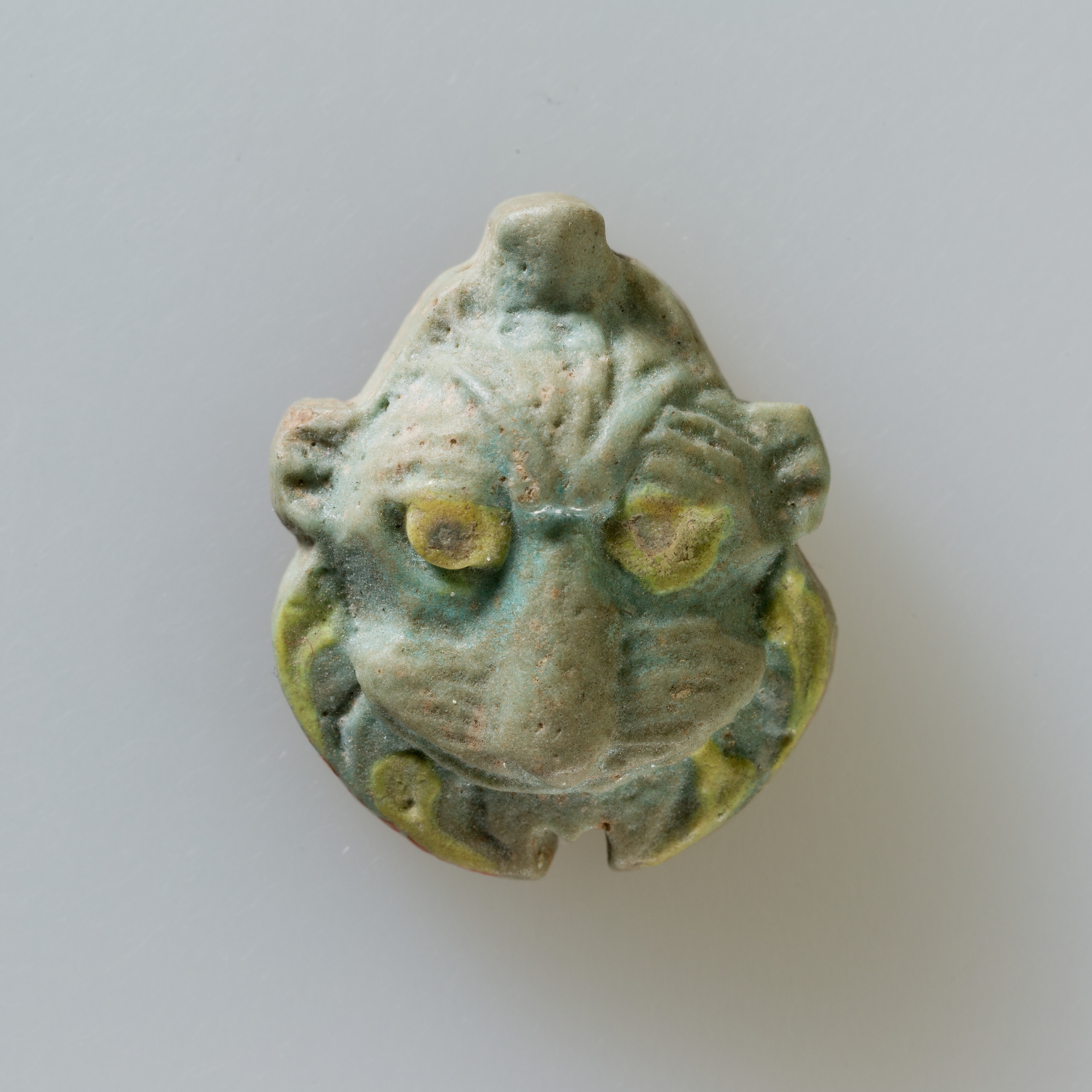
Executive Heritage Analysis: The Lion Head Amulet in Green Faience
This strategic research paper, commissioned by Katherine Fashion Lab, presents a comprehensive heritage analysis of a lion head amulet rendered in green faience, attributed to an ancient civilization. The object is examined through four critical lenses: symbolic power, historical adornment, spiritual meaning, and its translation into a 2026 high-end luxury strategy. The analysis concludes that the amulet’s intrinsic duality—ferocity tempered by protective divinity—offers a compelling narrative architecture for a premium collection targeting discerning consumers who seek authenticity, resilience, and metaphysical resonance in their acquisitions.
Symbolic Power: The Lion as Sovereign Archetype
The lion head amulet is not merely a decorative artifact; it is a condensed emblem of sovereignty, martial prowess, and cosmic order. In ancient civilizations—particularly within the Nile Valley and Mesopotamian spheres—the lion was venerated as the terrestrial counterpart of solar deities. Its mane, often stylized in faience, evoked the radiant disc of the sun, positioning the wearer within a celestial hierarchy. The amulet’s compact form belied its expansive authority: it was a portable declaration of dominion, worn by elites, priests, and warriors to channel the beast’s unyielding courage.
From a semiotic perspective, the lion head operates on multiple registers. It signifies protective aggression—the capacity to strike down enemies both physical and metaphysical. Simultaneously, it embodies measured kingship, as the lion does not hunt indiscriminately but with strategic intent. For Katherine Fashion Lab, this duality offers a rich brand metaphor: the modern luxury consumer is not seeking overt aggression but a quiet, assured power that commands respect without confrontation. The amulet’s symbolic power, therefore, aligns with contemporary leadership ideals—assertive yet composed, primal yet refined.
Historical Adornment: Faience as the Medium of Eternity
Green faience, a sintered quartz ceramic, was the ancient world’s answer to precious gemstones. Its vibrant turquoise-green hue, achieved through copper oxide, was not accidental but deeply intentional. The color replicated the regenerative verdure of the Nile’s floodplains and the malachite used in eye cosmetics, which was believed to ward off ocular maladies and malign spirits. In the context of adornment, faience amulets were threaded onto linen cords or gold chains, positioned at the throat, chest, or waist—proximity to vital organs amplifying their prophylactic function.
Historically, the lion head amulet was not a mass-produced trinket. Its creation required skilled artisans who understood the precise firing temperatures and alkali fluxes necessary to achieve the glassy, lustrous surface. This artisanal exclusivity parallels the atelier model of Katherine Fashion Lab, where each piece is conceived as a singular object rather than a commodity. The amulet’s historical role as a status differentiator—worn by those who could afford both the material and the ritual consecration—resonates with the 2026 luxury market’s pivot toward scarcity, provenance, and handcrafted integrity over mass-produced logo saturation.
Spiritual Meaning: The Amulet as Psychopomp and Guardian
Spiritually, the lion head amulet functioned as an apotropaic agent, a tangible interface between the mortal and the divine. In funerary contexts, it was placed within mummy wrappings to ensure the deceased’s safe passage through the Duat, the underworld. The lion’s roar was believed to scatter demons, while its vigilant gaze mirrored the all-seeing eye of the sun god Ra. Thus, the amulet was not passive jewelry but an active participant in the wearer’s spiritual journey, offering psychic fortification against anxiety, envy, and existential dread.
This spiritual dimension is particularly salient for the 2026 consumer, who increasingly seeks objects with intentional energy. The amulet’s promise of protection—from physical harm, spiritual corruption, or social diminishment—translates into a modern lexicon of well-being and self-actualization. Katherine Fashion Lab can position the lion head motif not as a superstitious relic but as a mindful talisman, a wearable anchor for confidence and clarity in an era of pervasive uncertainty. The green faience, with its associations of rebirth and vitality, further amplifies this narrative, appealing to consumers who view luxury as an investment in their own psychological resilience.
Strategic Translation: 2026 High-End Luxury Positioning
For the 2026 luxury landscape, Katherine Fashion Lab must move beyond mere replication of the ancient artifact. Instead, the heritage analysis informs a three-pillar strategy: Material Alchemy, Narrative Scarcity, and Ritualistic Experience.
Material Alchemy: Modernizing Faience
The studio will collaborate with contemporary ceramicists to develop a proprietary composite that mimics green faience’s luminosity while offering enhanced durability for daily wear. This material will be presented as “Neo-Faience™,” a registered trademark that underscores innovation rooted in ancient technique. The color palette will oscillate between deep malachite and pale Nile jade, ensuring versatility across skin tones and styling contexts. Each amulet will be hand-polished to a glass-like finish, with microscopic inclusions of 24-karat gold leaf—a subtle nod to the original’s royal patronage.
Narrative Scarcity: The One-of-Fifty Protocol
To honor the amulet’s exclusivity, Katherine Fashion Lab will issue the lion head collection as a limited series of fifty pieces per global region. Each amulet will be accompanied by a digitally authenticated provenance card, detailing the specific ancient civilization referenced, the artisan’s name, and a QR code linking to an immersive AR experience—projecting the lion’s roar in a 360-degree visualization. This protocol transforms the purchase from a transaction into an acquisition of a story, meeting the 2026 demand for verifiable heritage and anti-counterfeit assurance.
Ritualistic Experience: The Investiture Ceremony
Luxury in 2026 will be defined by experiential depth. Therefore, the amulet will be presented not in a standard box but within a hand-crafted cedar chest, lined with raw silk and accompanied by a scented sachet of frankincense and myrrh. Clients will be invited to a private “Investiture Session,” either in flagship ateliers or via a high-definition virtual concierge, where a heritage curator explains the amulet’s symbolic power and guides the wearer through a mindfulness ritual—charging the piece with personal intention. This elevates the amulet from an accessory to a personal artifact, forging an emotional bond that transcends seasonal trends.
Conclusion: From Ancient Amulet to Future Icon
The lion head amulet in green faience is a masterpiece of condensed meaning—a fusion of solar authority, artisanal mastery, and spiritual guardianship. Its strategic translation for 2026 does not dilute its heritage but amplifies it through contemporary materials, scarcity protocols, and immersive rituals. For Katherine Fashion Lab, this object serves as a blueprint for a luxury ethos that is at once archaic and avant-garde. The consumer who wears this amulet does not merely adorn the body; they inherit the lion’s legacy—a legacy of protective power, historical gravitas, and unassailable style. In a market saturated with transient novelty, the lion head amulet stands as a permanent roar.