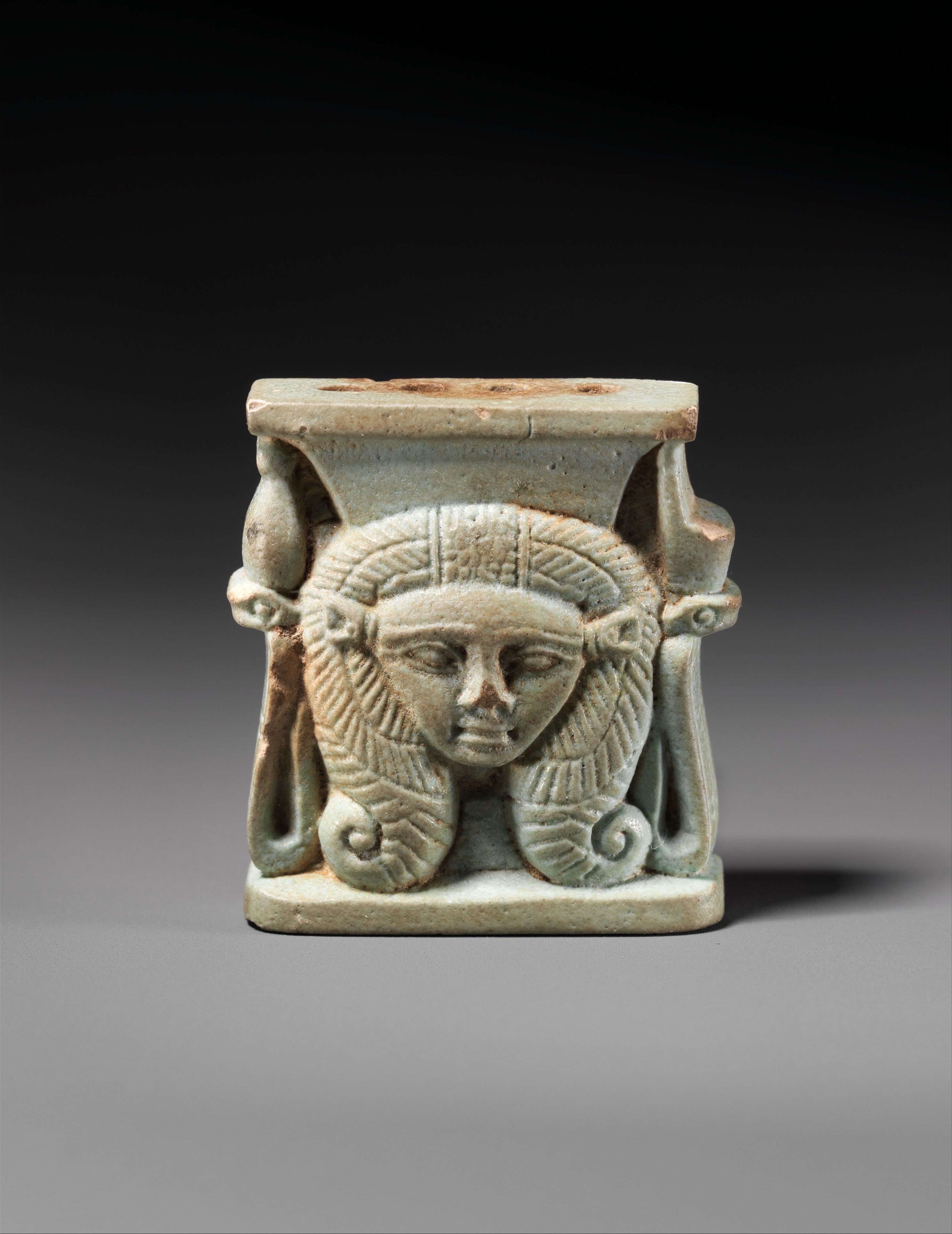
The Hathor Head Amulet: A Heritage Analysis for Strategic Luxury Positioning
Introduction: The Object as an Archetype of Divine Femininity
The Hathor Head Amulet, rendered in vibrant blue-green faience, represents one of the most potent and enduring symbols of divine femininity, protection, and generative abundance in the ancient world. Originating from the Nile Valley’s rich spiritual and artistic traditions, this small yet profoundly significant object was not merely decorative. It functioned as a conduit between the mortal realm and the celestial domain of Hathor, the goddess of music, dance, joy, motherhood, and the sky. For Katherine Fashion Lab, this amulet offers a strategic opportunity to anchor a 2026 high-end luxury narrative in a heritage that transcends transient aesthetics, aligning the brand with timeless themes of empowerment, beauty, and protective elegance.
Symbolic Power: The Cow-Eyed Goddess and the Solar Eye
At its core, the Hathor head amulet embodies a complex layering of symbolic power. Hathor is frequently depicted as a woman with the ears of a cow, or simply as a cow, symbolizing her nurturing and life-giving attributes. However, the head amulet specifically emphasizes her human face, often crowned with a sun disk and cow horns, or framed by a voluminous, intricately detailed wig. This iconography is not arbitrary. The sun disk connects her to Ra, the supreme solar deity, positioning her as the “Eye of Ra.” In this role, Hathor embodies both the fierce, protective solar eye that destroys the enemies of order and the gentle, loving eye that watches over the living.
For a modern luxury context, this duality is exceptionally resonant. The amulet’s symbolic power lies in its representation of authority combined with compassion. It is a talisman of sovereignty that does not abandon tenderness. This offers Katherine Fashion Lab a narrative of “soft power” – a concept that is increasingly relevant in a 2026 market where consumers seek brands that balance assertive leadership with ethical, nurturing values. The amulet is not a symbol of passive beauty; it is an active agent of protection and royal dignity.
Historical Adornment: The Democratization of Divine Protection
Historically, the Hathor head amulet was a staple of personal adornment across social strata, although the medium and craftsmanship varied. While elite examples were crafted from gold, silver, or semi-precious stones, the faience versions were ubiquitous. Faience, a self-glazing ceramic made from quartz, was prized for its brilliant blue-green color, which was associated with life, rebirth, and the Nile’s fertile waters. The choice of faience is significant; it was a material that mimicked turquoise and lapis lazuli, achieving a high-status aesthetic while remaining accessible.
This historical context provides a powerful lesson in luxury accessibility. The amulet was worn by living women as a girdle or necklace to promote fertility and safe childbirth, and equally placed upon mummies to ensure the deceased’s rebirth into the afterlife. Thus, it adorned both the living and the dead, bridging the gap between temporal existence and eternal life. For Katherine Fashion Lab’s 2026 strategy, this dual functionality speaks to the modern consumer’s desire for jewelry that is not merely ornamental but serves a deeper, personal purpose. The amulet’s history demonstrates that true adornment is a language of identity and intention, not just an expression of wealth.
Spiritual Meaning: The Ankh, the Sistrum, and the Rhythm of Joy
The spiritual meaning of the Hathor head extends beyond her visual form. Hathor is intimately connected to the sistrum, a sacred rattle whose sound was believed to appease the goddess and ward off malevolent forces. The rhythmic shaking of the sistrum was a form of auditory magic, invoking the goddess’s presence to bring joy, dispel sorrow, and restore cosmic balance. Consequently, the amulet is not a static symbol; it is a frozen moment of ritual action, a silent echo of the music that was central to Hathor’s worship.
In the context of spiritual meaning, the amulet represents the concept of Maat – cosmic order, truth, and justice. By wearing this amulet, an individual aligned themselves with Hathor’s principles, ensuring that their life path was guided by harmony rather than chaos. This spiritual dimension is profoundly relevant for contemporary high-end consumers who are increasingly seeking “meaningful luxury.” The 2026 luxury buyer is not satisfied with mere craftsmanship; they demand provenance and spiritual resonance. The Hathor amulet offers a narrative of alignment with natural cycles, feminine power, and joyful protection. It is a tangible asset for mental and emotional well-being, a concept that will dominate the luxury sector as it pivots toward holistic wellness.
Strategic Application: Crafting the 2026 High-End Luxury Narrative
For Katherine Fashion Lab, the Hathor Head Amulet is not a historical curiosity but a strategic blueprint for a 2026 capsule collection or signature emblem. The brand can leverage the amulet’s heritage to establish a new archetype of luxury that is both ancient and futuristic. The strategy should be structured around three pillars: Material Alchemy, Narrative Provenance, and Ritualistic Engagement.
Material Alchemy involves reinterpreting the faience medium through a contemporary lens. Instead of traditional ceramic, Katherine Fashion Lab could utilize high-fire porcelain glazed with a proprietary “Nile Blue” or use advanced lab-grown gemstones in the same hue. The focus is on achieving the luminous, otherworldly quality of faience while adhering to modern standards of sustainability and durability. The texture should evoke the smooth, cool touch of the ancient artifact, creating a sensory connection to the past.
Narrative Provenance requires a deep, authentic storytelling campaign. The brand must position the amulet not as an Egyptian relic but as a universal symbol of the divine feminine. The marketing narrative should emphasize Hathor’s attributes – joy, music, fertility, and protection – and map them onto the modern woman’s journey. The amulet becomes a metaphor for the wearer’s own inner power and resilience. This is not cultural appropriation but cultural appreciation, executed with scholarly rigor and respectful acknowledgment of the source civilization.
Ritualistic Engagement is the final, crucial pillar. Luxury in 2026 will be defined by experience. Katherine Fashion Lab can create a “Ritual of Adornment” where clients are guided through the amulet’s history before purchase, perhaps in a private salon designed to evoke a temple sanctuary. Each piece could be presented with a bespoke “sistrum-inspired” packaging that creates a gentle, resonant sound upon opening, engaging the auditory sense and connecting the client to the amulet’s spiritual function. This transforms a purchase into a ceremony, embedding the piece with personal meaning and emotional value that cannot be replicated by fast fashion or mass-market jewelry.
Conclusion: From Ancient Talisman to Modern Icon
In conclusion, the Hathor Head Amulet is a masterclass in sustained symbolic relevance. Its power lies in its ability to communicate complex spiritual and social messages through a compact, wearable form. For Katherine Fashion Lab, this amulet provides the ideal foundation for a 2026 high-end luxury strategy that is intellectually profound and commercially astute. By honoring the amulet’s historical context, utilizing its symbolic duality of strength and nurturing, and translating its spiritual essence into a modern ritual, the brand can create a product that is not merely worn but experienced. The amulet offers a path to a luxury that is conscious, connected, and deeply resonant – a true testament to the enduring power of heritage in shaping the future of high fashion.