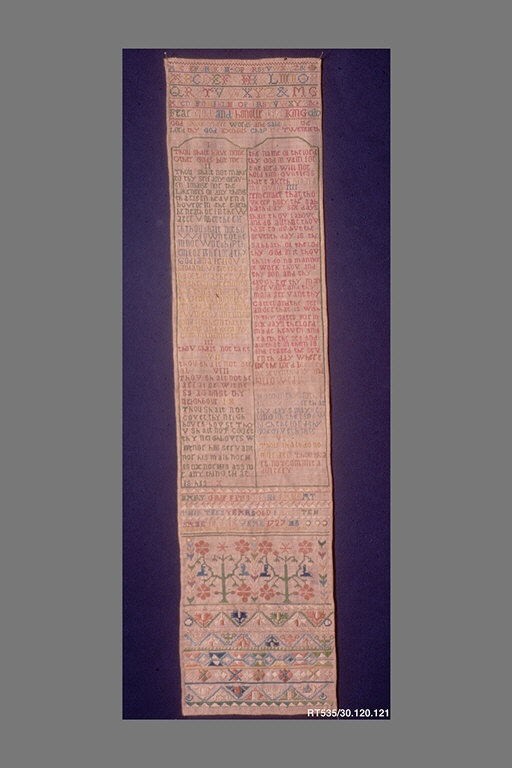
The Cartography of the Hand: A Couture Analysis of the Embroidered Sampler
Within the hallowed archives of Katherine Fashion Lab, the embroidered sampler is frequently misread as a quaint relic—a pedagogical exercise confined to the nursery rooms of Victorian England. Such a reduction does a profound disservice to the object’s true magnitude. In this standalone study, we deconstruct a singular specimen: a linen ground, densely populated with silk thread, whose provenance is best described not by a single nation but by the fluid, interwoven concept of Global Heritage. This is not a practice piece; it is a cartographic document of human civilization, a micro-cosmos of technical mastery, and a philosophical treatise on the transmission of cultural memory.
To approach this sampler as couture is to liberate it from the dusty taxonomy of folk art and elevate it to the rarefied air of haute construction. The couture atelier and the sampler’s creation share a foundational DNA: the absolute subordination of material to the intelligence of the hand. Here, the linen ground is not merely a fabric; it is a structural membrane, a grid of warp and weft that demands respect. Its even, tight weave—likely a high-count Belgian or Irish lawn—provides the tensile architecture necessary to support the weight and tension of the silk. In couture, the toile is the skeleton; here, the linen is the canvas, but a canvas with a specific modulus of elasticity that dictates every subsequent stitch.
Deconstructing the Silk Thread: A Study in Light and Discipline
The choice of silk thread is the first marker of elevated intention. Unlike wool or cotton, silk filament possesses a triangular prism-like structure that refracts light, creating a luminosity that shifts with the viewer’s angle. This is not a passive decoration; it is a kinetic interplay between the object and its environment. The artisan has exploited this property with surgical precision. In the dense satin-stitch blocks, the silk lies flat and parallel, creating a mirror-like surface that captures ambient light. In the delicate stem-stitch outlines, the thread twists, breaking the light into a thousand tiny glints, delineating form with a shimmering edge.
This manipulation of thread direction is the core of the sampler’s couture value. It demonstrates an advanced understanding of optical texture. The embroiderer has not simply filled shapes; they have engineered surfaces. A leaf is not green; it is a topography of green silks, angled to suggest a central vein catching the sun while the edges recede into shadow. This is the same logic that governs a bias-cut gown or a meticulously pleated panel in a Dior atelier—the fabric is not a flat plane but a three-dimensional medium of expression.
Global Heritage: The Syntax of a Universal Language
The designation of Global Heritage is critical to this analysis. To look at this sampler is to witness a palimpsest of global influences. The geometric motifs—the eight-pointed stars and interlocking circles—bear the unmistakable imprint of Central Asian and Persian textile traditions, where mathematical perfection was a spiritual act. The floral sprays, rendered with naturalistic shading, echo the botanical studies of European botanical gardens, yet their execution in tightly packed long-and-short stitch speaks to the Chinese and Japanese traditions of silk embroidery, where the needle acts as a paintbrush. The border, a repeating pattern of undulating vines, is a motif found from the Bayeux Tapestry to the Mughal courts.
This is not cultural appropriation; it is cultural synthesis. The sampler functioned as a global database of patterns, passed from hand to hand, ship to ship, across centuries. The maker did not view these motifs as foreign but as a shared lexicon of beauty. In a contemporary couture context, this is profoundly instructive. It reminds us that true luxury is not about novelty but about the deep, resonant curation of historical forms. The house of Katherine Fashion Lab recognizes that the future of design lies not in erasure but in the intelligent, respectful recombination of these global threads.
The Hierarchical Composition: A Masterclass in Negative Space
Compositionally, the sampler defies the modern fear of emptiness. The arrangement is a masterclass in hierarchical balance. A central cartouche, containing the alphabet and numerals, anchors the piece. This is the intellectual core—the assertion that literacy and numeracy are the foundations of civilization. Surrounding this are bands of increasing decorative complexity, moving from the simple cross-stitch of the lower registers to the opulent raised work and padded satin stitch of the upper sections.
Critically, the artisan has respected the negative space of the linen. They have not covered every square inch. The unembroidered linen acts as a visual palate cleanser, a moment of quiet breathing between the dense passages of silk. This restraint is the hallmark of high craftsmanship. It demonstrates confidence—the ability to stop before excess becomes clutter. In the fast-paced world of fast fashion, where maximalist embellishment is often used to mask poor construction, this sampler is a rebuke. It proves that true luxury is found in the decision of what to leave out.
Technical Virtuosity: The Grammar of Stitch
To the trained eye, the sampler is a grammar book of technical possibility. We observe not one or two, but over a dozen distinct techniques. The Holbein stitch, also known as the double-running stitch, creates a line that is identical on both sides—a feat of bilateral symmetry that is the gold standard of reversibility. The drawn-thread work, where warp threads are carefully removed and the remaining weft is bundled and wrapped, speaks to the highest level of material manipulation, creating a lace-like transparency that is the ancestor of modern cutwork.
Furthermore, the presence of couched gold-work—where a metallic thread is laid on the surface and secured with a finer silk in a precise grid pattern—introduces a metallic element that catches the eye with a harder, more assertive glint than the softer silk. This juxtaposition of textures—the soft, matte linen; the glossy, fluid silk; the rigid, brilliant metal—creates a sensory experience that is profoundly tactile. It is a symphony of touch.
Conclusion: The Sampler as a Blueprint for Modern Ateliers
In concluding this standalone study, we must re-frame the embroidered sampler. It is not a primitive artifact but a sophisticated prototype for the very concept of artisanal luxury. It encapsulates the entire ethos of Katherine Fashion Lab: a reverence for material, a mastery of technique, and an intellectual engagement with global history. The time, patience, and sheer manual dexterity required to produce such a piece are incalculable in a modern, mechanized economy. It represents a human investment that cannot be replicated by a machine.
This sampler is a testament to the fact that couture is not a size or a price point; it is a standard of execution. It is the physical manifestation of a decision to pursue perfection, one stitch at a time. As we move forward into an era of digital fabrication, the lesson of this linen and silk artifact is more urgent than ever. It reminds us that the hand is the original technology, and that the dialogue between human intellect and natural fiber remains the most profound and enduring form of creative expression. The sampler is not a relic of the past; it is a benchmark for the future of meaningful design.