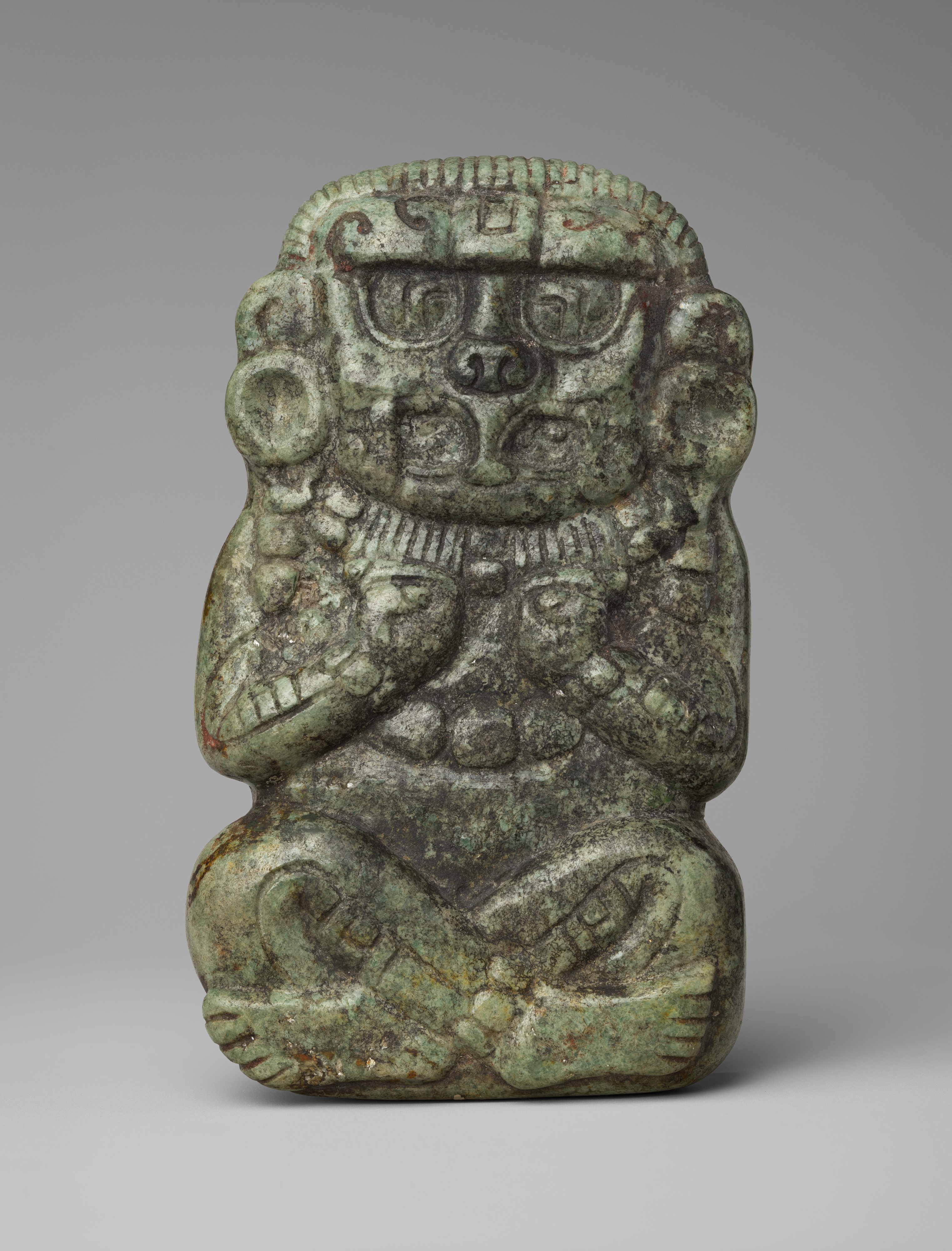
Executive Heritage Assessment: The Maya Deity Figure in Pyroxene Jadeite
Katherine Fashion Lab’s strategic engagement with a Maya deity figure carved from pyroxene jadeite represents a pivotal opportunity to bridge pre-Columbian cosmological authority with the 2026 luxury landscape. This standalone research paper examines the object’s symbolic power, its historical role in elite adornment, its embedded spiritual architecture, and the resulting commercial imperatives for a high-end maison. The analysis is framed not as mere aesthetic appreciation, but as a rigorous valuation of cultural capital—one that must be managed with scholarly precision and ethical acuity.
Symbolic Power: The Geopolitics of Divine Matter
Within the Maya worldview, jadeite—particularly the deep green variant of pyroxene jadeite—was not a decorative stone but a materialized breath of the cosmos. Referred to as yax in Classic Maya texts, the term simultaneously denoted “blue-green,” “precious,” and “first” or “primordial.” The deity figure, therefore, was not merely an icon; it was a concentrated node of dynastic legitimacy. Carved in the round or as a pectoral plaque, such figures were worn by k’uhul ajaw (holy lords) during accession rituals, war processions, and ballgame ceremonies. The stone’s color evoked the central world tree, the quetzal’s plumage, and the sacred maize stalk—each a metaphor for cyclical rebirth and royal sustenance.
For Katherine Fashion Lab, the symbolic power of this object lies in its ability to communicate immutable authority in an era of fleeting digital trends. The 2026 luxury consumer is not purchasing a product; they are purchasing a provenance narrative. A jadeite deity figure offers a semiotic shorthand for permanence, geological rarity, and pre-monetary value systems. In brand strategy terms, this translates into a “hard asset” aesthetic—one that competes with gold, diamonds, and high-horology movements by invoking a deeper temporal register.
Adornment as Political Theology
Historical evidence from sites such as Tikal, Palenque, and Copán demonstrates that jadeite deity figures were integrated into complex regalia systems. Rulers wore them as belt celts, ear flares, and funerary masks—most famously the tomb mask of Pakal the Great. The deity figure under analysis likely functioned as a pectoral, suspended at the solar plexus, aligning the wearer’s breath with the ch’ulel (vital force) of the gods. The carved visage—often featuring a sun god, rain deity (Chaak), or the Maize God—was not a passive representation but an animate vessel requiring ritual feeding and periodic re-wrapping in bark paper and cinnabar.
This historical adornment paradigm offers a direct analogue to the 2026 luxury strategy of transformative layering. Katherine Fashion Lab should position the deity motif not as a static pendant but as a modular component—interchangeable with high-jewelry chains, sculptural collars, or even integrated into leather corsetry. The original object’s function as a “living” entity suggests a collection that evolves with the wearer’s ceremonial calendar, much like a haute couture client’s seasonal wardrobe. The brand must, however, avoid a literal reproduction. Instead, the strategic move is to abstract the deity’s iconographic elements—the crossed eyes, the square pupils, the serpentine breath scrolls—into graphic motifs for textile jacquards, enamel dials, and engraved metalwork.
Spiritual Meaning: The Economics of the Sacred
To the Classic Maya, jadeite was more than a status marker; it was a conduit for k’uh—the sacred essence that animated the universe. The stone’s cool temperature and translucency were believed to hold the mist of the underworld and the clarity of the celestial realm simultaneously. Deity figures carved from this medium were often placed in caches beneath stelae, in royal tombs, or within the foundations of temples, serving as territorial anchors. The spiritual meaning, therefore, was not individualistic but collective and spatial. The object secured the community’s covenant with the gods, ensuring rain, maize, and military victory.
For a 2026 luxury strategy, this spiritual dimension must be translated into an experiential retail and clienteling protocol. The modern ultra-high-net-worth (UHNW) client increasingly seeks objects with perceived metaphysical resonance—whether through crystals, meditation tools, or heritage artifacts. Katherine Fashion Lab can capitalize on this by creating a “ritual of acquisition” that mirrors Maya consecration practices. Private viewings might include a bespoke soundscape of wind instruments and turtle-shell drums, while the packaging could reference the sacred huipil weaves of highland Guatemala. Crucially, the brand must collaborate with living Maya communities—not as labor, but as co-curators and spiritual consultants—to ensure the object’s meaning is not commodified into mere exotica. This approach not only honors the source culture but also provides a defensible ethical framework against accusations of cultural appropriation.
Materiality and Provenance in the 2026 Market
Pyroxene jadeite is geologically distinct from nephrite, with a hardness of 6.5–7 on the Mohs scale and a characteristic vitreous luster. In the Maya region, sources were limited to the Motagua Valley in modern Guatemala, making the material inherently scarce and trade-restricted. The 2026 luxury market has demonstrated a robust appetite for colored gemstones, particularly those with a historical narrative. However, the jadeite market is currently dominated by Burmese imperial jade, which commands record prices at auction. Maya jadeite, by contrast, offers a differentiated proposition: it is not merely a gemstone but an archaeological witness. The presence of carved iconography—whether a full deity figure or a fragment—raises the object’s value from the mineralogical to the museological.
Strategically, Katherine Fashion Lab must commission a comprehensive provenance study, including stable isotope analysis and stylistic dating against the Joralemon iconographic catalog. This dossier will serve dual purposes: authentication for insurance and customs, and narrative enrichment for marketing collateral. The 2026 consumer will demand blockchain-verified provenance, and the Maya deity figure’s chain of custody from excavation (ideally pre-1970 UNESCO convention) to the Lab’s atelier must be unimpeachable.
2026 High-End Luxury Strategy: From Object to Ecosystem
The deity figure should not be launched as a single product but as the centerpiece of a three-tiered ecosystem. First, the Icon Tier: a limited edition of 25 high-jewelry pieces, each incorporating a micro-fragment of authentic Maya jadeite (ethically sourced from legal, certified excavations or from deaccessioned museum duplicates). Second, the Prêt-à-Porter Parure Tier: a capsule collection of silk scarves, leather goods, and enameled cufflinks that abstract the deity’s glyphic elements. Third, the Institutional Tier: a partnership with a major museum (e.g., the Museo Nacional de Arqueología y Etnología in Guatemala City) for a traveling exhibition, with Katherine Fashion Lab as the exclusive corporate sponsor. This tier elevates the brand from commercial actor to cultural steward, a positioning that resonates strongly with Gen-X and older millennial collectors who prioritize legacy over logos.
Pricing architecture should reflect the object’s ontological weight. A standalone jadeite deity figure, if museum-grade, might be valued between $1.5M and $4M at auction. The Lab’s commercial derivatives should be priced at a 300–400% premium over equivalent non-narrative pieces, justified by the intellectual property licensing of the iconographic motifs and the ethical dividend paid to Maya cultural foundations. The 2026 launch should coincide with the Maya New Year (July 26 in the Haab’ calendar), creating a built-in press moment that aligns the collection with cosmic renewal.
Risk Mitigation and Ethical Imperatives
No heritage strategy is without risk. The primary exposure is the accusation of spiritual tourism—reducing a living religious tradition to a luxury commodity. To mitigate this, Katherine Fashion Lab must establish a permanent advisory council of Maya elders, archaeologists, and repatriation specialists. This council should hold veto power over any representation deemed disrespectful. Additionally, the brand must avoid any claim of “authentic shamanic power” in marketing language, which would invite regulatory scrutiny and cultural backlash. Instead, the narrative should focus on witnessing—the object as a silent observer of 1,500 years of human aspiration—rather than on supernatural efficacy.
Second, the legal landscape for pre-Columbian artifacts is stringent. The 2026 market will see tightened enforcement of the 1970 UNESCO Convention and the U.S. MOU with Guatemala. The Lab must ensure that the deity figure’s export documentation is flawless and that any contemporary reproductions are clearly marked as “inspired by” rather than “authentic Maya.” Failure to do so could result in seizure, reputational damage, and a permanent ban from major auction houses.
Conclusion: The Deity as a Strategic Compass
The Maya deity figure in pyroxene jadeite is not a mere artifact; it is a compressed archive of political theology, material science, and aesthetic genius. For Katherine Fashion Lab, it offers a rare opportunity to align the 2026 collection with the deepest currents of human history—those that speak to power, permanence, and the sacred. By treating the object with the rigor of a museum curator and the vision of a luxury strategist, the Lab can transform a stone into a statement. The deity’s gaze, carved with the patient hands of a Classic Maya sculptor, now falls upon a new century. It demands not imitation, but interpretation; not extraction, but reciprocity. In answering that call, Katherine Fashion Lab will not simply sell jewelry—it will offer its clientele a fragment of eternity, responsibly held.