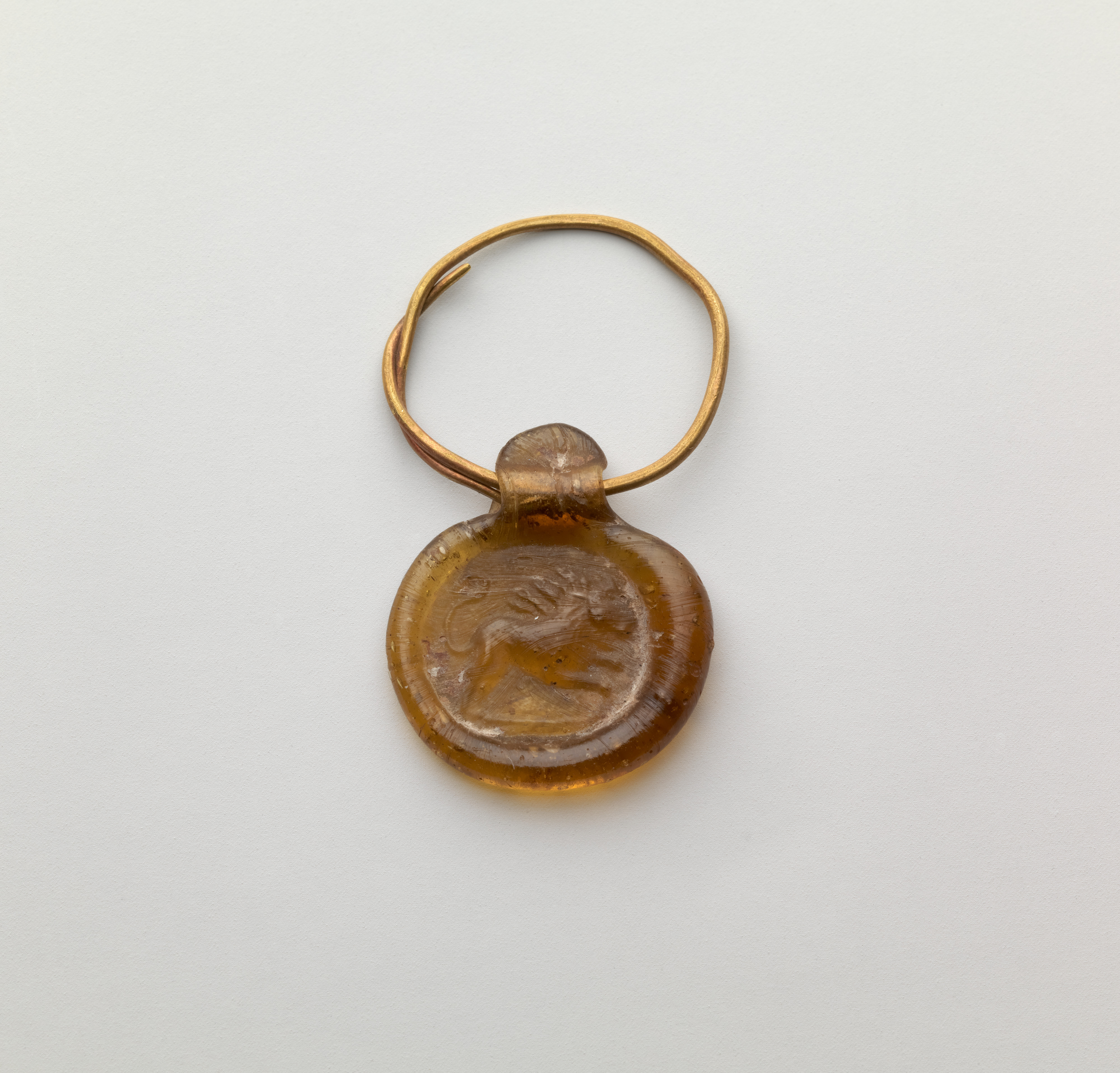
Heritage Analysis: The Roman Gold Hoop with Glass Pendant Stamped Disk
Introduction: An Object of Layered Imperial Significance
The Roman gold hoop earring with a glass pendant stamped disk, dating from the early Imperial period (circa 1st–3rd century CE), represents a sophisticated convergence of material wealth, optical innovation, and socio-religious signaling. For Katherine Fashion Lab, this artifact is not merely a decorative antecedent but a strategic blueprint for 2026 luxury positioning. The object’s dual nature—structural simplicity married to intricate symbolic stamping—offers a compelling narrative of restrained ostentation that aligns directly with contemporary high-net-worth consumer preferences for quiet luxury with hidden depth.
Symbolic Power: The Disk as Microcosm of Roman Authority
The stamped disk pendant functions as a miniature declarative surface. In Roman visual culture, stamped or embossed disks—often bearing the imago clipeata (shield portrait) or solar motifs—served as portable assertions of allegiance. When the disk depicts a deity, emperor, or abstract cosmic symbol, the wearer translates public ideology into intimate, bodily proximity. The gold hoop itself carries martial resonance, evoking the murus (circuit wall) and the unbroken circle of aeternitas—the promise of Rome’s perpetual dominion. For the 2026 Katherine Fashion Lab client, this translates into jewelry that communicates personal sovereignty without verbal declaration. The stamped disk becomes a coded insignia, viewable only at close range—a luxury of exclusivity that modern digital visibility cannot replicate.
Historical Adornment: Engineering Light and Gaze
Roman goldsmiths mastered the interplay of material density and optical play. The hoop’s substantial gold gauge—often 1.5–2.5 millimeters in diameter—was engineered to catch ambient light continuously, while the glass pendant introduced a deliberate chromatic interruption. Roman glass, particularly in the early Imperial period, was prized for its vitrum blattum (blue-green translucency) and occasional millefiori patterning. The juxtaposition of opaque gold and translucent glass created a dialectical visual rhythm: solidity versus luminosity, permanence versus fragility. This is not accidental aesthetics but calculated adornment strategy. The earring’s weight distribution—hoop counterbalancing pendant—allowed for both static elegance and dynamic motion, ensuring that the stamped disk rotated subtly with the wearer’s head, thus alternating between reflective flash and shadowed secrecy. Katherine Fashion Lab’s 2026 strategy should resurrect this kinetic storytelling—jewelry that performs differently under varying angles, rewarding the attentive observer while remaining understated from afar.
Spiritual Meaning: The Glass Amulet and Protective Gaze
Beyond ornament, the glass component carried apotropaic function. Roman women and men alike wore glass pendants imbued with fascinum—the power to deflect the evil eye. Glass’s inherent refractive properties were believed to scatter malevolent glances before they could settle on the wearer. The stamped disk, when depicting Gorgoneia or solar rays, amplified this protective matrix. The hoop’s circularity further invoked fortuna’s wheel and the cyclical nature of fate, positioning the earring as a personal talisman of resilience. For the 2026 luxury market, where wellness and spiritual protection have become status markers, this artifact offers a historical precedent for jewelry as energetic armor. Katherine Fashion Lab can leverage this narrative by framing the glass pendant not as mere decoration but as a modern amulet—a wearable object that claims to shield its owner from digital fatigue, social surveillance, and psychological fragmentation. The stamped disk becomes a personal sigil, chosen by the wearer, rather than imposed by corporate branding.
Material Semiotics: Gold as Unyielding Value, Glass as Democratic Luxury
The pairing of gold and glass in a single Roman artifact reveals a nuanced class calculus. Gold was the undisputed metal of imperial elites, yet glass—initially a Phoenician innovation—was democratized by Roman mass production. However, the quality of glass in this earring, likely high-lead or crystalline, suggests deliberate selection to mimic precious stones. This material hybridity is a strategic lesson for 2026: luxury need not be monolithic. Katherine Fashion Lab can employ recycled 18k gold alongside lab-grown or upcycled glass with antiquarian chromatic precision—not as a cost-saving measure, but as a philosophical statement on resource consciousness. The Roman object demonstrates that value is not inherent in material alone but in the dialogue between materials. Gold’s permanence is elevated by glass’s vulnerability; glass’s fragility is ennobled by gold’s embrace. This symbiotic material narrative resonates with Gen-Z and elder millennial luxury consumers who prioritize provenance and ethical production without sacrificing visual opulence.
2026 Luxury Strategy: From Replica to Archetype
Katherine Fashion Lab’s strategic opportunity lies not in literal reproduction but in archetypal extraction. The Roman hoop-and-disk configuration offers three transferable design principles for the 2026 collection:
1. The Unbroken Circle as Brand Signature: The hoop’s geometric purity can be reimagined as a continuous, seamless gold ring—perhaps with a hidden hinge—that references Roman engineering while satisfying modern comfort requirements. This becomes the house’s leitmotif, a recognizable silhouette that whispers heritage without costume-like historicism.
2. The Stamped Disk as Customization Interface: Instead of fixed iconography, Katherine Fashion Lab can offer a bespoke stamping service—clients select from a library of symbols derived from Roman numismatics, astrological charts, or personal monograms. The disk becomes a micro-canvas for identity, echoing the Roman practice of personalizing military phalerae (decorative disks). This service-oriented luxury aligns with the 2026 trend toward hyper-personalization while maintaining a cohesive collection aesthetic.
3. The Glass Pendant as Chromatic Disruption: The 2026 iteration should use cast glass with internal air bubbles—a deliberate nod to Roman imperfections—in colors derived from excavated Mediterranean glass shards (seafoam green, amber, cobalt). This introduces a color-blocking strategy against gold’s neutrality, creating instant visual differentiation on retail shelves and social media feeds. The glass’s translucency also allows for light-reactive marketing: campaign imagery can capture the pendant catching sunset or gallery spotlight, emphasizing the object’s temporal beauty.
Brand Narrative and Consumer Psychology
The luxury consumer of 2026 is not purchasing an earring; they are purchasing temporal continuity. The Roman artifact offers a narrative of survival—through conquests, plagues, and empires—making it a metaphor for personal endurance in an era of climate anxiety and geopolitical volatility. Katherine Fashion Lab should position this piece as “The Eternal Witness”—jewelry that has witnessed history and now witnesses the wearer’s personal history. The marketing language should avoid overt historical pedantry; instead, it should employ evocative suggestion: “Wear the circle that outlasted Rome. Stamp your own mark upon it.” This dual temporality—past permanence and present agency—creates an ownership paradox: the consumer feels they are borrowing from eternity while simultaneously authoring a new chapter.
Pricing and Exclusivity Architecture
Given the artifact’s provenance, Katherine Fashion Lab can justify a price point between $8,500–$15,000 for the 18k gold version, with a limited museum-grade edition (using actual Roman glass fragments, ethically sourced from licensed archaeological repositories) at $35,000+. The stamped disk customization service should be appointment-only, offered in flagship stores or via private video consultations, reinforcing the Roman patronage model. This scarcity-driven approach—limited to 300 pieces globally—mirrors the original artifact’s exclusivity and prevents brand dilution.
Conclusion: Heritage as Forward Engineering
The Roman gold hoop with glass pendant stamped disk is not a relic to be copied but a strategic archetype to be decoded. Its symbolic power lies in silent assertion; its spiritual meaning in protective luminosity; its material dialogue in gold’s permanence versus glass’s fragility. For Katherine Fashion Lab’s 2026 collection, this artifact provides a rigorous framework for creating jewelry that is simultaneously ancient and futuristic, personal and universal. By honoring the Roman understanding that adornment is communication without speech, the brand can position itself not as a purveyor of accessories but as a curator of enduring significance—a role that transcends seasonal trends and secures cultural relevance for decades to come.