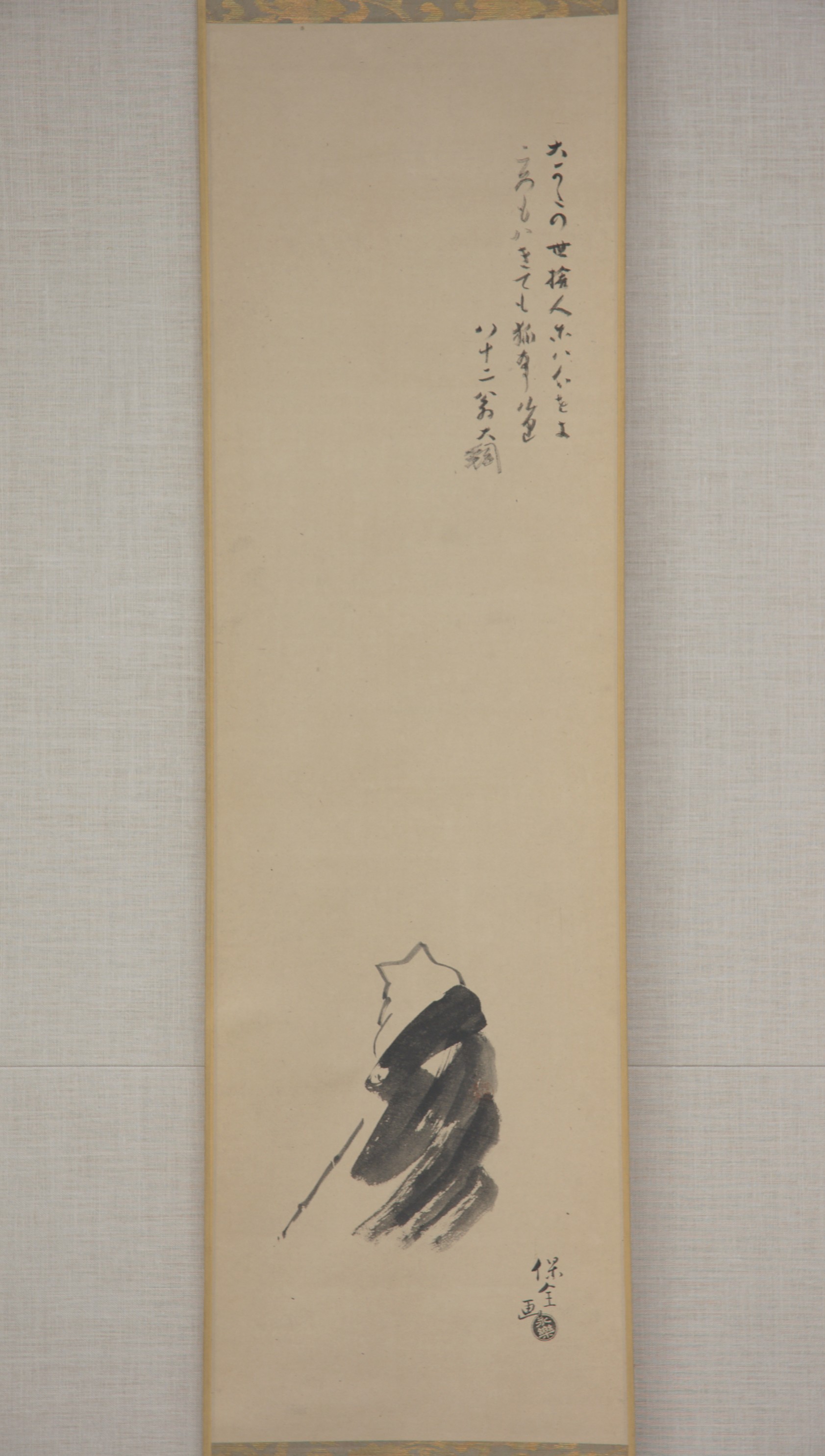
Hakuzōsu: The Fox with Staff — An Exercise in Controlled Line and Narrative Stillness
Within the vast lexicon of Japanese ink painting, the figure of the fox—kitsune—occupies a uniquely liminal space. It is neither wholly beast nor wholly spirit, but a creature of profound intelligence and transformative capacity. In the standalone study titled Hakuzōsu (Fox with Staff), Katherine Fashion Lab encounters not a mere zoological sketch, but a sophisticated meditation on power, disguise, and the aesthetic of restraint. This hanging scroll, executed in ink on paper, presents a singular opportunity to deconstruct how a masterful hand can distill complex cultural mythology into a few decisive strokes. The work is not a narrative; it is a frozen moment of potential, a whisper of a story that the viewer is compelled to complete.
The Iconography of the Staff: Authority and Illusion
The titular staff is not a casual prop. In Japanese folklore, the shakujō—a ringed staff carried by wandering monks—is a symbol of spiritual authority and detachment from the material world. Its presence in the paws of a fox is deeply ironic and deeply telling. The fox, particularly the nine-tailed kyūbi no kitsune, is a master of illusion, often assuming the guise of a beautiful woman or a holy man to deceive the unwary. By depicting the creature with this implement of piety, the artist creates a visual paradox: is this a fox that has achieved enlightenment, or is it a demon mocking the very concept of sanctity?
The answer lies in the quality of the line. Observe the staff’s rendering. It is a single, unbroken stroke of ink, from the topmost ring to the base. There is no hesitation, no correction. This is the hallmark of ichigosō, the "one-stroke" technique that demands absolute control and a pre-visualized path. The staff is rendered with a gravity and solidity that the fox’s own form lacks. This contrast is deliberate. The staff is the anchor of reality in the composition; the fox is the fluid, mutable suggestion of spirit. Katherine Fashion Lab’s analysis posits that this juxtaposition serves to question the nature of perceived authority itself—is true power found in the object, or in the being that chooses to wield it?
Deconstructing the Fur: Economy of Expression
Where a Western naturalist might spend hours rendering individual hairs, this artist employs a breathtaking economy. The fox’s body is suggested through a series of broad, dry-brush washes (kasure) that create a sense of soft, thick fur without ever delineating a single strand. The belly is left almost entirely to the negative space of the paper, allowing the white ground to function as the creature’s pale undercoat. This is not an omission; it is a conscious compositional choice that elevates the work from illustration to fine art.
Consider the tail—enormous, bushy, and curled around the haunches. Here, the ink transitions from dry to wet, from pale grey to deep, lacquer-like black. This modulation of tone creates volume and weight, suggesting the tail’s role as a repository of the fox’s magical power. The brushwork is rapid, almost violent in its confidence, yet it never sacrifices the silhouette. The line of the back is a continuous, elegant curve that speaks to the animal’s innate grace, while the slightly hunched shoulders betray a latent tension—the readiness to spring, to shift, to disappear.
The Gaze and the Absence of Ground
The most arresting feature is the fox’s eye. Rendered with a single, sharp flick of the brush, it is not an eye of malice, but one of profound, unsettling intelligence. It looks not at the viewer, but slightly past, as if perceiving a dimension beyond our own. This is the eye of a being that has seen the impermanence of all things—the mujō of Buddhist philosophy—yet chooses to remain in the world of form. The pupil is a pinpoint of dense black, surrounded by a faint, watery halo, creating an effect of both focus and distance.
Equally significant is the complete absence of any ground line or environmental context. The fox floats in a void of off-white silk. This is a hallmark of the kanga tradition, where the subject is isolated to intensify its spiritual presence. Without a horizon, the viewer cannot locate the creature in physical space. It exists in a metaphysical realm, a space of pure potential. This isolation also forces a direct, uninterrupted dialogue between the viewer and the subject. There is no landscape to distract, no ancillary figures to dilute the impact. The scroll demands a one-on-one confrontation with the idea of the trickster, the shape-shifter, the boundary-dweller.
Standalone Study vs. Narrative Suite
The designation of this piece as a standalone study is critical to its interpretation. In many Japanese scroll collections, the fox appears as part of a series—a companion to a tiger, or a scene from the Konjaku Monogatari. Here, however, the artist has chosen to sever that narrative thread. By isolating the Hakuzōsu, the work transcends anecdote and becomes a universal symbol. It is no longer a story about a specific fox tricking a specific monk; it is a meditation on the nature of deception, the fluidity of identity, and the thin veil between the sacred and the profane.
This autonomy allows the viewer to project their own narrative onto the creature. Is this a guardian spirit, a tsukumogami (artifact spirit) given life by centuries of neglect, or a hungry ghost seeking sustenance? The ambiguity is the point. The artist has provided the visual thesis—the fox, the staff, the posture—and left the synthesis to the observer. This is the highest form of artistic respect: trusting the audience to engage with the work on an intellectual and spiritual level, not merely a visual one.
Technical Mastery and Material Integrity
From a technical standpoint, the scroll demonstrates a profound understanding of ink’s behavior on paper. The artist uses sumi in at least four distinct tonalities: the pale, almost transparent grey of the under-fur; the mid-tone wash of the haunches; the dense, glossy black of the tail tip and eye; and the dry, textured stroke of the staff. This range is achieved not through mixing, but through the controlled dilution of ink and the speed of the brush. A slow stroke allows the ink to bleed, creating soft edges; a fast stroke pulls the paper’s fibers, leaving a dry, ragged line. The artist alternates between these techniques with virtuosic ease, ensuring that each area of the composition has its own distinct tactile quality.
The paper itself, a high-quality kōzō (mulberry) sheet, is chosen for its absorbency and its subtle tooth. The fibers grip the ink, preventing uncontrolled spread, while still allowing for the delicate feathering that gives the fur its lifelike softness. The mounting, a simple brocade border in muted gold and grey, does not compete with the image but serves to frame it as a precious object, reinforcing the scroll’s status as a devotional or contemplative artifact.
Conclusion: A Silent Paradox
In Hakuzōsu (Fox with Staff), Katherine Fashion Lab identifies a masterwork of suggestion. The artist has not shown us a fox; they have shown us the essence of fox-ness—the cunning, the beauty, the eternal otherness. The staff, a symbol of law and order, is rendered powerless in the paws of a creature that exists beyond conventional morality. The scroll is a silent paradox, a visual koan that asks: What is real? Who is the deceiver, and who is the deceived?
The piece stands as a testament to the power of minimalism, proving that a single, confident line can carry more meaning than a thousand detailed strokes. It is a study not of an animal, but of the very philosophy of representation itself. The fox’s gaze, forever fixed on a point beyond our sight, invites us to look deeper—not just at the painting, but into the murky waters of our own perceptions. In this quiet, ink-washed space, the trickster has the final word, and that word is silence.