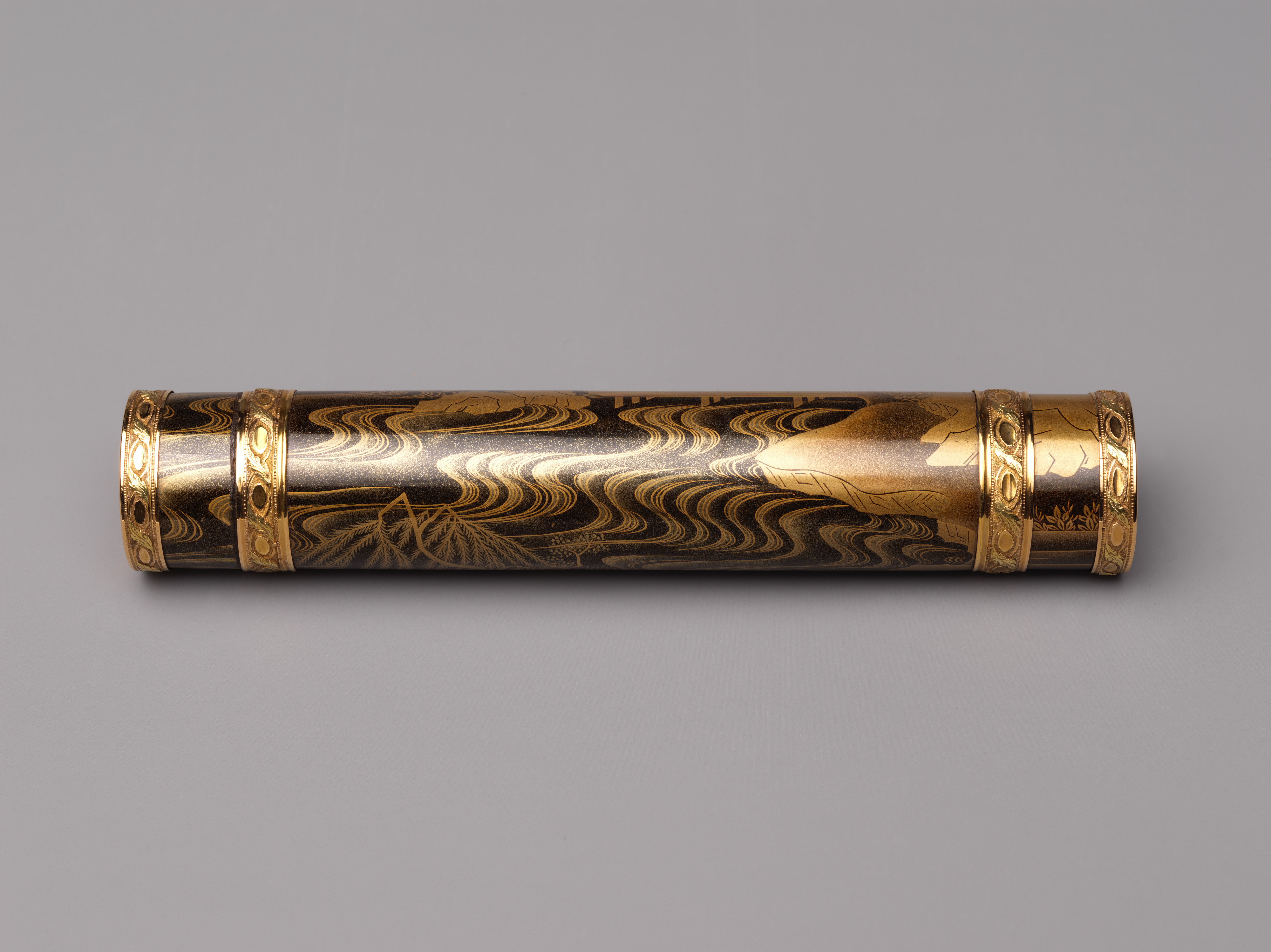
Executive Heritage Assessment: The Message Case as a Confluence of Franco-Japanese Artistry
Katherine Fashion Lab presents a strategic examination of the Message Case with Landscape, an artifact of profound cultural duality. Originating from the technical and spiritual confluence of Japan and France, this object—crafted in lacquered wood with gold and silver hiramaki-e and togidashimaki-e, and adorned with gilded mounts—transcends its utilitarian function. For the 2026 luxury landscape, this case is not merely a historical relic but a blueprint for cross-cultural storytelling, material mastery, and the monetization of intangible heritage. This analysis deconstructs its symbolic power, historical adornment, and spiritual meaning to propose a high-end strategy that leverages authenticity as the ultimate scarcity.
Symbolic Power: The Cartography of Status and Transience
The visual lexicon of the Message Case is a deliberate exercise in symbolic communication. The landscape depicted is not topographical documentation but a metaphysical map. In Japanese aesthetics, specifically within the ukiyo-e and rinpa traditions that inform such lacquerware, landscapes represent the transient beauty of the natural world—mono no aware, the pathos of things. The inclusion of water, mountains, or seasonal flora would signify the impermanence of human endeavor against the eternal rhythm of nature. For the elite recipient of such a case, the message within was framed by this external reminder of cosmic order, positioning the sender as a person of philosophical depth and refined taste.
However, the French contribution—the gilded mounts—introduces a contrasting symbolic layer of permanence and regal authority. Gilt bronze (bronze doré) in 18th-century France was the material of the ancien régime, signifying divine right and institutional power. The fusion of Japanese lacquer with French ormolu creates a dialectic: the ephemeral, poetic soul of the East meets the structural, monumental power of the West. In a heritage strategy, this duality is the product’s core equity. It allows Katherine Fashion Lab to position itself not as a producer of accessories, but as a curator of bi-cultural authority, where the client carries a piece that speaks to both global sophistication and introspective spirituality.
Historical Adornment: The Politics of the Gift and the Body
Historically, the Message Case functioned as a portable epistolary kit, used by Japanese nobility and later coveted by European collectors. Its adornment was never passive. The hiramaki-e (low-relief sprinkled lacquer) and togidashimaki-e (polished-out lacquer) techniques were painstaking processes requiring hundreds of hours, effectively rendering the object a repository of labor value. In the context of the 17th and 18th centuries, when Japan engaged in limited trade via Dejima, such objects were diplomatic gifts—souvenirs for the Dutch East India Company—that carried the weight of national prestige.
For the French aristocracy who acquired these pieces, the Message Case was an adornment of the intellect. It was not worn on the body but used in the ceremonial act of writing, a performance of social connectivity. The lacquer surface, cool and glass-like, contrasted with the warm tactility of the gilded mounts, creating a sensory experience that elevated correspondence to a ritual. This historical context is critical for a 2026 strategy. Modern luxury consumers are fatigued by digital ephemerality. The Message Case offers a tactile counter-narrative. By reviving this object—or its aesthetic principles—Katherine Fashion Lab can tap into the growing market for slow luxury, where the act of writing a note becomes a performative act of status, mirroring the historical rituals of the French salon and Japanese court.
Spiritual Meaning: The Lacquer as a Conduit of Purity
The spiritual dimension of the lacquer itself is often underestimated in Western analysis. The sap of the Toxicodendron vernicifluum tree, when cured, produces a surface that is not merely decorative but considered purifying in Shinto and Buddhist contexts. The process of lacquering is a metaphor for spiritual refinement—layer upon layer of applied resin, each polished to a mirror finish, represents the elimination of ego and the attainment of clarity. The use of gold and silver powders in the maki-e techniques is not decorative extravagance but an invocation of celestial light, transforming the case into a miniature mandala.
In contrast, the French gilded mounts, often depicting acanthus leaves or laurel, carry Greco-Roman spiritual connotations of victory and eternal life. The synthesis of these two spiritual systems—Japanese purity through natural process and European classical triumph—creates a hybrid sacred object. For the contemporary high-end consumer, this spiritual fusion offers a form of secular talisman. The case is not blessed by a single doctrine but by a confluence of philosophies. This is profoundly relevant for the 2026 market, where affluent clients seek objects with "energy" or "intention." The narrative is not religious but philosophical: owning this case aligns one with the discipline of the Japanese artisan and the grandeur of the French ébéniste.
Strategic Application: The 2026 High-End Luxury Framework
To translate this heritage into a viable 2026 strategy, Katherine Fashion Lab must move beyond replication and into adaptive transmutation. The following framework is proposed, grounded in the artifact’s inherent dualities.
Product Architecture: The "Epistolary Revival" Collection
Introduce a limited series of modern Message Cases, not as nostalgic copies, but as functional art objects for the digital age. The case should house not only writing implements but also a secured NFC chip that unlocks a digital archive of the owner’s correspondence—a bridge between the lacquer’s permanence and digital fluidity. The exterior must utilize authentic maki-e techniques, but the landscape should be abstracted to represent the owner’s personal "territory"—perhaps a stylized map of their birth city or a place of significance. This personalization elevates the object from a commodity to a patrimonial asset.
Brand Positioning: "The Bilateral Patron"
Position the brand as the sole arbiter of high-level Franco-Japanese craftsmanship in the luxury accessories sector. This requires a vertical integration narrative: partner exclusively with a Living National Treasure lacquer workshop in Kanazawa and a Parisian fondeur-ciseleur for the mounts. The supply chain becomes the story. For 2026, where provenance is paramount, this bilateral patronage offers a defensible moat against counterfeiters and fast-fashion dilution. The pricing strategy should be value-skipping—priced at a point that ignores mid-tier competition, targeting the ultra-high-net-worth individual (UHNWI) who values rarity of skill over rarity of material.
Experiential Marketing: The "Ritual of Despatch"
Leverage the spiritual meaning by hosting invitation-only writing ateliers in flagship stores, designed to emulate the historical use of the case. Clients are guided through the physical act of writing a letter, using implements stored in the case, while a tea ceremony master or a French calligrapher provides context. This is not a workshop; it is a performance of heritage. The takeaway is not the letter but the memory of the ritual, which is then associated indelibly with Katherine Fashion Lab. In 2026, the luxury sector is pivoting from selling objects to selling time well spent; this strategy capitalizes on that behavioral shift.
Narrative Control: The "Dialectic of Materials"
All marketing collateral, from press releases to the microsite, must articulate the tension between the lacquer (the soul) and the gilded mount (the structure). Use macro-photography to show the grain of the gold powder against the black lacquer, and the cold sheen of the ormolu. The copy should be concise, MBA-grade, and avoid flowery adjectives. Instead, state the facts of labor: "300 hours of lacquer work, 80 hours of chasing and gilding." This factual transparency appeals to the intelligent luxury buyer who distrusts overt advertising. The message case becomes a case study in the brand’s own philosophy of disciplined beauty.
Conclusion: A Mandate for Curated Fusion
The Message Case with Landscape is a masterclass in how luxury operates when it respects both origin and destination. It was never a purely Japanese or purely French object; it was a third entity, born of trade, diplomacy, and mutual aesthetic respect. For Katherine Fashion Lab’s 2026 strategy, the mandate is clear: do not dilute the heritage by modernizing it superficially, but rather amplify its original thesis—that true luxury lies in the harmonious, albeit tense, coexistence of disparate spiritual and material traditions. By adopting this artifact as a strategic cornerstone, the Lab positions itself as a leader in heritage-driven innovation, offering clients not just a product, but a portable piece of cultural diplomacy that is as relevant today as it was in the salons of Paris and the courts of Edo.