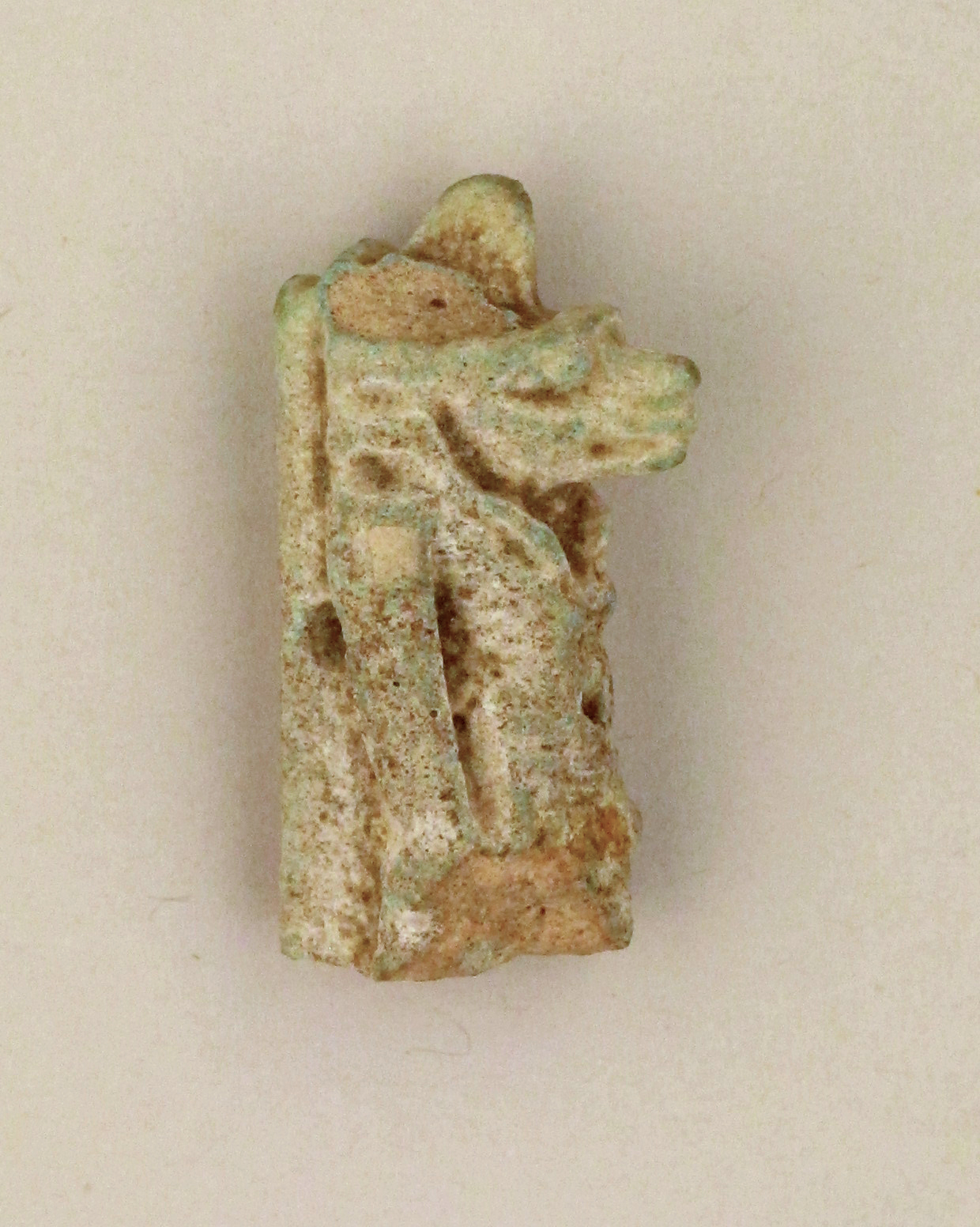
Heritage Analysis: The Canine-Headed Anubis in Faience
This strategic standalone research paper, prepared for the executive leadership of Katherine Fashion Lab, examines a singular artifact of profound cultural resonance: the Egyptian faience amulet depicting the canine-headed god Anubis. Moving beyond mere aesthetic appreciation, this analysis deconstructs the object as a concentrated nexus of symbolic power, historical adornment, and spiritual meaning. Our objective is to extract core principles that can inform a forward-looking, high-end luxury strategy for the 2026 season, translating ancient codes of protection, transformation, and exclusivity into a contemporary vernacular of sophisticated design.
Deconstructing the Artifact: Materiality and Symbolic Power
The chosen medium, faience, is itself a statement of symbolic intent. More than a simple ceramic, Egyptian faience was a manufactured precious material, its shimmering, glass-like blue-green surface consciously evocative of life-giving water, regenerative vegetation, and the luminous heavens. It was a substance that transcended its humble components (silica, lime, alkali, and a copper colorant) to become a symbol of rebirth and eternal life. To encase the form of Anubis in this luminous material was a deliberate fusion of form and meaning, elevating the amulet from ornament to a functional spiritual device.
The canine form of Anubis—specifically a jackal or wild dog—is a masterclass in symbolic inversion and power. Jackals were scavengers, creatures associated with the edges of the desert and the cemeteries where Egyptians buried their dead. Rather than recoiling from this connection, Egyptian theology co-opted it. Anubis, as the "Lord of the Sacred Land" and "He Who is Upon His Mountain," became the guardian of the necropolis, the protector of the deceased from the very chaos he was associated with. His sleek, alert form symbolizes vigilance, territorial authority, and a guiding intelligence through the liminal space of death. The amulet, therefore, is a portable distillation of this protective power, a wearable shield against spiritual and metaphysical peril.
Historical Adornment and Spiritual Mechanics
In the context of historical adornment, this amulet was not discretionary jewelry; it was essential functional wear. Amulets were a mandatory component of funerary practice, often woven into the mummy's wrappings in specific configurations as outlined in funerary texts like the Book of the Dead. Their placement was strategic, each location on the body corresponding to a specific protective function. An Anubis amulet would serve as a guardian for the journey, ensuring the integrity of the body and the soul's safe passage to the Hall of Judgment.
This introduces the concept of spiritual mechanics—the belief that the object, through its precise form, material, and ritual activation, performed a tangible, non-physical function. The adornment was an active interface between the wearer (living or deceased) and the divine realm. The value was intrinsic, derived from its perceived efficacy and its role in a critical rite of passage. For Katherine Fashion Lab, this presents a potent conceptual framework: moving beyond surface decoration to design that embodies a performative value—pieces that are perceived as active agents in the wearer’s personal narrative, conferring confidence, authority, or a sense of curated identity.
Core Principles for Luxury Strategy Extraction
From this analysis, we distill three core heritage principles relevant to a 2026 high-end luxury strategy:
1. The Alchemy of Materials: Faience teaches us that luxury lies in transformation, not just inherent rarity. The 2026 strategy should investigate innovative material sciences—bio-acetates, lab-grown crystals, composite resins—that are ethically engineered to possess unique luminous, textural, or chromatic properties. The story is not "what it is," but "what it has been made to signify."
2. Guardianship and the Liminal: Anubis protects during transition. The modern luxury consumer faces liminal spaces: career shifts, personal milestones, the negotiation between public and private selves. Our 2026 collections can conceptualize pieces as "guardians" for these moments—a cuff for the decisive boardroom meeting, a pendant for a personal rite of passage. This positions our pieces as companions for transformation, imbued with narrative depth.
3. Symbolic Inversion & Intellectual Allure: Anubis transforms a symbol of fear into one of protection. This mirrors a contemporary luxury desire for pieces that convey erudition and layered meaning. Our design language can employ subtle, sophisticated references that require decoding—abstracted canine motifs in clasps, jackal-ear silhouettes in structured shoulders, the use of "necropolis grey" and "faience blue" in unexpected combinations. The value is amplified by the intellectual engagement of the discerning client.
Strategic Application: The 2026 "Anubis Code" Collection Framework
For a targeted 2026 launch, we propose a high-jewelry and signature accessories capsule titled "The Anubis Code." This is not literal Egyptian revivalism, but a conceptual translation.
Product Pillars:
Guardian Silhouettes: Structured bags and clutches with architectural lines echoing the alert, forward-leaning posture of the jackal, employing innovative, cool-touch materials that feel both ancient and futuristic.
Luminous Amulets: Statement pendants and brooches in transformed materials—dichroic glass that shifts from desert sand to midnight blue, ceramics fired with metallic lusters. Each is presented as a "modern amulet," with a discreet, engraved cartouche for the owner's initials, personalizing the protective covenant.
The Liminal Wardrobe: Eveningwear that plays with veiling and revelation, using layered silks and technical meshes to represent the veil between worlds, with clasps and fastenings inspired by amulet settings.
Brand Narrative & Client Experience: The marketing campaign will pivot on themes of "Guarded Transition" and "The Alchemy of Self." VIP client presentations will not be simple viewings; they will be curated experiences discussing the heritage of adornment as empowerment, perhaps involving a personalized "ritual" of unboxing or engraving. This elevates the transaction to a ceremonial adoption of a protective icon.
In conclusion, the faience amulet of Anubis offers Katherine Fashion Lab a profound strategic blueprint. It demonstrates that ultimate luxury is the fusion of transcendent materiality, profound symbolic narrative, and a deep, almost functional, relevance to the human journey. By encoding these ancient principles of protection, transformation, and intellectual allure into a 2026 strategy, we position the brand not as a follower of trends, but as a curator of meaning, crafting heirlooms for the modern psyche that are as spiritually resonant as they are impeccably crafted.