Heritage Analysis: Songs of Innocence and of Experience – A Strategic Framework for Katherine Fashion Lab
Introduction: The Artifact as a Cultural Archetype
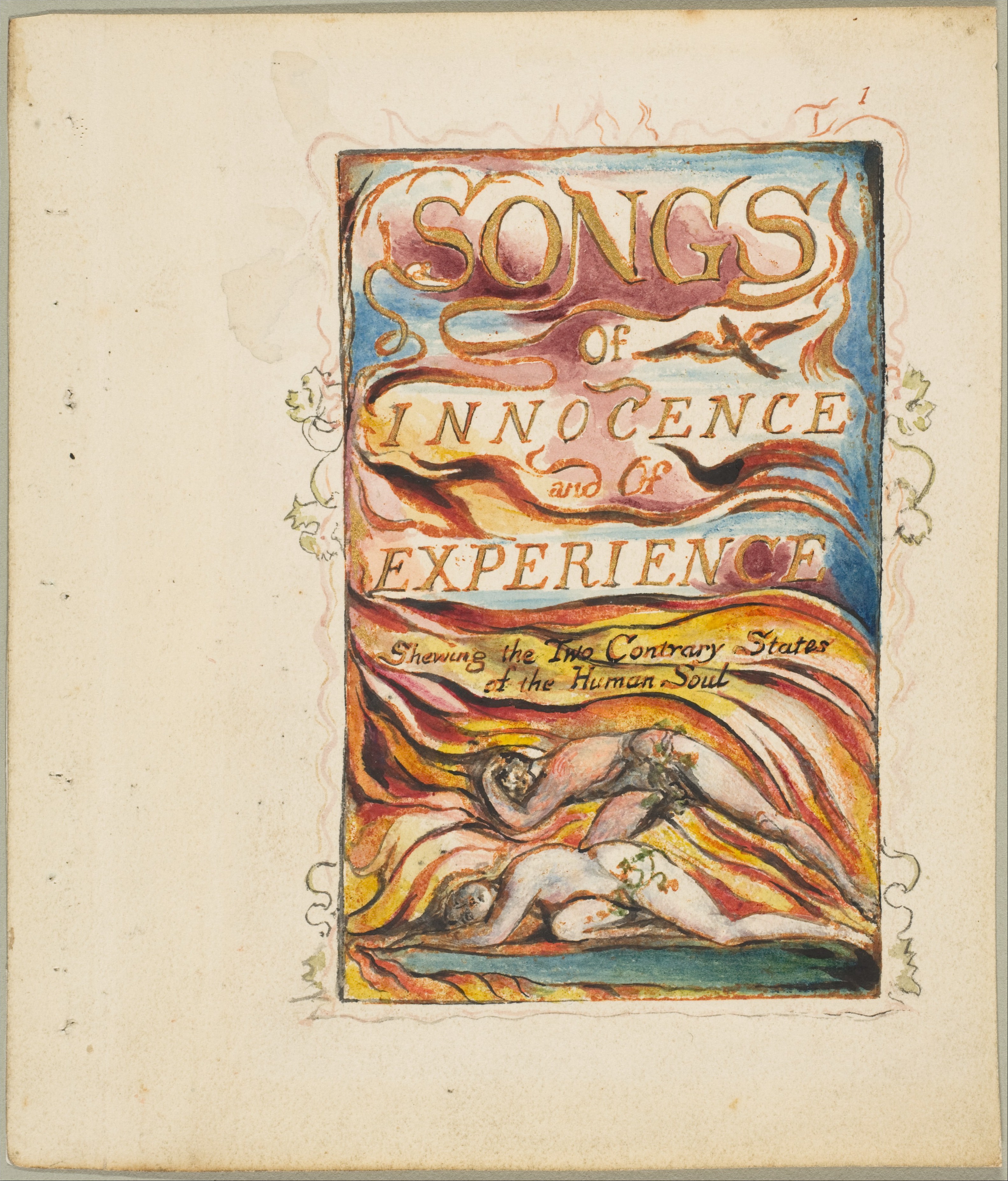
The combined title-page of William Blake’s *Songs of Innocence and of Experience*—though rooted in the late 18th century—carries an aesthetic and philosophical resonance that transcends its historical moment. For Katherine Fashion Lab, this artifact serves not as a literal reference, but as a strategic archetype for understanding the duality inherent in luxury adornment. The relief etching, printed in orange-brown ink and hand-finished with watercolor and shell gold, embodies a tension between the primal and the refined, the innocent and the experienced. This analysis positions the work within the framework of an “ancient civilization” not by chronology, but by its foundational status as a visual and spiritual document—an origin point for the visual language of contraries that defines human expression.
Symbolic Power: The Dialectic of Light and Shadow
The title-page’s central figures—a mother and child beneath a vine, contrasted with a mourning figure beneath a barren tree—are not mere illustrations but symbolic coordinates. They map the human condition onto a binary axis: nurture versus loss, growth versus decay. For a heritage curator, this is a masterclass in dualistic branding. Katherine Fashion Lab can adopt this symbolic structure to articulate its own collections as dialogues rather than monologues. Each garment, accessory, or textile pattern should be conceived as a contrary state—one that holds both innocence (purity of form, unadorned silhouette) and experience (ornamentation, layered complexity, patina). The shell gold applied to the etching is not decorative excess; it is a marker of transcendence, catching light to signify moments of spiritual clarity. In luxury strategy, this translates to selective use of precious materials—not as abundance, but as punctuation within a visual sentence.
Historical Adornment: The Body as a Manuscript
Blake’s relief etching process—wherein the text and image are cut into a single copper plate—parallels the ancient practice of body adornment as inscription. In civilizations from Mesopotamia to the Nile Valley, jewelry and textile patterns were not applied to the body; they were written onto it, encoding status, lineage, and spiritual protection. The orange-brown ink evokes the earthy pigments of ochre and terracotta used in funerary adornments, while the hand-coloring recalls the individualized nature of artisanal craft. For Katherine Fashion Lab, this historical context demands a departure from mass-produced homogeneity. The 2026 high-end consumer does not seek a product; they seek a manuscript of selfhood. Each piece must be conceived as a unique imprint—hand-finished, with visible evidence of the maker’s hand. The shell gold, in this context, becomes the equivalent of a cartouche: a personalized seal that elevates the wearer from the anonymous to the ancestral.
Spiritual Meaning: Adornment as Contemplative Practice
Blake’s subtitle—“Shewing the Two Contrary States of the Human Soul”—is a theological proposition. It suggests that spiritual maturity is not the suppression of opposites but their simultaneous holding. This is profoundly relevant to the philosophy of adornment. In many ancient traditions, jewelry was worn not only for beauty but as a mnemonic device for spiritual truths. Amulets, seals, and pectorals reminded the wearer of cosmic order and personal duty. Katherine Fashion Lab can translate this into a 2026 strategy by creating collections that are contemplative in structure—each garment or accessory paired with a conceptual “contrary.” For example, a stark, unadorned silk column dress (innocence) might be offered with a detachable, hand-embroidered collar of thorns and gold (experience). The wearer is invited to choose, combine, or alternate—thereby enacting Blake’s dialectic on their own body. This is not mere aesthetics; it is a ritual of self-authorship, aligning the brand with a deeper, quasi-liturgical consumer experience.
Materiality and Craft: The Economics of the Hand
The medium—relief etching with watercolor and shell gold—demands a reconsideration of material value in luxury markets. Blake produced each copy of his *Songs* individually, hand-coloring every print. No two are identical. This is the antithesis of the industrial luxury model, which relies on repetition for brand recognition. For Katherine Fashion Lab, the 2026 strategy must pivot toward a limited-edition ontology. The orange-brown ink serves as a metaphor for raw materiality—earth pigments, natural dyes, unbleached fibers—that ground the collection in tactile authenticity. The watercolor layers represent translucency and variability, qualities achieved through hand-dyeing or garment washing. The shell gold, applied in minute, deliberate strokes, signifies the ultimate luxury gesture: not the gold itself, but the time and intention required to place it. In a market saturated with logo-driven excess, this approach repositions Katherine Fashion Lab as a curatorial house, where each piece is a numbered artifact rather than a seasonal commodity.
2026 High-End Luxury Strategy: The Contrarian Brand
To operationalize this heritage analysis, Katherine Fashion Lab must adopt a contrarian positioning in the 2026 luxury landscape. While competitors accelerate toward AI-driven personalization and virtual try-ons, this brand will champion slowness and irreversibility. The Blakean contraries offer a strategic template:
Innocence in branding = minimalism, negative space, and the “first glance” aesthetic. This is the clean, architectural silhouette that draws the eye without shouting.
Experience in branding = narrative complexity, historical referencing, and the “second glance” discovery. This is the hidden lining, the irregular stitch, the asymmetrical hem that reveals itself only upon closer inspection.
The combined title-page teaches that these states are not sequential but simultaneous. Therefore, Katherine Fashion Lab’s 2026 collections should be launched as paired presentations—two shows, two lookbooks, two retail experiences—that mirror each other in structure but invert their emotional tones. One might be titled “Innocence” (ivory, unbleached linen, fluid shapes) and the other “Experience” (deep indigo, structured leather, oxidized metal). The consumer is positioned not as a passive buyer but as an interpreter who must reconcile the two. This creates a deeper brand loyalty than trend adoption, as it engages the client’s intellectual and spiritual faculties.
Conclusion: The Soul as a Luxury Asset
The heritage of *Songs of Innocence and of Experience* is not in its provenance but in its philosophical utility. For Katherine Fashion Lab, the combined title-page is a strategic artifact that legitimizes a return to meaningful contrariety in luxury. In 2026, the high-end consumer will not be satisfied with beauty alone; they will seek resonance—objects that speak to their internal contradictions. By adopting Blake’s dialectical structure, his reverence for handcraft, and his symbolic use of light and shadow, Katherine Fashion Lab can position itself as a house that dresses not merely the body, but the soul in its two contrary states. The shell gold is not a trend; it is a testament. And in a world of mass-produced similitude, that testament is the ultimate luxury.