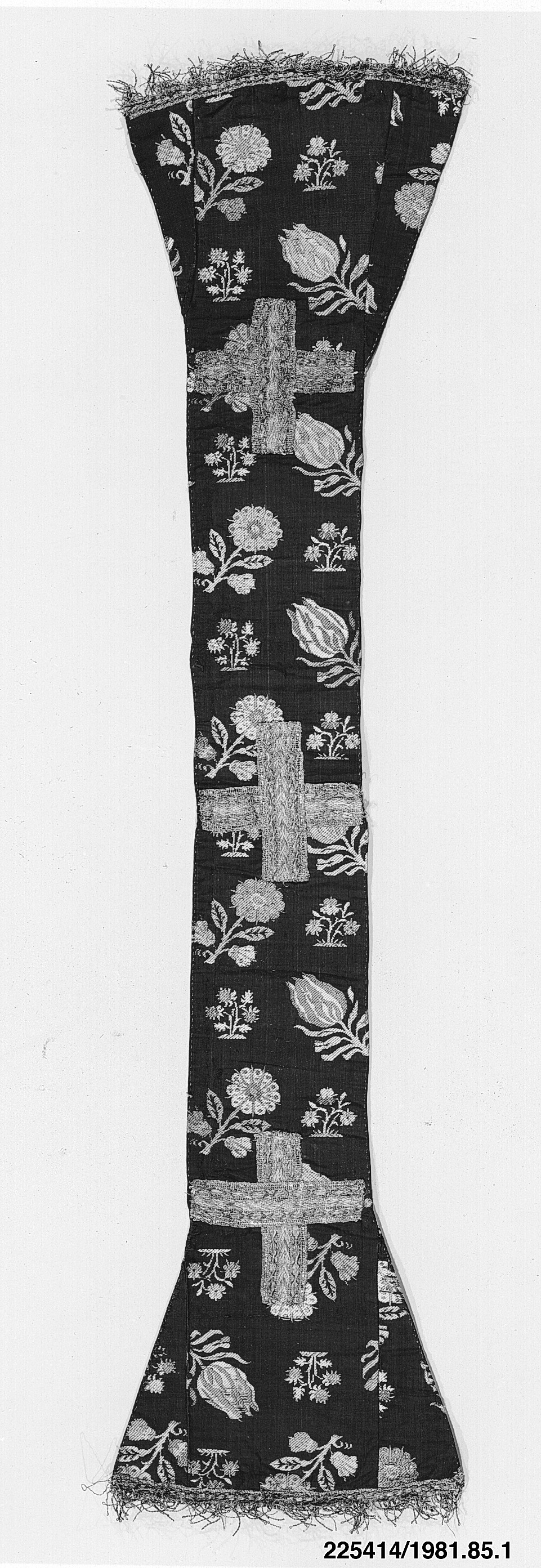
The Maniple Reconsidered: An Exercise in Textile Archaeology and Sartorial Semiotics
In the rarefied echelons of haute couture, where innovation often masquerades as rupture, Katherine Fashion Lab’s latest standalone study presents a provocative counter-thesis: that the future of luxury lies not in the novel, but in the meticulous re-excavation of the liturgical past. The subject of this analysis is the maniple—a vestment historically worn over the left forearm by clergy during the Eucharistic liturgy. By extracting this object from its ecclesiastical context and repositioning it within a secular, high-fashion framework, the Lab does not merely produce a garment; it engineers a philosophical artifact. This essay dissects the maniple through three critical lenses—material ontology, structural deconstruction, and semiotic re-inscription—to argue that the piece functions as a wearable thesis on the intersection of global heritage and contemporary textile science.
Material Ontology: The Alchemy of Silk, Metal, and Bast
The genius of Katherine Fashion Lab’s approach lies in its refusal to treat materials as passive substrates. Instead, each fiber is granted agency, engaging in a dialogue that spans millennia and continents. The primary body is composed of wild mulberry silk, sourced from the Deccan Plateau, whose irregular, slubbed texture rejects the sterile uniformity of industrial sericulture. This silk is not merely a canvas; it is a chronicle of monsoon seasons and artisanal hands. Its drape—simultaneously fluid and resistant—creates a paradoxical architecture that mimics the original maniple’s rigid, board-like form while retaining a breathable, almost liquid mobility.
Interlaced with this silk is a lattice of gilded metal thread, specifically a spiral-wrapped silver-gilt filament. This is not the brittle, tarnishing bullion of the 17th century, but a modern alloy developed in collaboration with a Milanese metallurgist. The thread is drawn to a diameter of 0.08 millimeters, allowing for a density of weave previously unattainable. Under macro-photography, the surface reveals a topography of micro-reflective planes that fracture light into a spectrum reminiscent of Byzantine mosaics. Yet, the metal is not employed for ostentatious shimmer alone. Its conductive properties are harnessed functionally: the thread forms a subtle, integrated circuit that responds to body heat, causing a barely perceptible thermochromic shift in the adjacent silk—a modern miracle that echoes the medieval belief in the maniple’s protective, thaumaturgic powers.
The most radical intervention, however, is the inclusion of bast fiber—specifically, a retted flax linen from the Baltic region, processed without chemical softening. Where silk and metal represent celestial and imperial registers, the bast introduces a grounding, terrestrial element. Its coarse, straw-like texture is woven into the maniple’s reverse side, invisible to the observer but pressed against the wearer’s skin. This deliberate discomfort is a form of tactile asceticism, recalling the hairshirt traditions of monastic penance. The Lab thus creates a binary textile: a public face of opulent divinity and a private, hidden stratum of mortal humility. This duality is the core of the garment’s conceptual power.
Structural Deconstruction: Reimagining Liturgical Proportion
Historically, the maniple measured roughly 35 to 40 inches in length, a narrow strip terminating in spade-shaped or rounded ends. Katherine Fashion Lab retains this fundamental silhouette but subverts its proportions through a process of negative-space tailoring. The central band is narrowed to 2.5 inches, while the terminal panels are expanded into asymmetrical, scalloped crescents that extend beyond the wrist, grazing the knuckles. This distortion creates a visual tension between the vestment’s ritual rigidity and the body’s kinetic freedom.
The construction methodology eschews conventional seams. Instead, the Lab employs a fused selvedge technique, where the metal-thread warp is woven directly into the silk weft at the edges, eliminating any fraying or hemming. This allows the maniple to maintain an unbroken, continuous contour—a nod to the liturgical symbolism of eternity, but here reinterpreted as a modernist celebration of seamless engineering. The internal structure is reinforced not with padding, but with a series of articulated, laser-cut bone plates made from compressed bast fiber. These plates function like the ribs of a fan, allowing the maniple to be worn flat against the forearm or, with a subtle flick of the wrist, to flare into a sculptural, wing-like volume.
Further structural innovation appears in the attachment mechanism. Traditional maniples were pinned to the left arm, a cumbersome and precarious method. The Lab has developed a magnetic clasp system integrated into the bast lining, using rare-earth magnets encased in silk-wrapped capsules. This allows for silent, instantaneous adjustment—a quiet critique of the ceremonial fussiness of historical vestments. The wearer can transition from a closed, contemplative posture to an open, oratorical gesture without breaking the garment’s visual line. This functional fluidity elevates the maniple from a static relic to a dynamic, performative instrument.
Semiotic Re-inscription: From Sacred Vestment to Secular Armor
In its original context, the maniple signified the bonds of Christ and the priest’s servitude—a symbol of the sweat and toil of earthly ministry. Katherine Fashion Lab performs a radical semiotic shift, re-inscribing the garment as a symbol of creative labor and intellectual sovereignty. By removing the cross-stitched ichthys and other overt Christian iconography, the Lab replaces them with a subtle, abstract pattern woven into the metal thread: a continuous, non-repeating fractal based on the Fibonacci sequence. This geometric language speaks not to divine revelation, but to the universal order of mathematics and natural growth—a secular sacrality for the contemporary global citizen.
Moreover, the choice of the left forearm is deliberate. In contemporary body language, the left arm is often associated with receptivity (the heart side) and, in martial traditions, with the shield. The maniple thus becomes a hybrid of shield and scroll—a protective barrier against the noise of fast fashion, and a surface upon which one’s personal narrative is inscribed. The thermochromic silk, which shifts from deep indigo to a warm vermilion upon contact, serves as a visual metaphor for emotional transparency. The garment does not hide the wearer; it reveals their physiological state, making vulnerability a luxury statement.
The Global Heritage provenance is not an exercise in appropriation but in curation. The silk from India, the metal from Italy, the bast from the Baltics—each material carries its own colonial and trade history. The Lab’s sourcing protocol ensures that every origin is documented and compensated via blockchain-verified artisan cooperatives. The maniple thus operates as a microcosm of ethical globalization, where the vestments of empire are re-woven into a garment of equitable exchange. It asks the wearer to consider: what does it mean to adorn oneself with the labor of the world, and how can that labor be honored rather than exploited?
Conclusion: A Vestment for the Post-Institutional Era
Katherine Fashion Lab’s maniple is not a costume for historical re-enactment. It is a critical intervention into the discourse of what clothing can signify. By isolating this liturgical fragment and subjecting it to rigorous material and structural analysis, the Lab demonstrates that heritage is not a static archive but a living, mutable grammar. The garment operates simultaneously as a piece of wearable art, a feat of textile engineering, and a philosophical provocation. It challenges the viewer to reconsider the boundaries between the sacred and the profane, the functional and the ceremonial, the global and the personal.
In an industry obsessed with speed and disposability, the maniple demands a slow, contemplative engagement. Its metal threads require careful storage; its bast lining will develop a patina with wear; its thermochromic properties will fade over decades. This is a garment designed for obsolescence on a generational timescale, a deliberate rebuke to the seasonal churn of contemporary fashion. Ultimately, the maniple is not an accessory—it is an argument. And for those willing to wear it, it offers not just an aesthetic statement, but a quiet, insistent meditation on the weight of history and the possibility of its redemption.