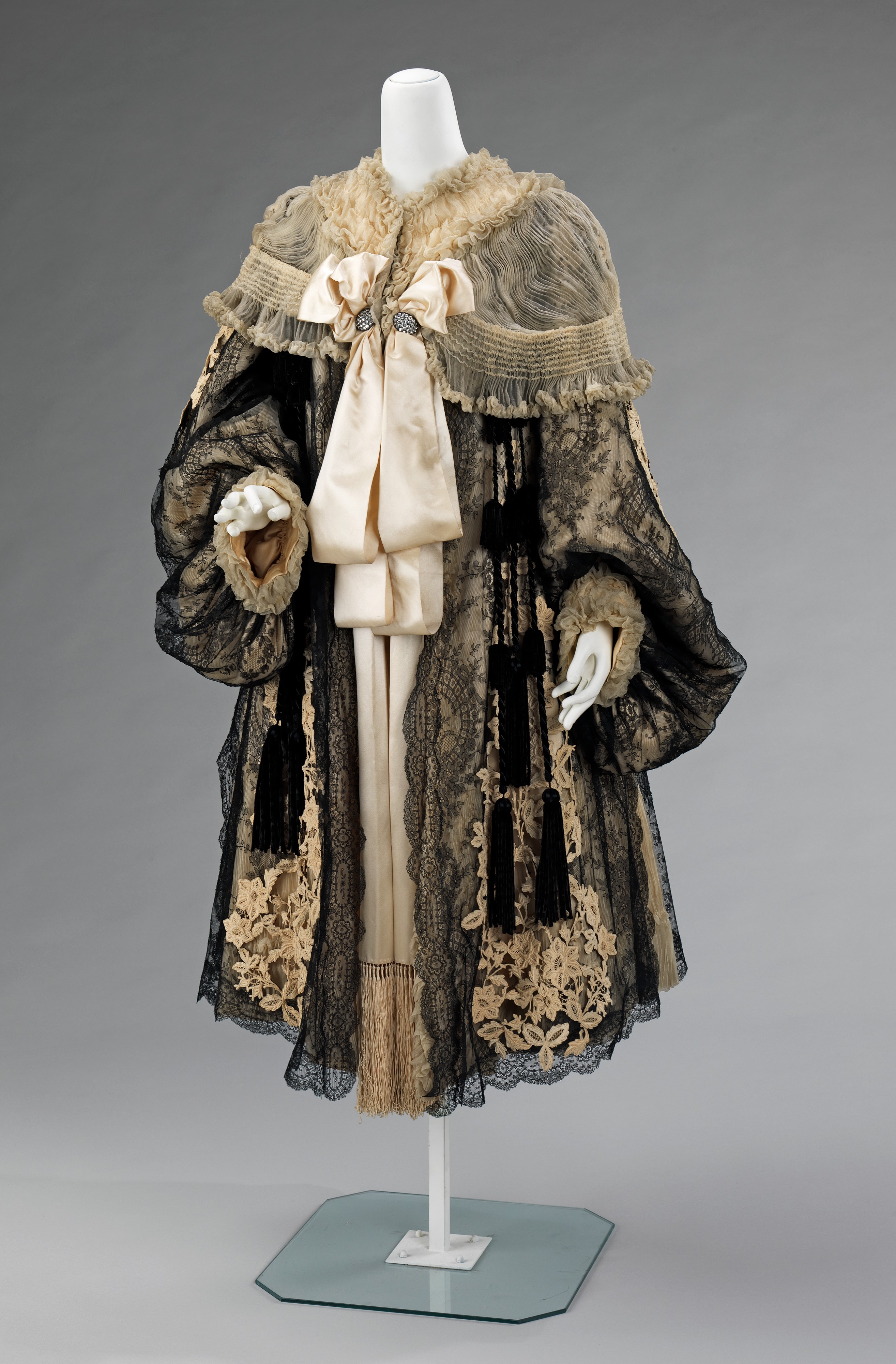
The Architectural Poetry of Night: A Couture Analysis of Katherine Fashion Lab’s French Evening Coat
In the rarefied echelons of haute couture, where garment construction transcends mere utility to become a form of sculptural expression, the evening coat occupies a singular throne. It is not a mere shield against the cold; it is a ceremonial mantle, a final, decisive statement before the wearer enters a room. Katherine Fashion Lab’s latest standalone study—a French-origin evening coat rendered in lustrous silk and punctuated by a constellation of rhinestones—offers a masterclass in this delicate balance between architectural rigor and ephemeral fantasy. This is not a garment that simply covers; it is a piece that envelops, defines, and ultimately liberates the silhouette through an intricate dialogue between material, structure, and light.
Deconstructing the French Atelier Lineage
To analyze this piece is to first acknowledge its geographical and philosophical provenance. The label “French origin” is not a mere logistical tag; it is a declaration of methodology. It evokes the ateliers of the Rue Cambon and the Avenue Montaigne, where première mains (first hands) and petites mains (finishing hands) operate in a silent, balletic hierarchy of precision. Katherine Fashion Lab has internalized this discipline, yet subverts its traditional austerity. The coat’s structure is a study in controlled volume—a departure from the fluid, body-skimming silhouettes popularized in contemporary ready-to-wear. Here, the shoulders are subtly extended, not in a padded, aggressive manner, but through a precise tailoring of the sleeve head that creates a clean, architectural line, reminiscent of a 1950s Cristóbal Balenciaga cocoon, yet rendered with the sharp, modern minimalism of a Japanese avant-garde patternmaker.
The collar, a crucial determinant of an evening coat’s character, is cut low and sharp in the front, creating a deep V that elongates the neck and draws the eye downward to the waist. This frontality is balanced by a dramatic, almost theatrical sweep at the back, where the fabric falls in a controlled, unbroken cascade. This is not a train in the traditional bridal sense, but rather a deliberate manipulation of negative space—the coat creates a moving shadow, a second silhouette that trails the wearer like a whispered secret. It is a garment designed for the flâneuse of the modern metropolis, one who understands that arrival is a performance.
The Alchemy of Silk and Rhinestone
The choice of materials in this standalone study is where Katherine Fashion Lab elevates the piece from exceptional tailoring to pure couture poetry. The primary fabric is a silk duchesse, a heavyweight, lustrous satin weave that possesses a remarkable structural memory. Unlike lighter silks that drape and cling, duchesse holds its shape with a firm, almost metallic rigidity. This is critical to the coat’s architectural integrity. The fabric does not yield to the body; it commands space around it. The sheen of the duchesse is not a flat, mirror-like gloss; rather, it is a subtle, liquid shimmer that shifts with every micro-movement, casting soft, pearlescent shadows across the folds. In low light, the coat appears as a block of solid, liquid ivory; under direct illumination, it reveals a depth that is almost aqueous.
Upon this pristine canvas, the rhinestones are not applied as mere ornamentation. In lesser hands, such embellishment would devolve into gaudy glitter. Here, they are treated as structural punctuation marks. The stones are not scattered randomly; they are meticulously placed along the sharp lapel edges, tracing the precise line of the collar and then converging into a tight, almost calligraphic cluster at the left shoulder. This asymmetrical placement is a deliberate counterpoint to the coat’s symmetrical base, introducing a visual tension that prevents the piece from becoming static. The rhinestones themselves are of the highest quality—likely a lead-crystal variant—cut with such precision that they refract light not as a single, blinding flash, but as a constellation of discrete, prismatic sparks. They are not meant to be seen all at once; they are meant to be discovered, catching the eye from across a room, then winking out of existence as the wearer turns, only to reappear in a different configuration.
Ergonomics of Grandeur: The Wearer’s Dialogue
A critical component of this analysis is understanding the garment’s relationship with the body, particularly in a standalone context—meaning it is designed to be worn over a relatively simple base, such as a slip dress or a tailored jumpsuit, allowing the coat to function as the definitive top layer. The internal construction is a marvel of invisible engineering. The silk duchesse is backed by a layer of fine, silk organza in the bodice, providing support without adding visible bulk. The seams are meticulously pressed, not flat, but with a “roll” that creates a soft, rounded edge, preventing the coat from looking like a piece of cardboard cut-out. The sleeves are cut with a two-piece construction, allowing for a natural forward movement of the arm, ensuring that the wearer can gesture, hold a glass, or dance without the coat pulling or straining across the back.
The weight of the coat is substantial, yet it is distributed with masterful precision. The wearer feels a sense of grounded gravitas, a physical reminder of the garment’s presence. This is not a piece for the faint of heart or the minimalist. It demands a certain posture—a straight spine, a relaxed shoulder, a deliberate pace. In return, it offers an unparalleled aura of authority and mystery. The deep V-neckline invites a statement necklace or a simple, bare collarbone, while the high, structured back offers a canvas for the play of light. It is a garment that creates its own microclimate, both physically and psychologically.
Conclusion: A Standalone Masterpiece for the Contemporary Collector
In the context of Katherine Fashion Lab’s broader oeuvre, this evening coat is not merely an item of clothing; it is a collectible artifact, a testament to the enduring power of haute couture in an age of fast fashion. It represents a synthesis of French atelier tradition and a bold, contemporary vision of femininity—one that is not passive, but assertive. The silk speaks of luxury and fluidity; the rhinestones speak of light and celebration; the architecture speaks of strength and control.
As a standalone study, it forces the viewer to contemplate the coat as an autonomous object of beauty, divorced from the context of a full collection. It asks a simple yet profound question: Can a single garment possess enough internal logic, enough narrative depth, to stand alone as a work of art? The answer, emphatically, is yes. This evening coat is a masterwork of restraint and excess, a silent symphony of fabric and light. It is not designed to make a woman look beautiful; it is designed to make her feel formidable. And in that quiet, powerful confidence, Katherine Fashion Lab has achieved the ultimate goal of couture—not to dress a body, but to empower a presence.