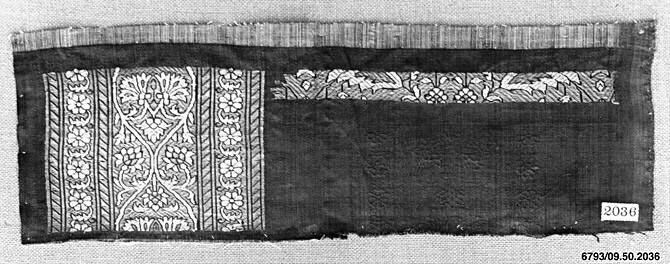
The Sovereign Thread: A Couture Analysis of a Global Heritage Kincob Fragment
Within the hallowed archives of Katherine Fashion Lab, a single textile fragment often speaks louder than a complete garment. It is within these severed swathes of fabric that the purest dialogue between technique, culture, and power resides. Our current subject—a standalone study piece of kincob, or kamkhwab, originating from the vast tapestry of Global Heritage—is precisely such an artifact. Composed of a lustrous silk satin ground, brocaded with precious metal-wrapped threads, this fragment is not merely a decorative remnant; it is a codified document of imperial aesthetics, a testament to the zenith of hand-loom virtuosity, and a profound challenge to contemporary couture’s understanding of materiality and value.
Deconstructing the Loom: Materiality and Structural Genius
To analyze this fragment is to first dissect its anatomical composition. The base cloth is a satin weave, a structure defined by long, floating yarns that produce a surface of unparalleled smoothness and high light reflectance. In this instance, the silk used is of a filament grade that exhibits a liquid, almost mercury-like sheen. This foundation was not chosen for economy but for its optical properties; the satin acts as a dark, reflective pool against which the ornamental wefts can perform.
The true tour de force lies in the brocaded elements, executed in the kincob tradition. Here, the supplementary weft is not a simple dyed fiber but a composite thread—a core of silk filament tightly wrapped in a ribbon of beaten metal. The analysis of this metal wrap reveals a sophisticated metallurgy: a high-karat gold or silver-gilt membrane, cut to micron-level fineness, spiraling around the silk core. This is not a metallic paint or a foil stamp; it is a structural integration of metal into the fabric’s very architecture. The result is a textile that possesses a unique kinetic quality—as the viewer moves, the light catches the metal-wrapped threads, causing the motifs to shimmer with an internal luminosity that shifts between molten gold and burnished silver. This is the signature of kincob, a fabric historically reserved for the courts of Mughal India and Safavid Persia, where it was known as the "dream of the loom."
The Grammar of Ornament: Reading the Motifs
Beyond the technical, the fragment’s iconography is a lexicon of cross-cultural sovereignty. The surviving pattern, though partial, allows for a reconstruction of its intended visual program. We observe the remnants of a buta motif—the paisley-esque droplet that originated in Persia and was absorbed into the Indian subcontinent’s decorative canon. Yet, here it is not rendered in a flat silhouette. The brocading technique allows for internal detailing: tiny, unbroken spirals and seed-pod shapes are delineated by the metal thread, suggesting the influence of European botanical engravings that flowed into the subcontinent via trade routes.
Interspersed with the buta are vertical stripes of contrasting scale—a hallmark of the jamewar (woven) aesthetic. These stripes are not static; they are composed of minute, repeating floral sprigs known as toda, which create a rhythm of verticality that elongates the visual field. The juxtaposition of the larger, curvilinear buta against the rigid, disciplined stripe is a masterclass in compositional tension. It speaks to a design philosophy that prized the balance between the organic and the geometric, the chaotic and the ordered. This is not mere decoration; it is a visual articulation of the imperial cosmos, where the natural world is subjugated to the order of the court.
Contextualizing the Fragment: Global Heritage and the Silk Road Economy
The provenance of this piece as "Global Heritage" is not a vague attribution but a precise geographic and economic reality. This fragment is a product of the vast early-modern globalized economy. The raw silk likely originated in China or Bengal; the gold thread may have been drawn from the bullion of the New World, transshipped through Europe; and the weaving expertise was a synthesis of Persian technique transplanted to Indian courts such as Lahore, Ahmedabad, or Varanasi. To hold this fragment is to hold a physical nexus of global trade routes that predate the modern concept of globalization.
In its original context as a length of fabric, this kincob would have been tailored into a peshwaz (an outer garment) or a courtly sari for a noblewoman, or perhaps used as a hanging (qanati) within a royal tent. Its presence in a "standalone study" context, divorced from a garment, is significant. It allows the analyst to focus purely on the weave structure without the distraction of silhouette or tailoring. We are forced to confront the fabric as a primary text, reading its density, its drape, and its stiffness. The metal weft inherently adds weight and a certain brittleness, creating a fabric that is more architectural than fluid—it is designed to hold its shape, to project power, rather than to follow the body’s natural contour.
Implications for Contemporary Couture: A Dialogue with the Past
For the modern designer at Katherine Fashion Lab, this fragment is not a nostalgic relic but a provocative brief. The first lesson is in the ethics and aesthetics of slowness. The kincob process is painstakingly slow; a single inch can take hours to weave. This challenges the contemporary fashion cycle’s obsession with speed. To incorporate this heritage technique is to make a political statement against disposability, aligning couture with the principles of haute joaillerie rather than ready-to-wear.
Second, the fragment teaches a lesson in tactile luxury versus visual luxury. In an age of digital rendering and synthetic imitations, this textile offers a purely haptic experience. The raised, metal-wrapped threads create a topographical surface that is cool to the touch, yet the silk base is warm. This thermal duality, combined with the audible whisper of the metal threads as the fabric moves, constitutes a multi-sensory experience that cannot be replicated. A contemporary couture application might not use this exact fragment, but it would seek to recreate this sensory dissonance—perhaps by juxtaposing this historic weave with a hyper-modern, laser-cut vegan leather, or by using the kincob’s structural rigidity to create a sculptural, origami-like collar that stands away from the neck, turning the wearer into a living monument.
Technical Preservation and Innovation
Finally, the study of this fragment informs our approach to restorative couture. The integrity of the metal thread is fragile; oxidation is the enemy. In a contemporary commission, a designer might collaborate with a master weaver in Varanasi to recreate this pattern using a modernized core—perhaps a stainless-steel micro-filament wrapped in silk to prevent tarnishing, thereby honoring the original technique while ensuring the garment’s longevity for the next century. This is not dilution; it is evolution. The fragment serves as the genetic code, and the modern loom is the surrogate, allowing a heritage art form to survive within the unforgiving economics of the 21st century.
In conclusion, this textile fragment is a masterclass in material intelligence. It demonstrates that true luxury is not found in a logo or a silhouette, but in the invisible labor, the cross-continental supply chains, and the mathematical precision of the weave. It stands as a testament to the fact that the most profound innovations in couture often lie not in the future, but in a deep, scholarly, and reverent re-reading of our global past. The fragment is not an ending; it is a starting point for a new vocabulary of dress—one that values the hand of the artisan as highly as the name of the designer.