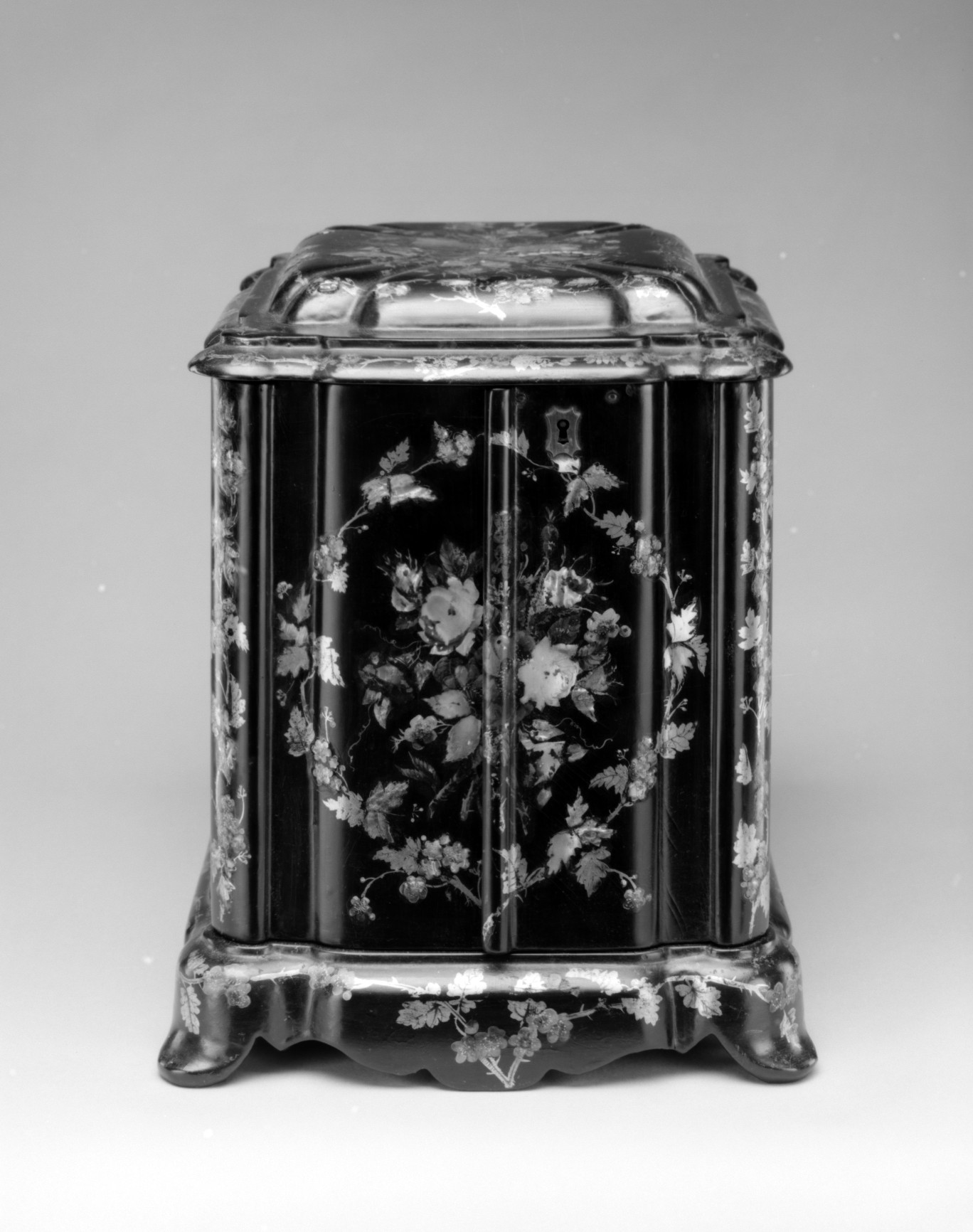
Objecthood and Ornament: A Curatorial Analysis of the Lacquered Work and Jewelry Cabinet
The small work and jewelry cabinet under consideration occupies a distinctive position within the decorative arts canon: it is an object of private utility that aspires to the condition of sculpture. Executed in black lacquer with gilded and painted decoration, its structure is augmented by papier-mâché elements, mother-of-pearl inlay, silk velvet, and paper linings. Its provenance is deliberately global—drawing upon lacquer traditions, export aesthetics, and the Victorian culture of collecting—yet it remains a standalone study, an autonomous artifact whose significance resides in its material intelligence and its capacity to organize intimacy.
This analysis examines the cabinet as a convergence of technique, trade, and gender-coded ritual. It argues that the object’s hybrid materiality—combining durable lacquer with fragile papier-mâché and soft textile linings—produces a dialectic of permanence and transience that mirrors the very function it serves: the safekeeping of precious, often sentimental, possessions.
Materiality as Cultural Memory
The primary surface is black lacquer, a material with deep roots in East Asian craft traditions, particularly Chinese and Japanese urushi and export lacquerware. By the nineteenth century, European and American workshops had adapted these techniques, producing “japanned” furniture that referenced Asian precedent while catering to Western domestic tastes. The cabinet’s black lacquered ground is not merely a chromatic choice; it is a statement of depth. Black lacquer absorbs light, creating a void against which gilded and painted motifs—likely landscapes, floral sprays, or chinoiserie figures—perform with heightened theatricality.
Gilding and painted decoration introduce a second layer of meaning. Gold, traditionally associated with the sacred and the regal, here serves a secular yet equally potent purpose: it transforms a utilitarian container into an object of display. The painted scenes, whether executed in polychrome or monochrome, narrate cultural fantasies—of distant lands, of pastoral leisure, of botanical curiosity. These are not neutral ornaments; they are ideological statements about refinement, travel, and the possession of world knowledge.
The inclusion of papier-mâché is particularly telling. This material, composed of paper pulp mixed with glue and molded under pressure, became a signature medium of nineteenth-century European decorative arts, especially in England and France. It was lightweight, inexpensive to produce, and capable of taking intricate molded relief. Its presence alongside lacquer and gilding reveals a hierarchy of materials that is also a hierarchy of labor: the cabinet brings together the exoticized prestige of lacquer, the artisanal ingenuity of papier-mâché, and the luxury of gilding. The object thus embodies a global supply chain of techniques, not merely of goods.
Mother-of-Pearl and the Aesthetics of Luminosity
Mother-of-pearl inlay—often associated with Ottoman, Persian, and East Asian traditions—introduces a third material register. Unlike gilding, which reflects light in a uniform, metallic manner, mother-of-pearl diffracts it, producing iridescent shifts of color depending on the angle of view. This quality makes the cabinet interactive: it changes as the viewer moves, as the light changes, as the cabinet is opened or closed.
In the context of a jewelry cabinet, mother-of-pearl is semantically resonant. It evokes the interior of shells, the origin of pearls, and by extension the organic origins of adornment. The cabinet thus frames its contents not as mere commodities but as natural wonders. The inlay may appear on the exterior as decorative panels or on the interior as drawer fronts and escutcheons. Wherever it appears, it disrupts the dominance of black and gold with a cooler, more elusive palette—silver, pink, pale blue—that suggests the hidden life of the object.
Interior Architectures: Silk Velvet and Paper Linings
The interior of the cabinet is its most intimate dimension. Here, silk velvet and paper linings create a sensory environment designed for protection and tactility. Silk velvet, with its dense pile and soft hand, cushions jewelry, prevents abrasion, and absorbs sound. Opening a drawer lined with velvet is a quiet, muffled experience—a deliberate contrast to the hard, reflective exterior. This material choice signals that the cabinet is not a display case for public exhibition but a private repository for objects worn close to the body.
Paper linings, often marbled, block-printed, or hand-painted, serve a dual function: they protect the wooden or papier-mâché substructure and they provide a final layer of decoration. In many historic cabinets, the paper lining is the most personal element—sometimes bearing the maker’s mark, a date, or a decorative pattern that echoes the exterior. Paper is fragile, susceptible to foxing and tearing, yet its survival in a well-used cabinet testifies to care. The lining is the object’s unconscious, holding traces of every hand that has opened a drawer.
Form, Function, and the Ritual of Adornment
The cabinet’s form—likely a fall-front or a table-top chest with multiple small drawers—reflects its function as a work and jewelry cabinet. “Work” in the nineteenth-century sense referred to needlework, lacemaking, and other domestic handicrafts. A cabinet that accommodates both jewelry and work implements is therefore a cabinet of female accomplishment. It organizes the tools of adornment and the tools of production in a single, beautifully crafted container.
This dual purpose challenges any simple reading of the object as merely decorative. It is a technology of time management and self-presentation. The drawers, compartments, and secret niches impose order on the chaos of small possessions. The lock and key—often gilded and ornamental—assert privacy. In a household where servants, children, or visitors might intrude, the locked cabinet is a zone of autonomy.
Global Heritage, Local Meaning
The cabinet’s “global heritage” is not a vague claim but a precise description of its material biography. Black lacquer from Asia, papier-mâché from Europe, mother-of-pearl from the Indian Ocean or the Persian Gulf, silk velvet from China or Italy, paper from European mills—these materials traveled along trade routes that connected continents. The cabinet is a node in that network, a small-scale monument to early globalization.
Yet its meaning is also local. As a standalone study, it invites us to consider how such an object functioned in a specific room—a dressing room, a boudoir, a study. It was not mass-produced furniture but a considered acquisition, perhaps commissioned or bought as a souvenir of a Grand Tour or a world’s fair. Its owner likely valued it not only for its utility but for its capacity to signal cosmopolitan taste.
Conclusion: The Cabinet as Argument
In sum, the small work and jewelry cabinet is an argument in material form. It argues that utility and beauty are not opposites. It argues that global trade can produce intimate, personal objects. It argues that the organization of small things—jewels, needles, letters, keepsakes—is a serious cultural practice. Through its black lacquer, gilding, papier-mâché, mother-of-pearl, silk velvet, and paper linings, it performs a complex negotiation between surface and depth, exterior and interior, public display and private ritual.
For the contemporary viewer, the cabinet remains a provocation. It asks us to look closely, to open drawers with care, to imagine the hands that once did the same. In an age of digital storage and disposable containers, it stands as a reminder that how we keep our treasures—and what we choose to keep—reveals who we are.