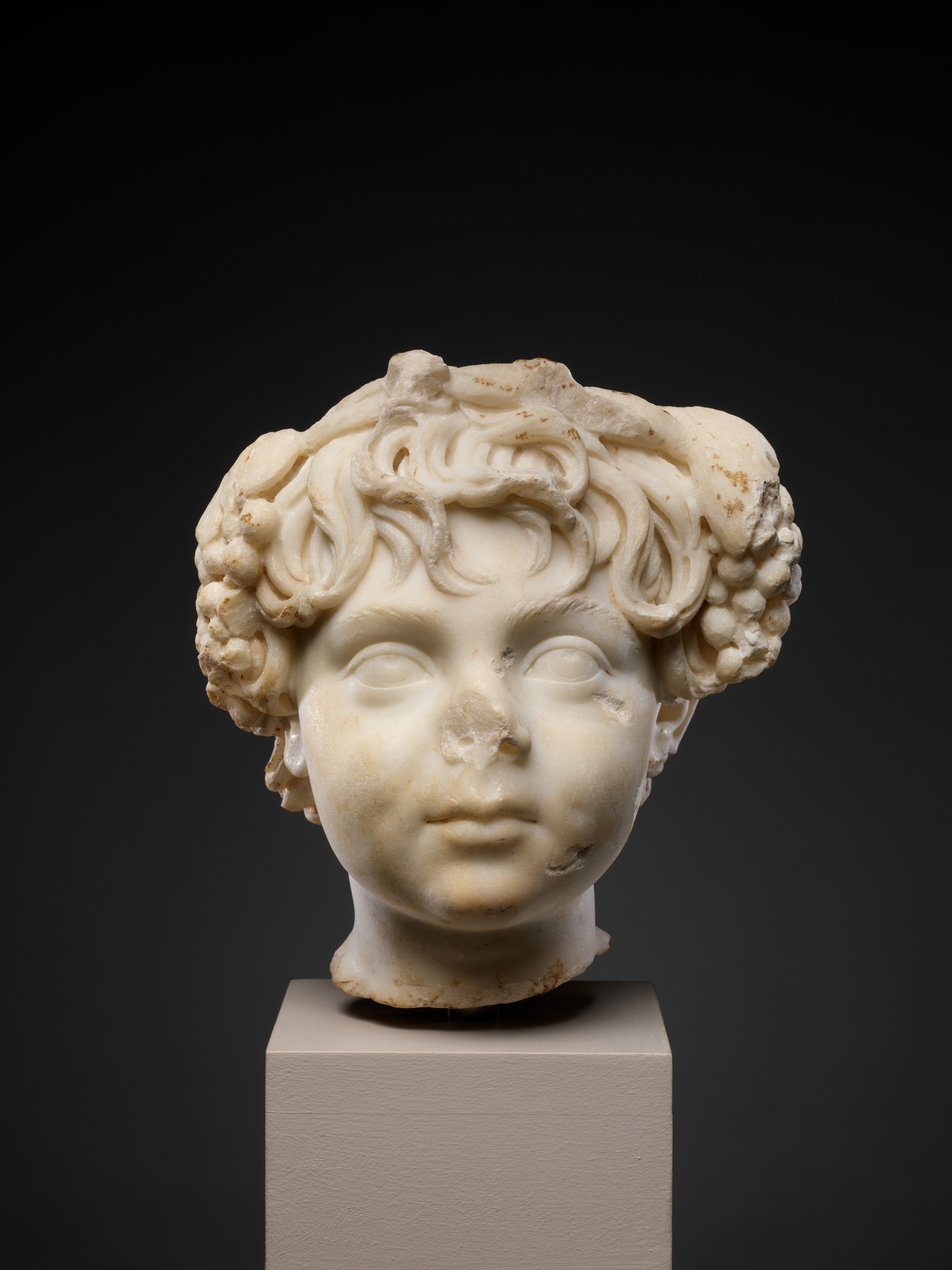
Object Overview: Roman Marble Head of a Boy Wearing a Wreath
The marble head of a boy wearing a wreath is a quintessential example of Roman portraiture’s dual capacity for naturalistic observation and symbolic encoding. Likely dating from the 1st century BCE to the 2nd century CE, this fragment—separated from its original body—retains a wreath encircling the brow. The medium is fine-grained marble, probably imported from Carrara or Greek quarries such as Pentelic or Parian, signaling both material prestige and the sculptor’s access to high-value trade networks. As a standalone research subject, the piece offers a concentrated lens into Roman attitudes toward youth, ritual adornment, and the commodification of virtue through visual culture.
Symbolic Power of the Wreath in Roman Adornment
In Roman visual language, the wreath (corona) was never a neutral accessory. It functioned as a compressed signifier of status, achievement, and divine favor. Different wreath types carried distinct meanings: the corona triumphalis (laurel) denoted military victory; the corona civica (oak) honored a citizen who saved another’s life; the corona obsidionalis (grass) recognized a commander who lifted a siege. For a boy, however, the wreath most likely referenced one of three contexts: religious service, funerary commemoration, or aristocratic initiation into public life.
Religious and Ritual Contexts
Boys served as camilli and camillae in Roman state religion—attendants to priests and priestesses during sacrifices. These youths wore wreaths made of laurel, olive, or wheat, symbolizing purity, fertility, and the favor of specific deities. A marble head of a wreath-wearing boy may have been a votive offering in a sanctuary, a dedication to a god such as Apollo or Dionysus, or part of a larger statuary group in a temple precinct. The wreath thus marked the child as a liminal figure: biologically immature but ritually potent, standing between the human and the divine.
Funerary and Memorial Meaning
Roman funerary art frequently depicts children with wreaths to signal premature death and posthumous apotheosis. The wreath here becomes an instrument of consolation—a visual promise that the deceased has been received among the blessed dead or even the gods. The marble’s permanence contrasts with the fragility of young life, making the material itself a metaphor for memory and enduring grief. In this reading, the head is not merely a portrait but a spiritual technology, designed to mediate between the living and the dead.
Historical Adornment and the Materiality of Marble
Marble was the preferred medium for Roman elite portraiture because it could be polished to a lifelike sheen while withstanding the elements. The wreath, often carved in high relief or added in separate pieces (e.g., gilded bronze leaves), would have originally shimmered with color and metal. Modern viewers see a monochrome head; the ancient viewer saw a polychrome object with inlaid eyes, painted skin tones, and gilded foliage. This gap between original and current appearance is critical for heritage analysis: the symbolic power of the wreath was amplified by its material contrast—white marble skin against gold or green leaves, a visual hierarchy that reinforced the boy’s elevated status.
The head’s fragmentary state also invites reflection on how Roman sculpture was reused, recycled, or displayed in later periods. Many such heads were embedded in Renaissance collections, Baroque fountains, or 18th-century Grand Tour cabinets, accruing new meanings with each installation. For Katherine Fashion Lab, this layered provenance is not a defect but a strategic asset—a narrative of continuity, curation, and cultural capital.
Spiritual Meaning and the Roman Concept of Genius
Romans believed that every person possessed a genius (for men) or juno (for women)—a protective spirit that guided one’s life and was honored on birthdays. A boy wearing a wreath may have been depicted in connection with his genius, especially if the object served as a domestic shrine piece (lararium). The wreath would then function as an offering to the genius, a visual prayer for the child’s safe passage into adulthood. This spiritual dimension elevates the head from a mere portrait to a devotional object, one that collapses the boundary between the secular and the sacred.
Moreover, the wreath’s circular form—without beginning or end—symbolized eternity, cyclical renewal, and the soul’s return. In a Roman context, this could refer to the annual cycle of agricultural festivals (e.g., Ambarvalia) or to the philosophical concept of metempsychosis. For a luxury brand in 2026, this symbolic density offers a template for storytelling that transcends seasonality and trend cycles.
2026 High-End Luxury Strategy: From Artifact to Aspiration
The marble head of a wreath-wearing boy is not a passive historical relic; it is a strategic asset for high-end luxury positioning. Three strategic imperatives emerge for Katherine Fashion Lab.
1. Symbolic Minimalism and Adornment as Power
The wreath is a masterclass in minimal adornment: a single, circular element that transforms the face’s meaning. For 2026 luxury consumers—who increasingly reject logo-heavy maximalism—this object validates a design philosophy of “one powerful symbol.” Katherine Fashion Lab can develop capsule collections where a single wreath motif (in gold, olive branch, or laurel) appears on jewelry, leather goods, or couture embroidery, each piece accompanied by a provenance card explaining the Roman corona system. The strategy is not to copy the wreath but to revive its logic: adornment as a compressed language of achievement, purity, and spiritual protection.
2. Material Honesty and Polychrome Revival
The head’s original polychromy challenges the modern myth of white marble purity. For 2026, luxury is moving toward material transparency and historical accuracy. Katherine Fashion Lab can pioneer a “polychrome revival” narrative—using gemstone inlays, enamel, and hand-painted leathers to recreate the lost color of Roman sculpture. A limited-edition handbag with a marble-print leather body and gilded bronze wreath hardware would not be a pastiche but a research-driven interpretation. The story: “We restored what time erased.”
3. Spiritual Luxury and the Genius Economy
The Roman genius—a personal spirit of protection—maps onto the contemporary wellness and intention-setting market. Katherine Fashion Lab can position the wreath as a talisman for the wearer’s own genius: a symbol of self-actualization, protection, and cyclical renewal. A 2026 campaign could feature a modern “boy” or gender-neutral figure wearing a minimal gold wreath necklace, photographed against Carrara marble textures. The messaging: “Adorn your genius.” This aligns with luxury’s shift from status display to meaning-making, where consumers pay premiums for objects that carry spiritual or philosophical weight.
Conclusion: Heritage as Forward-Looking Strategy
The marble head of a boy wearing a wreath is a dense cultural artifact—simultaneously a portrait, a ritual object, a funerary memorial, and a statement of Roman material ambition. For Katherine Fashion Lab, its value lies not in nostalgia but in strategic translation. By decoding the wreath’s symbolic power, honoring the original polychromy, and reframing the Roman genius for a 2026 audience, the brand can move beyond heritage imitation into heritage innovation. The object teaches a timeless luxury lesson: the most powerful adornment is the one that carries meaning before it carries price. In a market saturated with noise, a single wreath—properly understood—can still command silence, attention, and desire.