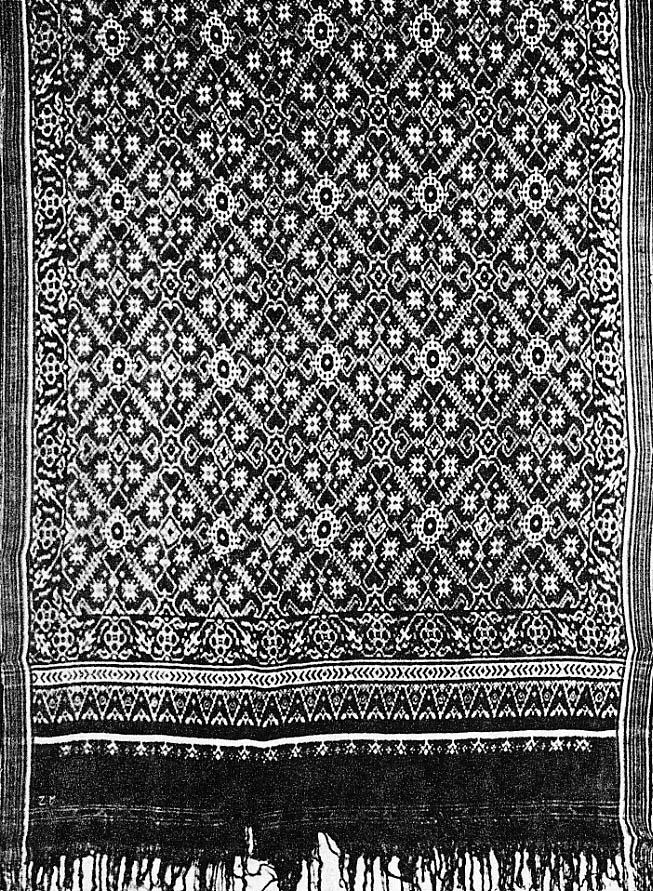
Patolu Sari: The Silk and Silver Masterpiece of Gujarat
The Patolu sari occupies a singular position within the global taxonomy of luxury textiles. Woven in the towns of Patan and Surat in Gujarat, India, this double-ikat silk textile represents the apogee of hand-loomed craftsmanship, distinguished by its luminous surfaces and the incorporation of silver and gold foil wrapped around silk filaments. For the connoisseur and the scholar of couture, the Patolu is not merely a garment; it is a material artefact that encodes centuries of trade, ritual, and technical virtuosity. This standalone study examines the Patolu sari through the lenses of materiality, technique, and cultural semiotics, positioning it as a precursor to modern couture's obsession with metallised textiles.
Historical Provenance and the Silk Route Nexus
The origins of the Patolu are inextricably linked to Gujarat's role as a maritime and commercial hub. By the fifteenth century, Patan had emerged as the epicentre of Patolu production, supplying textiles to the Mughal court, the Deccan sultanates, and eventually European markets via Portuguese and Dutch trading companies. The term "Patolu" itself derives from the Gujarati word pat, referring to the silk fabric, and the suffix olu, denoting the traditional weaving cluster. What distinguishes the Patolu from contemporaneous silk traditions—such as the Kanjivaram of South India or the Banarasi brocade—is its reliance on the double-ikat technique combined with metallic foil wrapping, a convergence that demanded extraordinary precision and capital.
Historical records from the seventeenth century indicate that a single Patolu sari could require six to nine months of labour by a team of weavers, dyers, and gold-thread specialists. The cloth was so valuable that it functioned as a store of wealth, often passed down through generations as heirloom property. In the context of Indian ritual, the Patolu was reserved for the most auspicious occasions: weddings, coronations, and temple consecrations. Its association with the goddess Lakshmi and with marital prosperity elevated it beyond fashion into the realm of the sacred.
Materiality: Silk Wrapped with Silver Foil
The material composition of the Patolu is central to its aesthetic and economic significance. The base fabric is woven from fine mulberry silk, typically degummed and dyed before weaving. However, the defining characteristic is the use of flattened silver foil—occasionally gold—wrapped around a silk or cotton core to create a metallic thread known as zari. In the Patolu tradition, this zari is not merely embroidered or supplementary; it is integrated into the warp and weft through the ikat process, meaning that the metallic elements are resist-dyed and woven into the very structure of the textile.
The silver foil used in Patolu production is typically 98% pure, hammered to a thickness of less than 0.1 millimetres, and then wound around a silk filament. This process, known as badla, requires the foil to be applied while the core thread is under tension, ensuring that the metallic layer does not crack during weaving. The resulting yarn is both conductive and reflective, giving the Patolu its characteristic shimmer—a quality that has been likened to liquid mercury. Unlike modern metallic yarns, which often rely on polyester films and aluminium coatings, the Patolu's silver foil is a noble metal, subject to oxidation and tarnishing, which means that historic Patolus acquire a patina that is valued as a sign of authenticity.
The density of the weave further contributes to the Patolu's hand. A typical Patolu sari weighs between 500 and 800 grams, with a thread count exceeding 100 ends per inch in the finest examples. This density allows the fabric to drape with a sculptural rigidity, holding pleats and folds in a manner that is impossible for lighter silks. In couture terms, the Patolu behaves more like a structured textile—comparable to a brocade or a duchesse satin—than a fluid one.
Technique: The Double-Ikat Discipline
The technical execution of the Patolu is as significant as its materials. Double ikat, known locally as patola weaving, involves the resist-dyeing of both warp and weft threads before they are woven together. This is a departure from single ikat, where only one set of threads is patterned. The precision required is extreme: the weaver must align the dyed sections of the warp and weft so that when they intersect, they form a coherent motif. Any misalignment results in a blurred or broken pattern, rendering the entire sari defective.
The motifs themselves are drawn from a repertoire that includes geometric lattices, floral repeats, elephants, parrots, and the ubiquitous kunbi or rupa patterns. These designs are not merely decorative; they are semiotic markers. For example, the popat (parrot) motif symbolises marital fidelity, while the kunbi (a stylised woman) represents fertility and domestic harmony. The Patolu weaver, therefore, is not an artisan but a semiotician, encoding cultural narratives into the molecular structure of the cloth.
Historically, the dyeing process employed natural colourants: madder root for red, indigo for blue, turmeric for yellow, and iron filings for black. The silver foil was left undyed, creating a contrast that was both visual and tactile. In contemporary production, synthetic dyes have largely replaced natural ones, but the finest ateliers—such as those in Patan's Salvi family—continue to use traditional methods, albeit with reduced output.
Couture Significance and Contemporary Relevance
For the modern couture analyst, the Patolu presents a paradox. On one hand, it is a pre-industrial artefact, produced under conditions that no luxury house could replicate at scale. On the other, its principles—material rarity, technical difficulty, and cultural embeddedness—are precisely those that define haute couture today. The Patolu anticipates the twentieth-century couture practice of incorporating metallic threads, as seen in the work of Mariano Fortuny and, later, in the metallic brocades of Christian Lacroix and Alexander McQueen.
Yet the Patolu resists assimilation into a Western couture framework. Its value is not determined by a designer's signature or a seasonal collection; it is determined by lineage, ritual use, and the integrity of its making. In an era of global fashion homogenisation, the Patolu sari stands as a reminder that true luxury is often local, slow, and deeply embedded in the social fabric. For Katherine Fashion Lab, the study of the Patolu is not an exercise in nostalgia but a call to re-examine the foundations of material excellence—where silver meets silk, and where technique becomes transcendence.