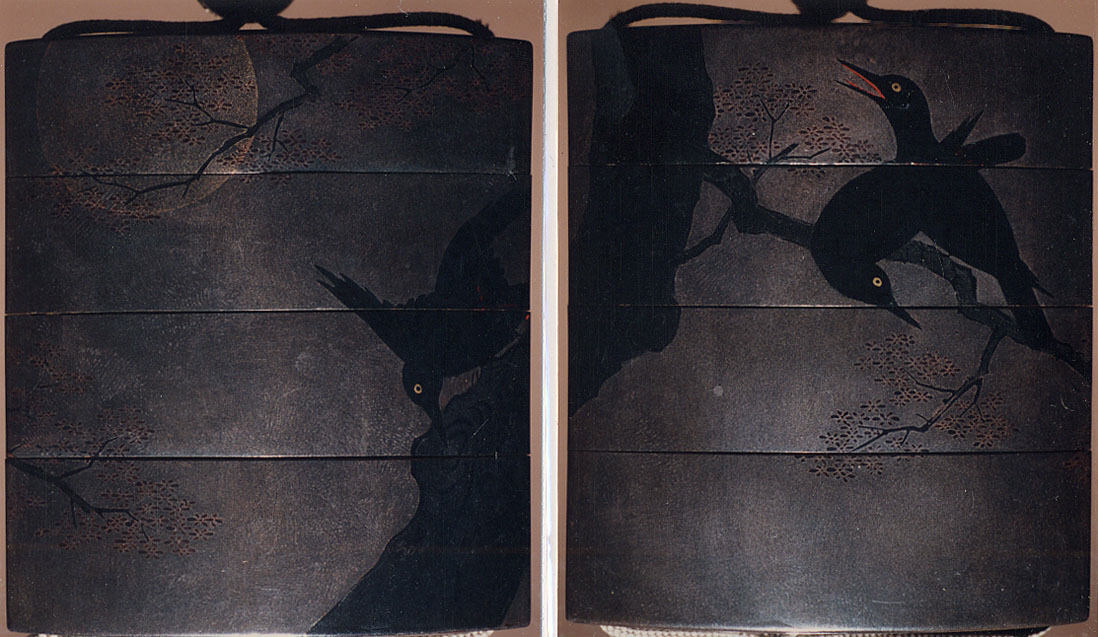
Heritage Asset Analysis: Inrō with Crows on Tree in Moonlight
Object Identification and Material Composition
The object under examination is a Japanese inrō—a segmented, portable case traditionally suspended from the obi sash of a kimono—executed in silver lacquer ground with black and red togidashi maki-e. The decorative program depicts crows perched upon a tree branch beneath a moonlit sky, a motif of considerable depth within Japanese visual culture. The ensemble is completed by a netsuke carved from ivory in the form of a demon's head and an ojime of silver bead with applied gold family crests (mon). Together, these three components constitute a functional and symbolic system: the inrō as container, the netsuke as counterweight and fastener, and the ojime as the sliding bead that tensions the cord. For Katherine Fashion Lab, this object represents a rare convergence of utility, artistry, and spiritual coding—an artifact whose strategic value extends far beyond its material worth.
The togidashi maki-e technique employed here is among the most technically demanding in the lacquerer's repertoire. Gold and silver powders are sprinkled into wet lacquer, then covered with additional lacquer layers and polished back to reveal the design flush with the surface. The result is a subtle, almost photographic depth—crows rendered in black lacquer against a shimmering silver ground, with red accents suggesting autumn foliage or the diffuse glow of moonlight. This is not decoration for its own sake; it is a discipline requiring years of apprenticeship, and it signals a patron of exceptional means and discernment.
Symbolic Power: Crows, Moonlight, and the Japanese Imaginary
In Japanese iconography, the crow (karasu) occupies a liminal position. Unlike the European association with death and ill omen, the Japanese crow is a messenger—sometimes of the gods, sometimes of the ancestors. The three-legged crow (Yatagarasu) is a divine guide in Shinto mythology, credited with leading Emperor Jimmu through the mountains of Kumano. Yet the crow is also a scavenger, a creature of dusk and decay. This duality is precisely what gives the motif its power: the crow mediates between the sacred and the profane, the living and the dead.
The moonlight setting amplifies this liminality. In Japanese aesthetics, moonlight (tsuki) is not merely illumination but a spiritual presence—cool, indirect, and revelatory. The crows on the tree, silhouetted against the silver ground, evoke the classic trope of tsuki ni karasu (crows in the moonlight), a subject painted by masters from the Muromachi period onward. The composition suggests a moment of quiet tension: the birds are still, watchful, as if listening to something beyond human perception. For a luxury brand, this is a narrative of quiet authority—the confidence to be still, to observe, to withhold.
Historical Adornment and the Samurai Aesthetic
The inrō emerged as a practical necessity in the Edo period (1603–1868), when kimono lacked pockets. Yet it quickly became a vehicle for conspicuous display. Samurai and wealthy merchants commissioned inrō from master lacquerers, often spending more on a single case than on a year's worth of clothing. The netsuke—here a demon's head in carved ivory—served as both functional counterweight and miniature sculpture, a conversation piece suspended at the wearer's hip. The ojime, with its applied gold family crests, personalizes the ensemble: it declares lineage, allegiance, and taste.
The demon's head (oni) is a deliberate paradox. Oni are fearsome, chaotic, and associated with disease and misfortune. Yet in Edo art, they are often rendered with humor or sympathy—a demon as netsuke is a talisman, a warding figure that absorbs negativity. This is apotropaic luxury: the wearer carries a monster at their side, not to frighten others but to demonstrate mastery over chaos. For a contemporary brand, this translates into a strategy of protective elegance—garments and accessories that feel both beautiful and quietly formidable.
Spiritual Meaning: Impermanence and the Polished Surface
Lacquer is a material of patience. Each layer must cure in humid darkness; each polishing reveals what was hidden. The togidashi technique is a meditation on impermanence—the design exists only because layers were applied and then removed. The silver ground is not paint but a metallic suspension, catching light differently depending on the angle of view. This is mono no aware in physical form: beauty that is inseparable from its own fragility.
The crows reinforce this theme. They are creatures of dusk, associated with the passage of time. The moon waxes and wanes. The tree, though rooted, sheds its leaves. The inrō itself, suspended from a cord, swings with the wearer's movement—a reminder that all things are in motion, that stability is an illusion. For Katherine Fashion Lab, this spiritual dimension offers a counter-narrative to the prevailing luxury codes of permanence and accumulation. The most valuable object is not the one that lasts forever, but the one that teaches us to see transience as beauty.
2026 Luxury Strategy: Heritage as Provocation
As we approach 2026, the high-end luxury market is bifurcating. On one side, heritage brands compete on nostalgia and logo recognition. On the other, a new consumer—wealthy, educated, spiritually curious—seeks objects with narrative density. The inrō with crows in moonlight is not a logo; it is a thesis. It rewards close looking. It demands knowledge. It refuses to be consumed quickly.
For Katherine Fashion Lab, this object suggests a three-part strategy. First, material integrity: invest in techniques that require time and skill, not just rare materials. Second, symbolic layering: design motifs that operate on multiple levels—historical, spiritual, personal—so that each wearer discovers their own meaning. Third, strategic scarcity: not artificial limited editions, but objects that are genuinely difficult to produce, and therefore genuinely rare.
The demon's head netsuke offers a final lesson. Luxury in 2026 will not be about projecting perfection. It will be about projecting mastery over imperfection—the confidence to carry a demon at your side, to let the silver ground catch the light unevenly, to accept that the moon will set. This is the heritage of the inrō: not a relic to be preserved, but a provocation to be lived.