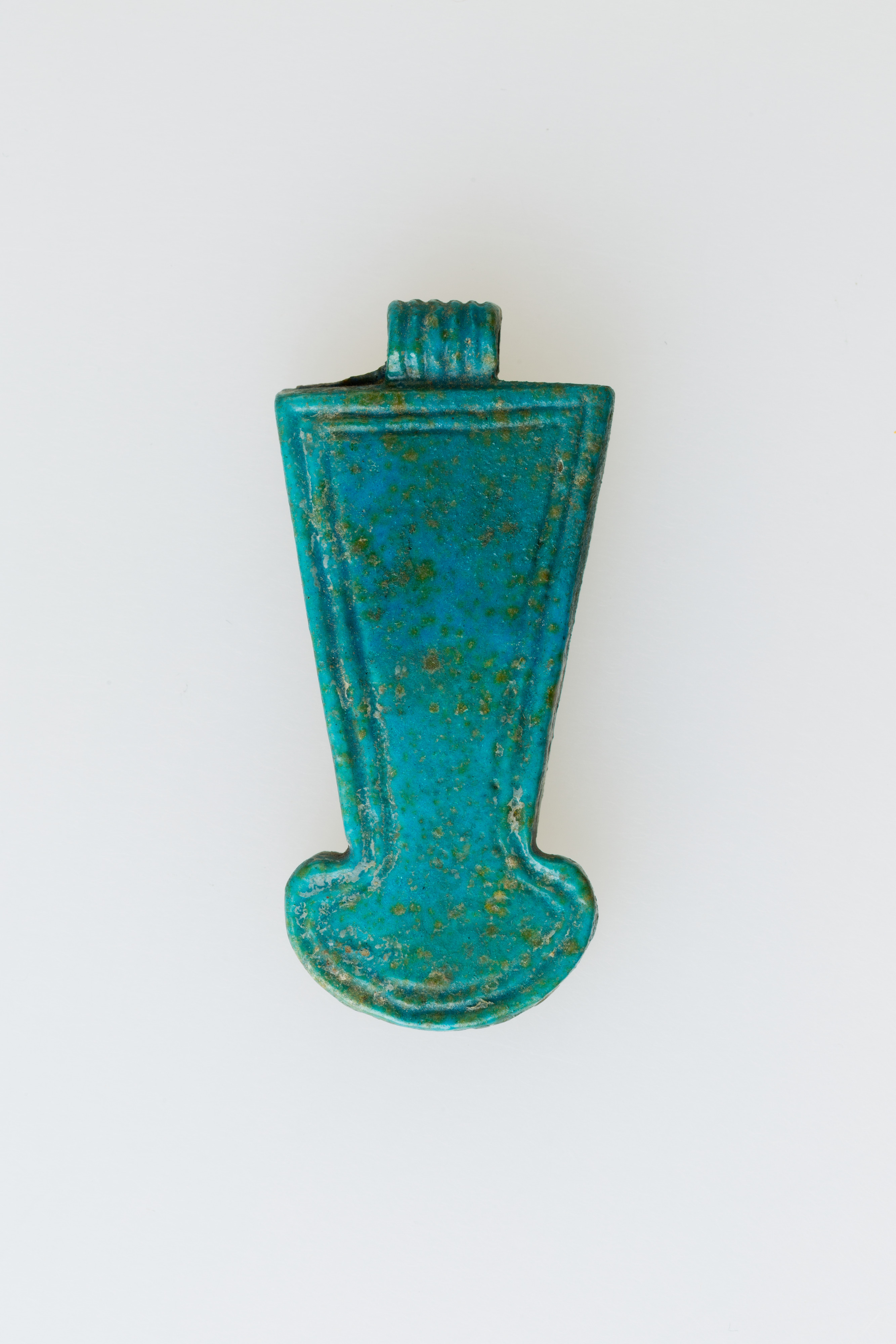
Heritage Asset Analysis: The Menit Amulet in Blue Faience
Executive Summary
This paper examines the Menit amulet—a ceremonial artifact of ancient Egyptian civilization rendered in blue faience—as a heritage asset with substantial strategic value for Katherine Fashion Lab's 2026 luxury positioning. The Menit functions simultaneously as jewelry, ritual instrument, and talisman, making it an unusually rich source of symbolic capital. For a maison seeking to differentiate within an increasingly saturated heritage-luxury market, the Menit offers a defensible narrative architecture: one grounded in authenticity, spiritual gravity, and material prestige rather than surface-level ornamentation.
Historical Context and Material Significance
The Menit originated as a ceremonial necklace associated with Hathor, goddess of love, music, fertility, and joy. Structurally, it consisted of a heavy crescent-shaped counterpoise suspended from a strand of beads, often held in the hand and shaken during ritual processions. Priests and priestesses wielded the Menit as an instrument of sound and blessing; it was believed to channel divine presence through both its physical form and the acoustics of its movement.
The choice of blue faience—a quartz-based ceramic with a vitreous, copper-tinted glaze—was not incidental. In ancient Egyptian cosmology, this material carried associations with regeneration, luminosity, and the eternal. Its blue-green tonality evoked the Nile's fertile waters, the turquoise of the sky, and the concept of heh, or endlessness. Faience was, in effect, the period's most sophisticated engineered material—technically demanding to produce, visually arresting, and symbolically charged. It represented the intersection of craft mastery and metaphysical intent, a duality that maps directly onto contemporary luxury's own value proposition.
Symbolic Power and Spiritual Function
The Menit's symbolic register operates across three interdependent layers. First, as a ritual instrument, it mediated between the human and the divine; its rattle-like counterpoise produced sound that sanctified space and invoked Hathor's protection. Second, as a talisman, it promised fertility, vitality, and rebirth—concerns central to Egyptian spiritual life and, notably, to modern consumer aspirations around renewal and wellbeing. Third, as adornment, it signaled status and sacerdotal authority, worn close to the body as an extension of identity.
This tripartite function—instrument, amulet, ornament—distinguishes the Menit from purely decorative heritage motifs. It carries what brand strategists might term "narrative density": a single object that can anchor multiple storytelling vectors without dilution. The amulet's association with Hathor further extends its cultural equity into domains of love, music, and feminine power, all of which align with luxury's core emotional territories.
Adornment Logic and Craft Implications
From a design perspective, the Menit's formal qualities are exceptionally adaptable. The counterpoise's crescent geometry offers a distinctive silhouette with strong recognition potential—an important criterion for building an iconic product line. The bead strand permits modular variation in length, material, and proportion, enabling a coherent collection architecture. Blue faience's glazed surface, meanwhile, presents an opportunity for material innovation: contemporary interpretations could explore ceramic composites, enameled precious metals, or glass-paste techniques that honor the original medium while meeting modern durability and wearability standards.
Crucially, the Menit's tactile dimension—the weight of the counterpoise, the movement of the beads, the sound produced—introduces a sensory narrative that most jewelry categories lack. In a luxury landscape where experiential differentiation drives premium pricing, this multisensory heritage offers a genuine competitive advantage.
Strategic Relevance for 2026 Luxury Positioning
Entering 2026, the high-end market is characterized by three dominant forces: the demand for provenance, the search for spiritual and emotional meaning, and the rejection of generic luxury codes. The Menit addresses all three. Its documented ancient origin provides verifiable provenance; its amuletic function speaks to a growing consumer interest in talismanic and intention-driven objects; and its relative unfamiliarity in mainstream luxury—compared with, say, the scarab or the ankh—offers white space for category ownership.
Katherine Fashion Lab should therefore position the Menit not as a reproduced artifact but as a living talisman: a contemporary object of protection, vitality, and creative power, rooted in an authentic ancient lineage. Marketing narratives can foreground the Hathor connection to music and feminine sovereignty, the regenerative symbolism of blue faience, and the ritual act of wearing and sounding the piece. Limited editions, artisanal collaborations, and experiential retail activations—where clients encounter the amulet's tactile and acoustic qualities—would reinforce exclusivity and deepen engagement.
Conclusion
The Menit amulet in blue faience represents a strategically potent heritage asset: materially sophisticated, symbolically layered, and spiritually resonant. For Katherine Fashion Lab, it offers a rare opportunity to build a signature collection that is at once historically legitimate and emotionally compelling. In a 2026 luxury environment that rewards depth over decoration, the Menit is not merely a motif to be referenced—it is a narrative to be inhabited, and a talisman whose time has, once again, come.