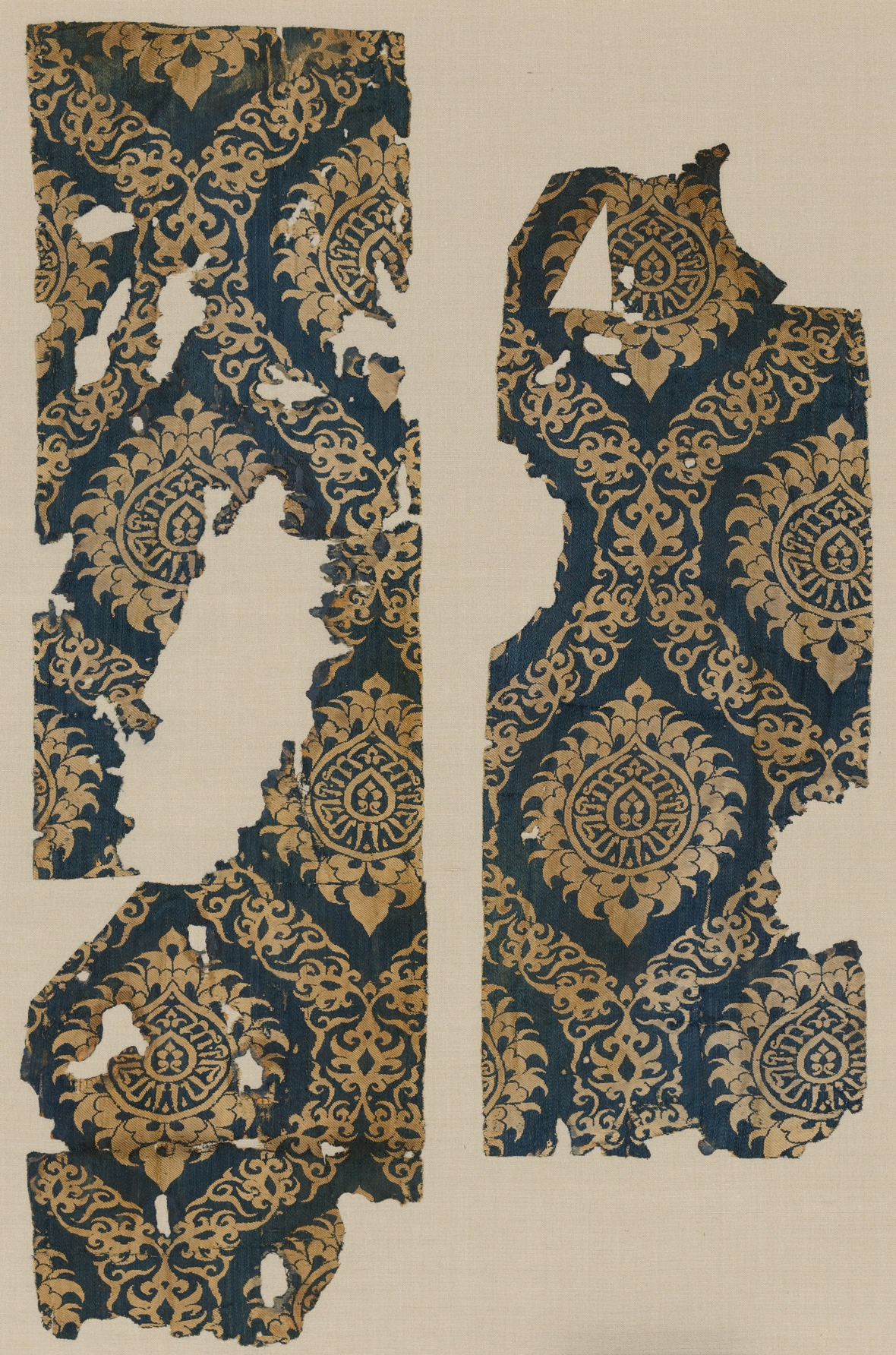
Textile Fragment with Ogival Pattern: A Material Reading of Silk Lampas in Global Heritage
The object under examination in this standalone study is a textile fragment bearing an ogival pattern, executed in silk using the lampas weave structure. Its designation as part of a broader Global Heritage context signals that the piece resists easy attribution to a single atelier, dynasty, or national tradition. Instead, it functions as a material witness to the movement of motifs, techniques, and markets across geographies. For the curator and the collector alike, such fragments are not merely decorative survivals; they are compressed archives of trade, patronage, and technical knowledge transfer. This analysis examines the fragment through four lenses: its structural logic as lampas, the iconographic significance of the ogival field, the economics of silk production that made such objects possible, and the methodological challenges of interpreting a decontextualised textile within a global heritage framework.
Structural Logic: Silk Lampas as a Technology of Control
Lampas is a compound weave in which a ground cloth and a pattern system are interwoven, typically with two or more sets of warp and weft. The structure allows for the creation of large, continuous figural or geometric patterns that are bound into the fabric rather than embroidered or printed onto it. In the case of this fragment, the silk lampas supports an ogival lattice—a repeating framework of pointed arches or almond-shaped medallions that organise the field into a rhythmic grid.
The technical demands of lampas are considerable. The weaver must control pattern warps and ground warps simultaneously, often using a drawloom or a similar mechanism that permits individual warp selection. The resulting textile is dense, lustrous, and dimensionally stable, with a reversible or near-reversible quality that distinguishes it from simpler weaves. The ogival pattern itself requires precise registration across the repeat, so that the points of the arches align vertically and horizontally. Any irregularity in tension or weft insertion would disrupt the visual rhythm—a fault line that would have been immediately legible to a trained eye in the period of production.
Silk amplifies these structural properties. Its long, continuous filaments produce a fabric with high tensile strength and a distinctive sheen that shifts with the angle of light. In lampas, silk's reflectivity can be manipulated through the choice of binding systems, creating areas of matte and gloss that articulate the ogival forms. The fragment's survival, even in partial form, is therefore a testament not only to the durability of silk but to the technical competence of its maker.
Iconography of the Ogival Pattern: From Cosmology to Commerce
The ogival pattern is a recurring motif in textile history, appearing across a wide arc from the eastern Mediterranean to Central Asia, China, and later Europe. Its basic unit—the pointed arch or ogee—can be read as a structural solution to the problem of covering a flat surface with a repeating, interlocking design. But it is also a symbolic form. In many traditions, the ogive has been associated with the vault of heaven, the gateway to the sacred, or the enclosure of a garden.
In this fragment, the ogival pattern likely served as a framing device for secondary motifs, though the fragmentary state makes it difficult to determine what those motifs may have been. What remains is the lattice itself: a geometry of containment and connection. The ogive's pointed apex and curved sides create a sense of upward movement, while the interstices between the arches form a secondary pattern of inverted forms. This figure-ground ambiguity is characteristic of sophisticated textile design, where the eye is invited to move between the positive and negative spaces.
The global heritage context suggests that this particular iteration of the ogival pattern may reflect a confluence of influences. Similar lampas fragments have been attributed to workshops in Iran, Central Asia, and China, with motifs travelling along the Silk Roads and later through maritime trade networks. The ogival pattern's adaptability—its capacity to absorb local variations in proportion, colour, and secondary ornament—made it a useful vehicle for cross-cultural exchange. It could be read as Islamic, Buddhist, or secular depending on the surrounding visual language, and it is precisely this polyvalence that makes it a compelling subject for global heritage studies.
Silk Economies and the Politics of Production
Silk lampas was not a vernacular textile. Its production required access to raw silk, specialised looms, and a labour force trained in complex weaving. In many historical contexts, silk was a state-controlled commodity, and lampas production was often centred in royal or imperial workshops. The fragment's existence therefore implies a network of sericulture, trade, and patronage that extended far beyond the immediate site of weaving.
From an economic perspective, the value of such a textile lay not only in its material but in its labour content. A single lampas panel could take weeks or months to complete, depending on the complexity of the pattern and the fineness of the silk. The ogival pattern, with its repeating units, would have required careful planning and a high degree of coordination between the designer and the weaver. In some traditions, pattern drafts were transmitted as codified instructions, while in others they were embedded in the weaver's embodied knowledge.
The fragment's status as a standalone study also raises questions about provenance and market value. Decontextualised textiles are often the most difficult to attribute, yet they are also the most mobile. They can enter collections through gift, purchase, or excavation, and their meanings shift accordingly. For the contemporary curator, the challenge is to resist the impulse to over-interpret and instead to read the fragment on its own terms—as a material object with a specific technical and aesthetic logic.
Methodological Reflections: Reading Fragments in Global Heritage
Studying a textile fragment requires a methodology that is both technical and interpretive. Technical analysis—fibre identification, weave structure, dye analysis—provides the empirical basis for understanding how the object was made. Interpretive analysis—iconographic comparison, contextual research, and theoretical framing—situates the object within broader narratives of trade, religion, and power.
In the case of this ogival silk lampas, the two approaches converge on a central insight: the fragment is not a passive survivor but an active mediator. It mediates between the loom and the eye, between the local and the global, between the sacred and the commercial. Its ogival pattern is both a formal device and a cultural sign, capable of carrying multiple meanings depending on the viewer's position.
For Katherine Fashion Lab, this analysis underscores the importance of treating textile fragments as primary sources rather than as decorative supplements. They are evidence of technical ingenuity, aesthetic choice, and economic exchange. They also remind us that global heritage is not a fixed canon but a dynamic field of objects, interpretations, and values. The ogival pattern, in this reading, becomes a figure for that dynamism: a shape that holds things together while remaining open to change.