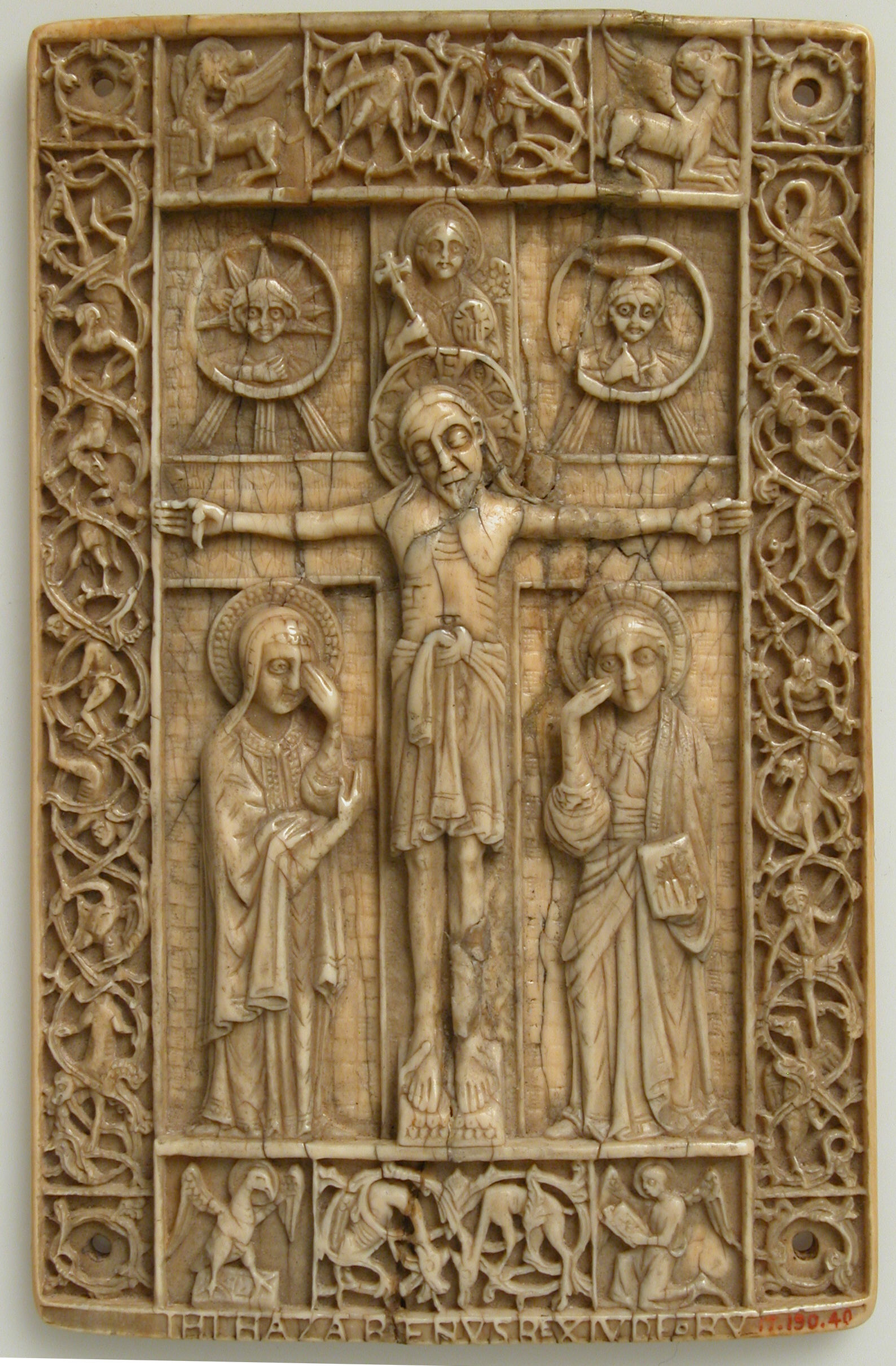
Heritage Asset Analysis: The Medieval Ivory Panel with Crucifixion
Object Overview and Material Provenance
The artifact under review is a carved elephant ivory panel depicting the Crucifixion, executed in the European medieval tradition—most likely within the High Gothic or late Romanesque idiom of the 12th to 14th centuries. At a period when ivory was among the most costly and logistically complex materials available to European workshops, its selection for a devotional object signaled both theological seriousness and unmistakable economic privilege. Elephant ivory reached medieval Europe through long-distance trade routes connecting the Mediterranean, North Africa, and, in later centuries, the Indian Ocean networks controlled by Islamic merchants and Portuguese navigators. The material's dense, fine grain permitted the sort of miniature relief carving that stone or wood could not sustain, enabling artisans to render the anatomy of Christ, the mourning figures of the Virgin and St. John, and the architectural framing of the cross with a precision that reads as both documentary and transcendent.
For Katherine Fashion Lab, the panel's materiality is not incidental. Ivory occupies a singular position in the history of luxury: it is organic, scarce, geographically contested, and ethically fraught in the contemporary context. Any 2026 strategy referencing this object must therefore engage with the material's dual identity—as a historical marker of devotional and artisanal excellence, and as a substance whose modern trade is regulated under CITES. The panel's value to the Lab lies not in replication but in translation: the transfer of its symbolic grammar into legally and ethically defensible luxury expressions.
Symbolic Power and Iconographic Structure
The Crucifixion is the central image of Christian soteriology, and its translation into ivory miniature compresses an entire theological architecture into a portable, tactile surface. Medieval devotional panels of this type were frequently designed for private contemplation—objects small enough to be held, kissed, or carried during travel. The physical intimacy of the encounter between viewer and object was itself a spiritual technology: the hand that touched the ivory touched the Passion.
Symbolically, the panel operates on several registers. The cross functions as an axis mundi, linking earthly suffering to cosmic redemption. The flanking figures—typically Mary and John—embody the Church's dual response of grief and witness. The architectural canopy or arcade frequently framing such scenes evokes the Heavenly Jerusalem, collapsing temporal and eschatological space. In ivory, these symbols acquire an additional layer: the material's warm, pale translucency has historically been associated with flesh, purity, and the Incarnation itself. The use of elephant ivory for a Crucifixion is thus not merely decorative but typological—the hardness of the material mirroring the hardness of the Passion, its organic origin mirroring the mystery of embodied divinity.
Historical Adornment and Courtly Circulation
Ivory panels of this caliber were not mass-produced commodities. They were commissioned by or for ecclesiastical elites, royal courts, and high-ranking merchant families. Surviving examples in cathedral treasuries and princely cabinets demonstrate that such objects circulated as diplomatic gifts, dowry items, and heirlooms—adornment in the fullest sense, where the object adorned not only a chapel or chamber but the social identity of its owner. The panel's small scale made it adaptable: it could be set into a book cover, a diptych hinge, or a reliquary frame, extending its ritual life across multiple contexts.
This portability is strategically significant for Katherine Fashion Lab. The medieval ivory panel is a historical precedent for the luxury object that travels—that accrues meaning through movement, touch, and recontextualization. It anticipates the modern collector's relationship to the wearable or carryable artwork.
Spiritual Meaning and the Aesthetics of Devotion
The panel's spiritual force derives from its economy of means. Medieval ivory carvers worked with knives, chisels, and abrasives on a material that punishes error; there is no room for revision. The resulting compression—figures reduced to essential gesture, drapery to rhythmic fold—produces an aesthetic of concentrated devotion. Every millimeter of surface is theological argument. For the contemporary viewer, this intensity offers a corrective to the diffuse visual culture of the present: it demonstrates that spiritual meaning can be carried by material precision rather than by scale or spectacle.
This principle aligns with the broader medieval understanding of adornment as an act of reverence. To adorn a sacred object was to honor it; to wear or display such an object was to participate in its sanctity. The panel thus models a theory of luxury in which value is generated by devotion, craft, and scarcity rather than by logo or trend cycle.
Strategic Implications for 2026 High-End Luxury
Three strategic vectors emerge from this heritage analysis for Katherine Fashion Lab's 2026 positioning.
First, material translation. Given CITES restrictions and shifting consumer ethics, the Lab should treat the ivory panel as a template for material substitution rather than replication. Bone, tagua, vegetable ivory, and bio-fabricated alternatives can carry the same symbolic weight if the carving discipline and iconographic rigor are preserved. The narrative becomes one of responsible custodianship: honoring the medieval tradition without perpetuating its ecological cost.
Second, symbolic compression. The panel's power lies in small-scale density. For 2026, the Lab can develop micro-carved or micro-embossed accessories—pendants, cufflinks, compact cases—that function as private devotional or contemplative objects for a secular luxury clientele. The value proposition is intimacy and permanence against a backdrop of disposable fashion.
Third, provenance storytelling. Luxury consumers in 2026 increasingly demand verifiable heritage narratives. The Lab should position any Crucifixion-derived collection within a documented chain of influence: from medieval ivory workshops, through cathedral treasuries and courtly cabinets, to contemporary atelier practice. This is not appropriation but curatorial lineage—a claim to be part of a continuous tradition of sacred adornment.
Conclusion
The Medieval ivory Panel with Crucifixion is more than an artifact of religious art history. It is a business case for how symbolic power, material scarcity, and spiritual meaning can converge into enduring luxury value. For Katherine Fashion Lab, the strategic task is not to reproduce the object but to internalize its logic: density over scale, devotion over display, provenance over novelty. Executed with ethical rigor and historical literacy, this heritage asset can anchor a 2026 collection that speaks to a market hungry for meaning—and willing to pay for it.