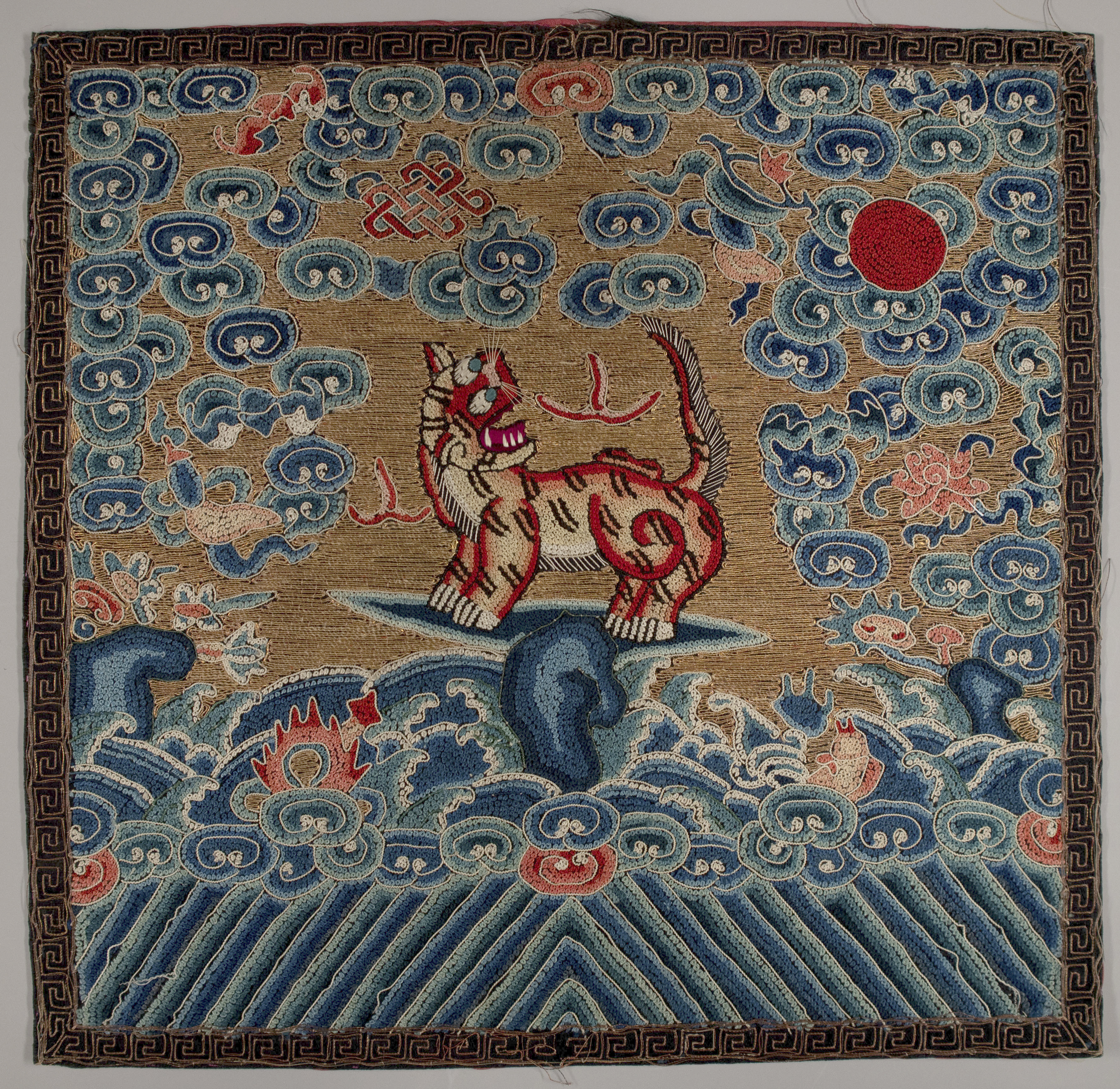
Rank Badge with Tiger: A Study in Silk, Metal Thread, and Imperial Authority
The rank badge with tiger stands as one of the most technically accomplished and symbolically dense artifacts in the Chinese decorative arts tradition. Produced for the bureaucratic and military elite of the Qing dynasty (1644–1911), these square or circular insignia—known in Chinese as buzi—were woven or embroidered onto the surcoats of officials and military officers to denote exact position within the imperial hierarchy. This standalone study examines a single example featuring the tiger motif, executed in silk and metal thread, as both a feat of textile engineering and a codified statement of state power.
Historical and Institutional Context
Rank badges were formalized as part of the Qing court dress system, which drew upon both Ming precedent and Manchu military structure. The Qing established a rigid correlation between animal imagery and rank: the dragon was reserved for the imperial family and princes, while the crane, peacock, and pheasant signified civil office, and the tiger, leopard, bear, and lion designated military rank. A tiger badge, specifically, identified a military official of the fourth rank, a position of considerable authority within the Eight Banners and the Green Standard Army.
The badge was not decorative in the casual sense. It functioned as a wearable credential, legible at a glance during court audiences, ceremonial processions, and official inspections. Its production was controlled by imperial workshops, and deviations in motif, color, or thread quality could constitute a breach of sumptuary law. This regulatory context explains the extraordinary consistency of design across surviving examples, even as individual craftsmanship varies.
Material Composition and Technical Execution
The two principal materials—silk and metal thread—represent a deliberate hierarchy of value. The silk ground, typically a tightly woven satin or twill, provided a smooth substrate that could withstand dense embroidery without distortion. Silk floss was used for the tiger's fur, the stylized cloud and wave motifs, and the surrounding floral or geometric borders, allowing for subtle gradations of color and a soft, lustrous surface.
Metal thread, by contrast, introduced a different optical and tactile register. Wrapped around a silk or cotton core, the metallic strip—often silver or silver-gilt—was couched onto the surface rather than stitched through it, preserving the reflective quality of the metal. In tiger badges, metal thread typically defines the claws, eyes, whiskers, and the stylized stripes of the animal, as well as the sun disc that often appears in the upper corner. The result is a deliberate contrast: the tiger's body reads as organic and tactile, while its defining features flash with metallic precision.
Techniques varied by workshop and period. Early Qing badges favored kesi (silk tapestry weave), while later examples more commonly employed embroidery on silk. The badge in this study, with its combination of flat silk and couched metal, aligns with the embroidered tradition, suggesting a date in the middle to late Qing period.
Iconography and Symbolic Reading
The tiger in Chinese cosmology is not merely a predator but a cosmological agent. Associated with the west, autumn, and the element of metal, the tiger balances the dragon's yang with its own fierce yin-yang dynamic. In the military context, the tiger signaled courage, ferocity, and the power to subdue—qualities essential to an officer entrusted with troops and border security.
The tiger on a rank badge is rarely depicted in a naturalistic pose. It is typically shown facing the sun, sometimes descending a rocky outcrop or standing amid stylized waves. The sun disc, often red or gold, represents the emperor himself, and the tiger's orientation signifies loyalty and receptivity to imperial authority. The surrounding cloud forms, rendered in silk, are not mere filler: they situate the tiger in a celestial rather than terrestrial landscape, elevating the military officer's role to a cosmic duty.
Borders and ground patterns also carry meaning. Many badges include waves at the base (representing the world of water and chaos) and clouds above (representing heaven and order). The tiger stands between them, a mediator. This tripartite structure—water, earth, heaven—echoes the Book of Changes and reinforces the badge's function as a microcosm of proper governance.
Condition, Rarity, and Collecting Considerations
Surviving rank badges vary widely in condition. Metal thread is particularly vulnerable to tarnish, breakage, and loss, and many examples show significant degradation of the metallic elements while the silk remains relatively intact. For this reason, badges with complete and lustrous metal thread are considerably rarer and more desirable.
The tiger badge occupies a specific niche in the market. It is less common than the crane (civil rank) but more available than dragon badges, which are largely institutional or imperial. Collectors value tiger badges for their dynamic composition and the technical challenge they represent: rendering a striped, muscular animal in two very different media without losing anatomical coherence.
Provenance matters. Badges removed from original surcoats and framed as standalone studies—as is the case here—lose their functional context but gain visibility as textile art. The best examples retain original backing papers or mounting evidence, which can confirm workshop origin and date.
Conclusion: The Badge as Textile Argument
The rank badge with tiger is not simply a pretty antique. It is a textile argument about order—about who commands, who obeys, and how the state makes those relationships visible. Silk provides the ground of legitimacy; metal thread provides the edge of enforcement. The tiger, caught between wave and cloud, embodies the military officer's paradoxical role: fierce in execution, subordinate in intent.
For the contemporary viewer, the badge offers a lesson in material intelligence. Every thread choice was deliberate. Every color had a code. Every pose carried a political charge. To study such an object is to recover not just a technique but a grammar of power, woven in silk and metal, still legible after two centuries.