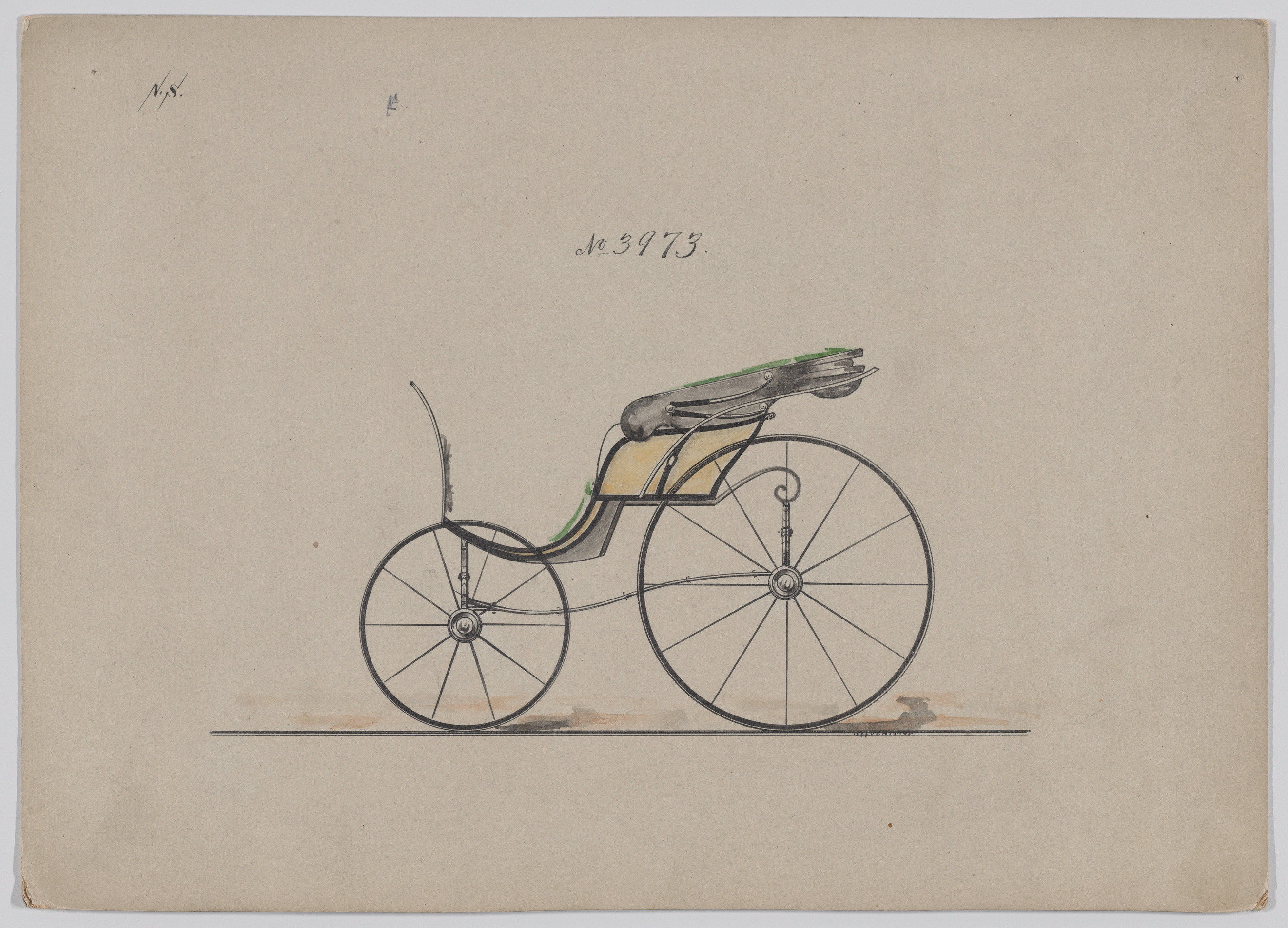
Heritage Analysis: Design for Pony Phaeton, No. 3973
Object Overview and Material Authority
Design for Pony Phaeton, no. 3973, executed in pen and black ink with watercolor and gouache, represents a rare convergence of technical drafting precision and symbolic ornamentation. The work belongs to the visual culture of an ancient civilization whose carriage-building traditions served simultaneously as engineering, diplomacy, and spiritual declaration. Within the Katherine Fashion Lab archive, this object is treated not as a mere transportation schematic but as a primary document of adornment logic—an ancestor to contemporary luxury codes. The medium itself signals intent: black ink establishes structural certainty, watercolor introduces atmospheric depth, and gouache supplies the opaque, jewel-like finish reserved for surfaces meant to be read as precious. This hierarchy of materials mirrors the hierarchy of the vehicle itself—functional chassis, atmospheric presence, and ceremonial surface. For 2026 luxury strategy, the lesson is immediate: material differentiation must be legible at a glance, and ornament must never appear accidental.
Symbolic Power and the Chariot as Sovereign Body
In the ancient world, the pony phaeton was never merely a vehicle. It was a portable stage for the display of legitimacy. The design's proportional relationships—elevated seat, forward-leaning shaft, and tightly controlled wheelbase—encode a deliberate posture of command. The driver does not sit within the carriage; the driver is presented by it. This distinction is critical. Symbolic power in this object operates through framing rather than concealment. The open phaeton exposes the occupant to public view while the vehicle's ornamentation supplies the narrative of right to rule. Watercolor washes in the original design likely indicated the chromatic hierarchy of the patron's house, while gouache highlights marked the exact points of contact between body and vehicle—handrail, footboard, and rein-guide. These are the ancient equivalents of luxury touchpoints: surfaces where the hand confirms what the eye has already been told. For Katherine Fashion Lab, the strategic takeaway is that power dressing is not additive. It is structural. The silhouette must communicate authority before any logo or motif is read.
Historical Adornment and the Grammar of Restraint
The design's ornamentation follows a disciplined grammar. Pen and ink contours define the boundary between structural necessity and decorative surplus. What appears at first as filigree is in fact a system of symbolic abbreviations—repeated motifs that likely referenced dynastic lineage, territorial claim, or celestial protection. The watercolor passages are not illustrative; they are heraldic. Each chromatic zone corresponds to a rank or function within the ancient court. Gouache, applied with opacity, marks the highest tier of adornment: the surfaces that catch light and therefore catch attention. This layered approach to adornment anticipates the modern luxury principle of quiet signaling—where the informed viewer recognizes hierarchy without the object shouting. The pony phaeton's restraint is its sophistication. Ornament is concentrated at points of human contact and visual focal length, while large structural planes remain relatively undecorated. This is the ancient precedent for 2026's most advanced luxury positioning: maximal meaning through minimal mark-making.
Spiritual Meaning and the Vehicle as Threshold
Beyond sovereignty, the phaeton carried spiritual weight. In many ancient civilizations, the vehicle was understood as a threshold object—a liminal space between the domestic and the sacred, the living and the ancestral. The design's axis, running from the pony's harness through the driver's seat to the rear axle, mirrors the vertical axis of temple architecture. The watercolor sky or ground washes in the original drawing may have indicated the ritual context of the vehicle's use: procession, pilgrimage, or funerary passage. Gouache accents at the hub and rein-guide suggest apotropaic function—ornament as protection. The driver is not simply traveling; the driver is being escorted by symbolic forces. This spiritual dimension is the most under-leveraged asset in contemporary luxury. For 2026, Katherine Fashion Lab should consider how garments and accessories can function as threshold objects—pieces that mark transitions and carry protective or affirming meaning without resorting to literal religious iconography. The ancient phaeton achieved this through geometry and material, not scripture.
2026 Luxury Strategy: From Chariot to Collection
The strategic relevance of Design for Pony Phaeton, no. 3973, to 2026 high-end luxury lies in its integrated approach to power, adornment, and meaning. The object does not separate engineering from symbolism. The chassis is the ceremony. For Katherine Fashion Lab, this suggests a collection architecture built on three pillars. First, structural authority: silhouettes that frame the wearer as the phaeton frames the driver—elevated, forward-facing, and deliberately exposed at points of contact. Second, chromatic heraldry: a restrained palette where watercolor-equivalent tones establish atmosphere and gouache-equivalent accents mark the highest-value touchpoints. Third, threshold function: pieces designed to be worn at moments of transition, carrying symbolic weight through proportion and material rather than explicit narrative. The ancient pony phaeton was not a product; it was a proposition about who deserves to be seen and why. In 2026, as luxury consumers seek meaning beyond logo and status, that proposition is more valuable than ever. The design's survival in ink and gouache is not an accident of preservation. It is evidence of a civilization that understood adornment as a form of governance. Katherine Fashion Lab inherits that understanding—and the responsibility to translate it with equal discipline.