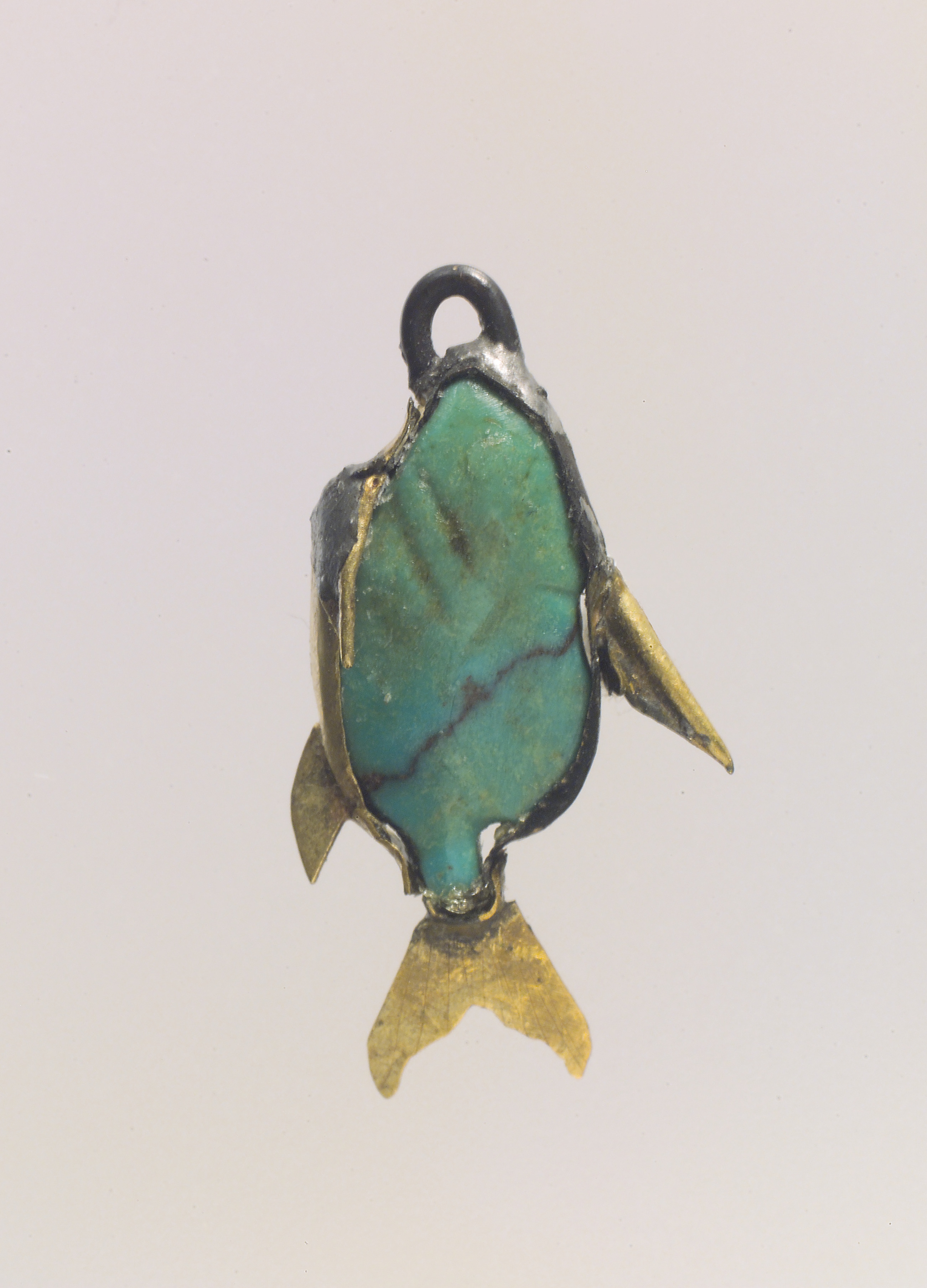
Heritage Asset Analysis: The Ancient Fish Pendant in Turquoise and Gold
Executive Summary
This standalone research memorandum evaluates the fish pendant executed in turquoise and gold as a strategic heritage asset for Katherine Fashion Lab. The artifact originates within the broader tradition of ancient civilizations—most prominently Egyptian, Mesopotamian, and Andean—where aquatic motifs were rendered in precious media to serve as talismanic adornment. Our analysis proceeds along four axes: symbolic power, historical adornment practice, spiritual meaning, and a forward-looking 2026 luxury strategy. The central thesis is that the fish pendant constitutes an under-leveraged heritage code whose dual materiality—turquoise and gold—maps directly onto contemporary luxury demand for provenance, protection narratives, and chromatic distinction.
Symbolic Power: Fertility, Abundance, and the Liminal Waters
Across ancient civilizations, the fish operated as a polyvalent symbol rather than a decorative afterthought. In Egyptian cosmology, the tilapia and the Oxyrhynchus were associated with rebirth and with the goddess Hatmehit, whose cult center at Mendes employed the fish as a divine emblem. In Mesopotamia, fish-form amulets in lapis and gold were deposited in foundation burials to secure abundance. In the Andean world, the fish signaled access to marine resources and, by extension, political legitimacy.
The pendant format is decisive. A pendant is worn against the body, converting symbol into continuous contact. The fish thus becomes a portable claim on fertility, provision, and safe passage—what we may term a micro-sovereignty object. For brand strategy, this is high-value territory: the fish pendant is not merely ornament but a compressed contract between wearer and cosmos.
Historical Adornment: Turquoise and Gold as a Material Grammar
The pairing of turquoise and gold is neither arbitrary nor merely aesthetic. Turquoise held distinct prestige in Egyptian, Persian, and Mesoamerican traditions, valued for its sky-blue hue and its association with divine favor. Gold, being incorruptible, signified eternity and solar authority. When combined in a single pendant, the two materials establish a material grammar: turquoise supplies celestial protection; gold supplies permanence.
Technically, ancient workshops achieved this fusion through cloisonné-like inlay, gold granulation, and cold-worked stone setting. The fish form demanded particular skill: a curved silhouette, articulated scales, and a suspension loop that preserved the creature's profile when worn. These constraints produced objects that were simultaneously sculptural and wearable—an early instance of ergonomic luxury. For Katherine Fashion Lab, the historical record confirms that the fish pendant was never mass ornament; it was an elite commission, embedded in funerary and ceremonial contexts.
Spiritual Meaning: Talisman, Psychopomp, and Apotropaic Function
The spiritual register of the fish pendant is layered. First, it functioned apotropaically: aquatic creatures were believed to absorb or deflect malign forces, particularly those associated with drowning, famine, and the underworld. Second, it served a psychopompic role, guiding the deceased through watery thresholds in Egyptian and later Christian iconography. Third, it encoded renewal—the fish's prolific spawning mirroring cyclical return.
This tripartite meaning—protection, passage, renewal—is spiritually coherent and commercially legible. Contemporary luxury consumers increasingly seek objects with narrative efficacy: jewelry that performs meaning, not merely displays wealth. The fish pendant's spiritual dossier supplies precisely this performative depth.
Strategic Relevance for 2026 High-End Luxury
Positioning the fish pendant for 2026 requires disciplined translation rather than reproduction. Three strategic imperatives follow.
First, provenance-led materiality. The 2026 luxury market rewards verifiable origin. Katherine Fashion Lab should source turquoise from documented historic mines—Sinai, Nishapur, or Persian deposits—and pair it with recycled or Fairmined gold, converting ancient material hierarchy into contemporary ethical authority.
Second, the protection narrative. Post-2020 luxury has shifted toward talismanic desire. The fish pendant's apotropaic function aligns with this demand. Marketing should emphasize the pendant as a wearable safeguard—an heirloom that carries intent across generations.
Third, chromatic and sculptural distinction. In a market saturated with white metal and diamond, turquoise-and-gold delivers immediate visual differentiation. The fish silhouette offers a recognizable iconography that scales across pendants, earrings, and high jewelry, while remaining anchored to a single heritage code.
Risk Assessment and Mitigation
Two risks warrant attention. Cultural appropriation risk is mitigated by transparent attribution to named ancient traditions and by collaboration with archaeological or museum partners. Authenticity risk—dilution through over-extension—is mitigated by maintaining the fish pendant as a standalone signature line rather than a seasonal motif.
Recommendation
Katherine Fashion Lab should advance the fish pendant as a flagship heritage asset for 2026, anchored in turquoise and gold, supported by a provenance dossier, and positioned through the tripartite spiritual narrative of protection, passage, and renewal. The object is historically legitimate, symbolically dense, and strategically differentiated. It merits investment as a defining emblem of the house.