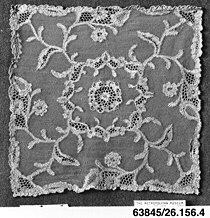
Square: A Standalone Study in Geometric Couture
The square occupies a paradoxical position in the vocabulary of haute couture. It is the most elementary of geometric forms—four equal sides, four right angles, a shape that a child can draw before learning to write. Yet within the ateliers of Paris, Alençon, and Brussels, the square becomes a site of extraordinary technical ambition. Katherine Fashion Lab presents this standalone study to examine how a form so austere can sustain such elaborate material investigation, particularly when executed in needle lace, point d’Alençon, and silk.
This analysis is not concerned with the square as motif or print. It addresses the square as structural premise—a boundary within which the hand of the lacemaker, the tension of the silk, and the geometry of the grid enter into sustained negotiation. The result is a study of restraint as a form of luxury.
Global Heritage and the Geometry of the Grid
The square appears across cultures with a consistency that suggests something closer to instinct than influence. In Andean textiles, the aksu cloth is organized through quadrants and stepped squares that encode kinship and cosmology. In West African kente, the grid is both loom logic and philosophical statement—each square a unit of meaning. Japanese shibori and sashiko traditions treat the square as a module for repetition, while Islamic tilework elevates the square into a system of infinite tessellation.
What unites these traditions is not ornament but discipline. The square demands alignment. It exposes error. A warp thread out of place, a stitch too loose, a corner that does not meet at ninety degrees—all become visible. In this sense, the square is the most honest of shapes, and the most unforgiving. For a couture study, that honesty is precisely the appeal.
The Square as Structural Constraint
When a designer chooses the square as a governing form, they accept a set of limitations. Curves must be justified. Drape must be earned. The square resists the flowing, body-hugging silhouettes that dominate contemporary couture, and in doing so, it forces a different kind of invention: the invention of the interior. If the exterior is a rigid four-sided boundary, then all expression migrates inward—into the lace, the stitch, the negative space.
Needle Lace and Point d’Alençon: Two Grammars of the Square
Needle lace and point d’Alençon are frequently discussed together, yet they represent distinct technical philosophies, and their behavior within a square format diverges instructively.
Needle Lace: The Square as Drawn Line
Needle lace is built stitch by stitch, often over a parchment or linen template, with no continuous ground fabric. The lacemaker constructs the motif from the inside out, using buttonhole stitches, cordonnet, and fillings to create a self-supporting textile. Within a square, needle lace behaves like drawing: the maker establishes the border, then fills the field with networks—réseau, brides, point de rempli—that can be dense or diaphanous.
The square here is not a cage but a frame for transparency. Because needle lace is essentially openwork, the square becomes a window. Light passes through it; the wall behind it becomes part of the composition. In a couture application, this means the square panel can read as solid or ephemeral depending on its placement against skin, lining, or shadow.
Point d’Alençon: The Square as Armature
Point d’Alençon, by contrast, is a needle lace with a cordonnet—a horsehair or synthetic cord that outlines every motif, giving the lace a sculptural, almost architectural relief. The technique, formalized in Alençon, France, from the seventeenth century, was historically reserved for court and ecclesiastical commissions precisely because of its labor intensity. A single square of authentic point d’Alençon can require hundreds of hours.
Within a square format, point d’Alençon introduces weight and shadow. The cordonnet raises the pattern above the ground, so the square acquires a third dimension. Corners become structurally significant: the cordonnet must negotiate the ninety-degree turn without buckling, and the lacemaker’s skill is measured by the crispness of that transition. The square, in this material, is less a frame than a relief panel.
Silk as Ground and Counterpoint
Silk performs a dual role in this study. As a ground, it provides the tension against which lace is mounted—typically a crêpe de chine or organza that holds the square’s geometry without competing with the lace. As a counterpoint, silk can be used in the passementerie, the binding, or the internal seams that define the square’s edges.
The critical variable is sheen. Silk’s characteristic luster changes with the angle of light and the direction of the weave. When a square panel of needle lace is mounted on silk, the two materials respond differently to illumination: the lace scatters light, the silk reflects it. The square thus becomes a study in optical contrast, its four sides framing a controlled dialogue between matte and gloss.
Finishing and the Ethics of the Edge
In couture, the edge is never incidental. A square finished with a hand-rolled hem, a picot, or a narrow cordonnet communicates a different intention than one left raw or bound with ribbon. For this study, the edge is treated as a threshold—the point at which the square’s internal logic meets the external world. The choice of finish determines whether the square reads as a sample, a panel, or a completed garment component.
Conclusion: The Square as Discipline
The square does not flatter the body; it interrogates the maker. In needle lace, it demands openness without chaos. In point d’Alençon, it demands relief without distortion. In silk, it demands tension without rigidity. Katherine Fashion Lab treats this standalone study as a corrective to the assumption that couture is defined by complexity of silhouette. Sometimes the most rigorous luxury lies in a form so simple that every error is visible—and every success is earned.
The square, in this reading, is not a starting point but a standard. It measures the hand, the eye, and the patience behind the cloth.