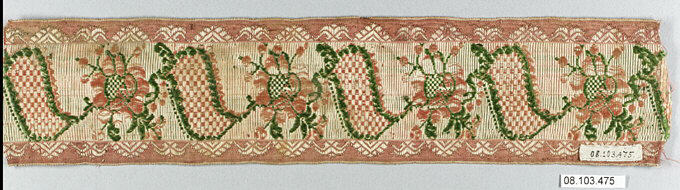
Galloon: The Silk Archive of Power, Protection, and the 2026 Luxury Opportunity
Within the strategic canon of Katherine Fashion Lab, few textile artifacts carry the civilizational density of galloon—a narrow, densely woven silk trim historically deployed at the edges of garments, vestments, and ceremonial regalia. While contemporary fashion discourse often reduces galloon to a decorative passementerie footnote, our standalone research repositions it as a primary carrier of symbolic authority. This analysis examines galloon's origins in Ancient Civilization, its evolution as a silk medium of spiritual and temporal power, and its underleveraged potential within the 2026 high-end luxury landscape.
Etymological and Material Foundations
The term galloon derives from the French galon, itself rooted in the Old French galonner—to adorn or trim. In Ancient Civilization, galloon emerged not as ornament but as boundary technology: a woven silk edge that simultaneously finished a garment and inscribed it with meaning. Silk's tensile strength, lustrous hand, and capacity for fine-gauge patterning made it the ideal medium for narrow-woven structures that could bear metallic threads, dyed warps, and miniature iconography without compromising drape.
Unlike broad silks, which served as surfaces for display, galloon functioned as compressed narrative. A single centimeter could encode rank, lineage, or divine affiliation. This compression is precisely what makes galloon strategically valuable today: in an era of visual saturation, luxury consumers increasingly seek density of meaning over expanse of surface.
Symbolic Power: The Woven Grammar of Authority
In Ancient Civilization, galloon was never neutral. Its application followed a strict grammar of placement: collar, cuff, hem, and seam. Each position corresponded to a distinct symbolic register.
Hem galloon signified territorial grounding—the wearer's connection to land, ancestors, and civic identity. Collar galloon denoted speech authority; it framed the voice as legitimate and binding. Cuff galloon regulated gesture, marking the hands as instruments of sanctioned action. Seam galloon concealed construction while revealing hierarchy, transforming the garment's interior logic into an external code.
This positional semiotics produced what we term at Katherine Fashion Lab a distributed sovereignty: power not concentrated in a single emblem but diffused across the body's edges. For 2026 luxury strategy, this offers a counter-narrative to logo-centric branding. Instead of a monogram placed at the chest, a house might deploy proprietary galloon at multiple thresholds—collar, cuff, hem—creating a systemic signature that rewards the informed wearer without broadcasting to the uninformed observer.
Historical Adornment: Silk Galloon as Diplomatic Currency
Historical records from Ancient Civilization indicate that silk galloon circulated as a form of diplomatic currency. Because it required specialized looms and highly skilled weavers, galloon production was centralized and controlled. Gifting galloon was not merely courteous; it was a transfer of symbolic capital. Receiving galloon implied incorporation into a network of obligation and protection.
This history has direct implications for contemporary luxury. Galloon's association with gift economies rather than market transactions positions it as an ideal medium for VIP relationship management. A client who receives a garment trimmed in house-specific galloon is not simply purchasing a product; they are being inducted into a lineage. The trim becomes a wearable archive of belonging.
Furthermore, silk galloon's historical resistance to replication—its production was guarded, its patterns were proprietary—prefigures modern intellectual property strategy. In 2026, as AI-generated design threatens to erode visual distinctiveness, galloon offers a defensible craft moat: narrow-woven, technically demanding, and intimately tied to a house's own loom archive.
Spiritual Meaning: The Apotropaic Edge
Across Ancient Civilization, galloon carried apotropaic—evil-averting—functions. The edge of a garment was considered a liminal zone, a threshold where the wearer's body met the external world. Unprotected edges invited spiritual intrusion. Galloon, woven with specific colors, metallic threads, and repeating motifs, sealed these thresholds.
This spiritual dimension is not mere folklore; it is a sophisticated pre-modern theory of boundary integrity. The galloon did not decorate the edge—it fortified it. Colors were selected for their vibrational correspondence: deep indigo for protection, crimson for vitality, gold for divine sanction. Motifs—interlocking knots, wave patterns, stylized eyes—functioned as visual mantras, repeating a protective intention with every thread pass.
For 2026 high-end luxury, this spiritual heritage offers a pathway beyond secular materialism. Consumers increasingly seek meaningful adornment—objects that do emotional and psychological work. A galloon designed with intentional color and motif, accompanied by transparent storytelling about its apotropaic origins, transforms a trim into a wellness technology. The garment becomes not just worn but trusted.
2026 High-End Luxury Strategy: From Trim to Thesis
Katherine Fashion Lab's strategic recommendation is to reposition galloon from component to collection thesis. This requires three moves.
First, vertical integration of galloon design. Houses should develop proprietary galloon looms or partner with heritage narrow-weaving ateliers. The galloon becomes a house signature as recognizable as a silhouette. Unlike printed logos, galloon cannot be scanned and replicated at scale without the specific loom setup—a natural anti-counterfeit measure.
Second, narrative layering. Each galloon collection should be released with a symbolic key: a document explaining the color, motif, and placement logic. This transforms the consumer from passive buyer to initiated participant. In an era of content abundance, interpretive depth is the scarcest luxury.
Third, cross-category application. Galloon's historical role at garment edges translates naturally to leather goods (edge binding), footwear (collar and heel trim), and even jewelry (woven silk cords for pendants). A single galloon archive can unify a house's entire product ecosystem under one symbolic grammar.
Conclusion: The Edge as Center
Galloon teaches a counterintuitive luxury lesson: the edge is not peripheral. In Ancient Civilization, the edge was where power was negotiated, where protection was secured, and where identity was declared. Silk galloon, as the material expression of that edge, is therefore not a minor trim but a major strategic asset.
For Katherine Fashion Lab, the 2026 opportunity is to reclaim galloon as a living archive—one that speaks to symbolic power, historical adornment, and spiritual meaning simultaneously. In a market that rewards depth over display, the narrowest woven band may prove the widest strategic moat.