Architectural Adornment as Sovereign Code: A Heritage Analysis for Katherine Fashion Lab
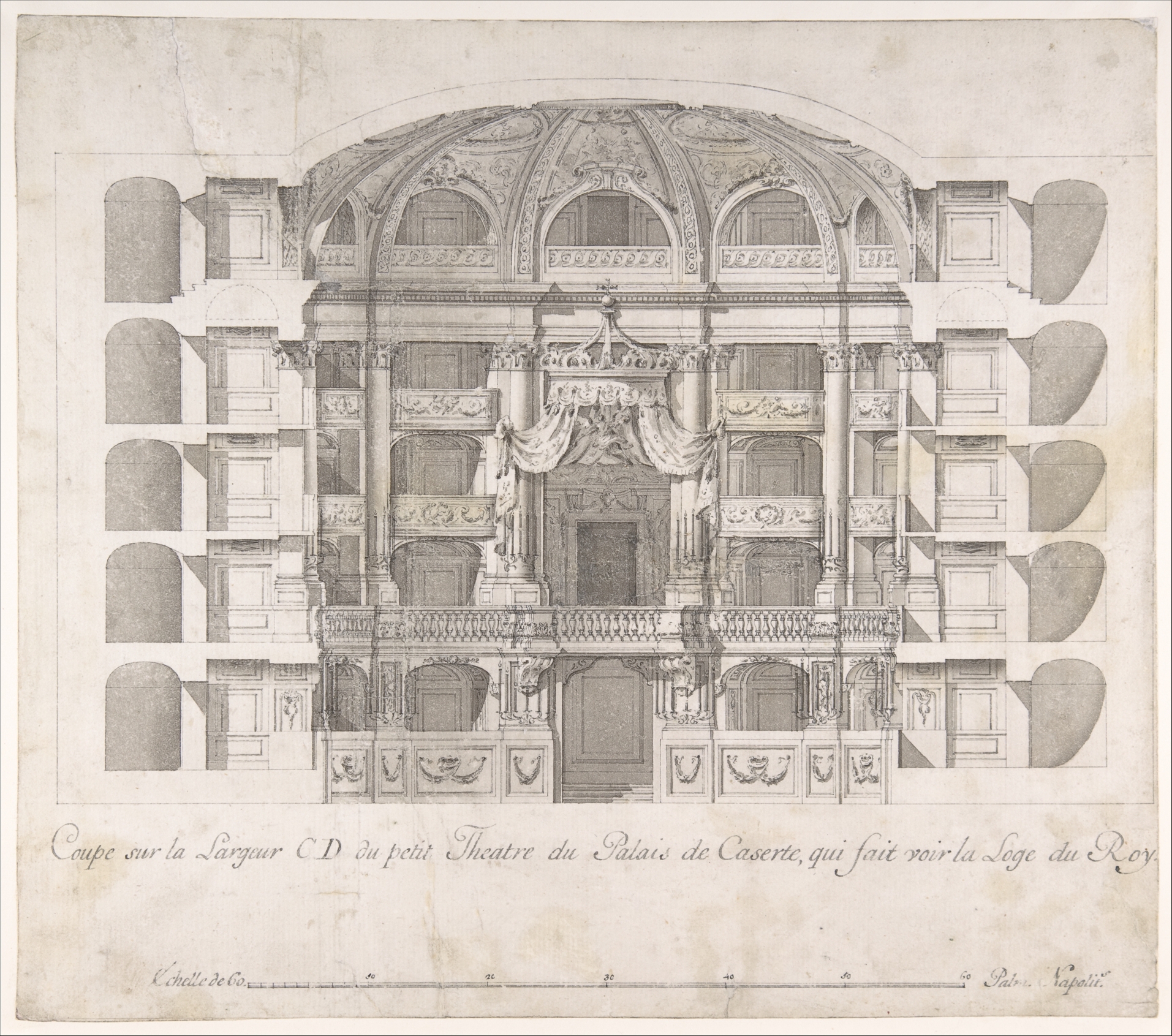
This strategic standalone research paper examines the drawing, Transverse Section of the Small Theater in the Palace of Caserta with a View Towards the Royal Box, not merely as an architectural artifact, but as a profound cipher of ancient power dynamics. Executed in pen and ink with gray wash over precise construction lines, this technical rendering transcends its medium to reveal a universal language of sovereignty, spectacle, and sacred geometry. For Katherine Fashion Lab, this analysis decodes the perennial principles of symbolic power and historical adornment embedded within structured space, providing a foundational narrative for a 2026 high-end luxury strategy rooted in authority, intimacy, and spiritual resonance.
Deconstructing the Hierarchy: The Royal Box as Ephemeral Crown
The transverse section is an act of strategic revelation, slicing through the theater to expose its social and political anatomy. The focal point—the Royal Box—is not merely a seating area but the sanctum of the gaze, the epicenter of a carefully orchestrated cosmology of power. Its architectural adornment—likely rendered in delicate gray wash suggesting plush velvets, gilt stucco, and intricate carvings—functions as a non-verbal heraldry. This is the historical adornment of privilege, designed to frame the sovereign as both a participant in and the ultimate object of the spectacle. The geometry of the space ensures that all sightlines converge upon this box, making the monarch the silent, omnipresent protagonist of every performance. This creates a bidirectional theater: the stage performs for the crown, and the crowned, in their adorned box, performs sovereignty for the assembled court. The medium itself, with its ruled construction lines peering through the finished ink, underscores that this hierarchy is not accidental but meticulously engineered—a crucial insight for luxury strategy where perceived effortlessness must be underpinned by invisible, rigorous construction.
The Spiritual Geometry of Audience and Ascent
Beyond the material adornment lies a deeper, spiritual meaning encoded in the theater’s very form. The semicircular cavea, ascending in tiers, echoes ancient amphitheaters and sacred gathering spaces designed to channel collective energy toward a focal point. This architecture ritualizes attention. The ascent towards the royal box is not just physical but symbolic, representing a gradient of access and enlightenment culminating in the sovereign’s presence, often historically aligned with the divine. The transverse section, therefore, maps a spiritual topography. The precise compass and ruled lines indicate an adherence to harmonic proportions, perhaps reflecting beliefs in the music of the spheres or celestial order made manifest on earth. The theater becomes a microcosm: the stage represents the world of human drama, the audience the layered strata of society, and the royal box the transcendent realm of ultimate authority and judgment. For the modern luxury connoisseur, this translates to an appreciation for spaces and objects that facilitate a personal, ritualistic ascent—items that serve as focal points in one’s own life narrative, charged with intention and superior craftsmanship that hints at a higher order.
Strategic Synthesis: A 2026 Luxury Strategy from Caserta’s Blueprint
Katherine Fashion Lab can distill this analysis into a potent, client-centric strategy for 2026, moving beyond trend to cultivate legacy.
Symbolic Power Through Architectural Silhouette & Framing
The Royal Box teaches the power of the frame and the commanding perspective. 2026 collections should introduce Architectural Cocooning: garments that create a personal "box" or aura. Think structured yet fluid outerwear, capes with dramatic arm apertures, and gowns with engineered silhouettes that command space in a room, framing the wearer as the focal point. Details should echo the "ruled construction lines"—visible seaming, precise darts, and internal architecture that speaks of meticulous, hidden engineering. This embodies symbolic power: the wearer is both the observer and the observed, in control of the gaze.
Historical Adornment Re-coded as Personal Heraldry
The adornment of the box is its identity. KFL should pioneer Modular Adornment—a system of detachable, heirloom-quality embellishments (e.g., embroidered panels, jeweled collars, metallic passementerie) that allow clients to customize a foundational garment. This mirrors how a theater is adapted for different performances. Each element becomes a piece of personal heraldry, telling a story of lineage, achievement, or aspiration. The medium of the drawing—layers of ink and wash over graphite—inspires a design philosophy of layered transparency and texture, where materials interact with depth and intention.
Spiritual Meaning in Ritual and Resonance
The spiritual meaning lies in the geometry of experience. The strategy must curate Ritualistic Unboxing and Client Journeys. Purchasing a KFL piece should be a theatrical ascent, with client appointments modeled on the gradual access to the royal box. This includes private viewings in calibrated environments, documentation of the garment’s creation (its "construction lines"), and perhaps a sonic or olfactory element tied to the collection’s narrative. The product is not just a garment but a key to an elevated state of being, offering the wearer a sense of centered authority and resonant calm—the modern equivalent of the sovereign’s transcendent perspective.
In conclusion, the transverse section of Caserta’s theater is a masterclass in the enduring principles of luxury: the engineering of hierarchy, the adornment of authority, and the spiritualization of space. For Katherine Fashion Lab, this ancient blueprint is startlingly contemporary. By interpreting symbolic power through architectural silhouette, re-coding historical adornment as personal heraldry, and embedding spiritual meaning in client ritual, KFL can architect a 2026 strategy that does not simply clothe the body, but builds a sovereign space around the individual. This approach positions luxury not as consumption, but as the conscious construction of one’s own world stage, with the wearer reigning supreme at its center.