Katherine Fashion Lab — Heritage Asset Dossier
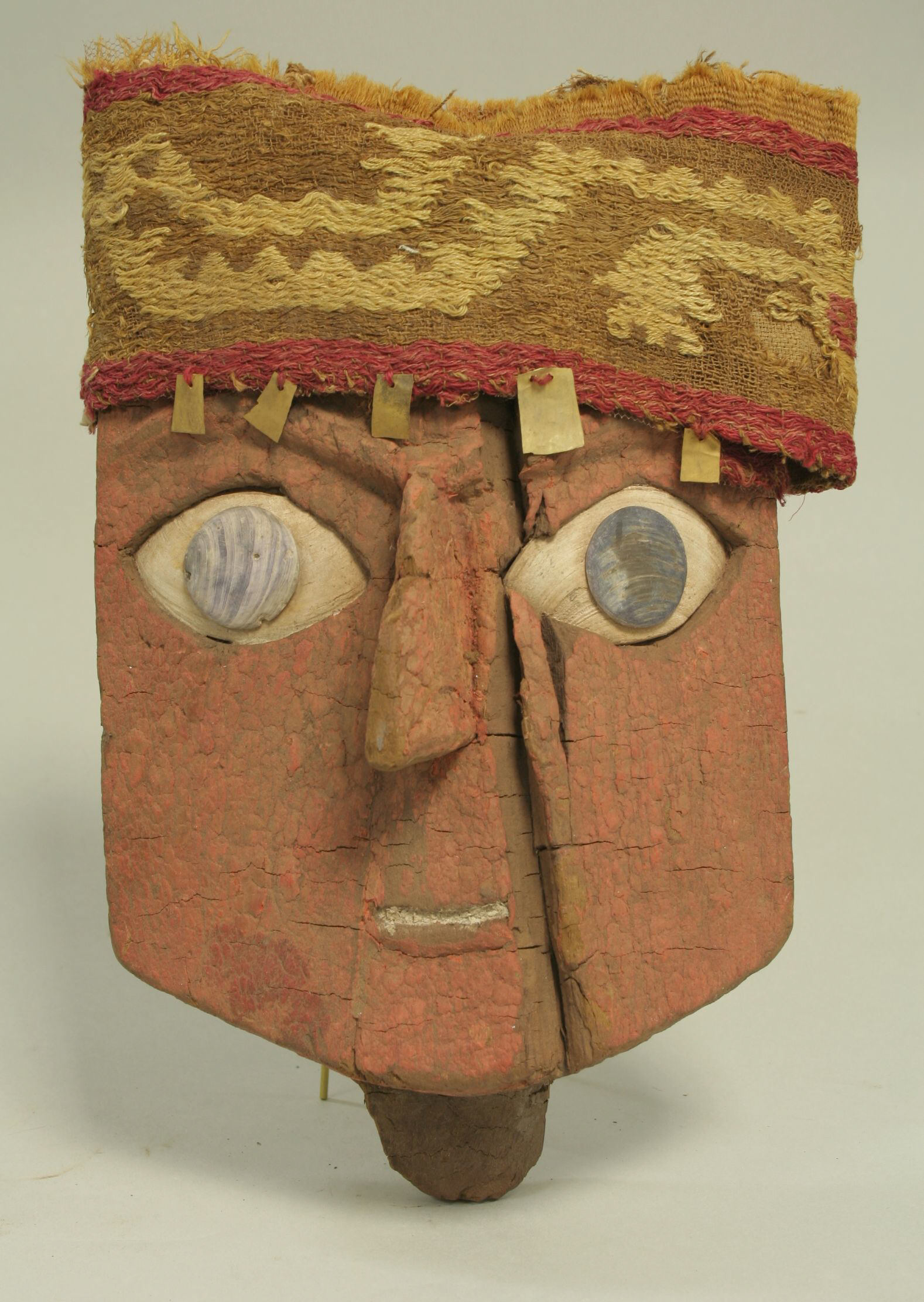
Object of Study: Ica Funerary Mask (Wood, Paint, Gold, Cloth, Shell)
The Ica funerary mask represents one of the most articulate surviving statements of pre-Columbian mortuary aesthetics. Produced by the Ica culture — heirs to the Paracas and Nazca traditions on Peru's southern coast — the mask is a composite object: a carved wooden core, layered with cloth, finished in polychrome paint, embellished with gold sheet, and inlaid with shell for eyes and teeth. Its material complexity is not incidental. Each medium carries discrete symbolic weight, and their convergence signals a sophisticated theology of death, transformation, and social continuity. For Katherine Fashion Lab, the mask is not merely an archaeological curiosity; it is a template for how luxury objects can encode meaning across multiple material registers simultaneously.
Symbolic Power and the Grammar of Materials
The Ica mask's symbolic authority derives from material hierarchy. Gold, in Andean cosmology, was not currency but the sweat of the sun — a solar emanation, incorruptible and divine. Its application to a funerary object positioned the deceased within the solar order rather than the mortal one. Shell, by contrast, carried aquatic and lunar associations; the spondylus shell in particular was traded from Ecuadorian waters and associated with fertility, rain, and the underworld's watery threshold. The pairing of gold and shell on a single face enacts a cosmological union: sun and sea, upper world and lower world, permanence and regeneration.
Wood, the structural core, was the medium of the living body — carved, shaped, and painted to reconstruct the face of the deceased. Paint supplied the final layer of identity: the specific colors, markings, and features that distinguished one ancestor from another. Cloth, wrapped between wood and paint, referenced the textile traditions for which Paracas and Nazca are justly famous, binding the mask to the lineage's weaving heritage. The mask thus operates as a material argument: identity is not single-sourced but assembled from the cosmos, the community, and the individual.
Historical Adornment and the Politics of the Face
In Ica and wider Andean practice, funerary masks were not passive grave goods. They were active agents in the transition of the deceased from living member to ancestral presence. The mask's face was typically idealized rather than portrait-like — a deliberate choice that elevated the individual into an archetype. Adornment functioned as political theology: the right to wear gold, shell, and finely woven cloth was restricted to elites whose authority was understood to persist beyond death. The mask therefore performed a double function — it honored the dead and legitimized the living heirs who commissioned and displayed it.
This is a critical insight for luxury strategy. The Ica mask demonstrates that adornment is never merely decorative; it is a claim. The materials, the craftsmanship, and the ritual context together constitute a statement of continuity — the assertion that a lineage, a house, or a brand possesses a value that survives its individual members. The mask is, in effect, an ancestor's signature on the future.
Spiritual Meaning and the Threshold Aesthetic
Andean mortuary practice conceived death as a passage rather than an endpoint. The mask served as the face the deceased would present in the next realm — a threshold identity. Its eyes, often inlaid with shell, were designed to be seen rather than to see; they fixed the ancestor's gaze upon the living, maintaining a relationship across the boundary. This threshold aesthetic — an object that belongs fully to neither world and mediates both — is one of the most powerful and least exploited territories in contemporary luxury.
In our parallel research context, the Angkorian ceramic mold fragment bearing musicians in eternal posture offers a striking resonance. Both objects — the Ica mask and the Khmer mold — are instruments of continuity. The Angkorian musicians play silently across centuries; the Ica ancestor gazes across the same span. Neither object was designed for the museum. Both were designed for duration. This shared intentionality across unconnected civilizations suggests a universal principle: the highest form of craft is the craft of persistence.
2026 High-End Luxury Strategy: From Artifact to Architecture
Katherine Fashion Lab's 2026 positioning should treat the Ica funerary mask not as a motif to be reproduced but as a strategic architecture to be reinterpreted. Three directives follow.
First, material hierarchy as narrative. The mask's power comes from the deliberate ordering of materials — structural wood, binding cloth, signifying paint, sacred gold, liminal shell. Luxury collections for 2026 should be built on comparable hierarchies, where each material earns its place through meaning rather than cost alone. A garment or accessory that layers a foundational textile, a painted or dyed intervention, a gilded accent, and a shell or mineral element tells a story before it is worn.
Second, the threshold aesthetic. The mask's gaze — fixed, idealized, otherworldly — offers a design language for objects that mediate between the everyday and the ceremonial. Limited editions, ritual-adjacent pieces, and heirloom commissions should be conceived as threshold objects: not costumes for daily life but presences that mark transitions. This aligns with the growing luxury consumer demand for objects with biographical depth rather than seasonal novelty.
Third, ancestor logic. The Ica elite understood that commissioning a mask was an investment in lineage. Katherine Fashion Lab should adopt the same horizon: pieces designed to be inherited, documented, and re-consecrated across generations. Provenance, materials, and craftsmanship should be recorded with the rigor of an archaeological dossier, because the 2026 luxury client is not buying a product but a future antiquity.
Curatorial Conclusion
The Ica funerary mask is a masterclass in integrated meaning. It refuses the separation of material, symbol, and spirit that characterizes so much contemporary design. For Katherine Fashion Lab, its lesson is unambiguous: the luxury objects that will matter in 2026 and beyond are those that, like the mask, are built to be looked at across time — objects that carry a face, a lineage, and a threshold. The Ica artisans did not decorate the dead. They equipped them for permanence. That is the standard we should set for everything we make.