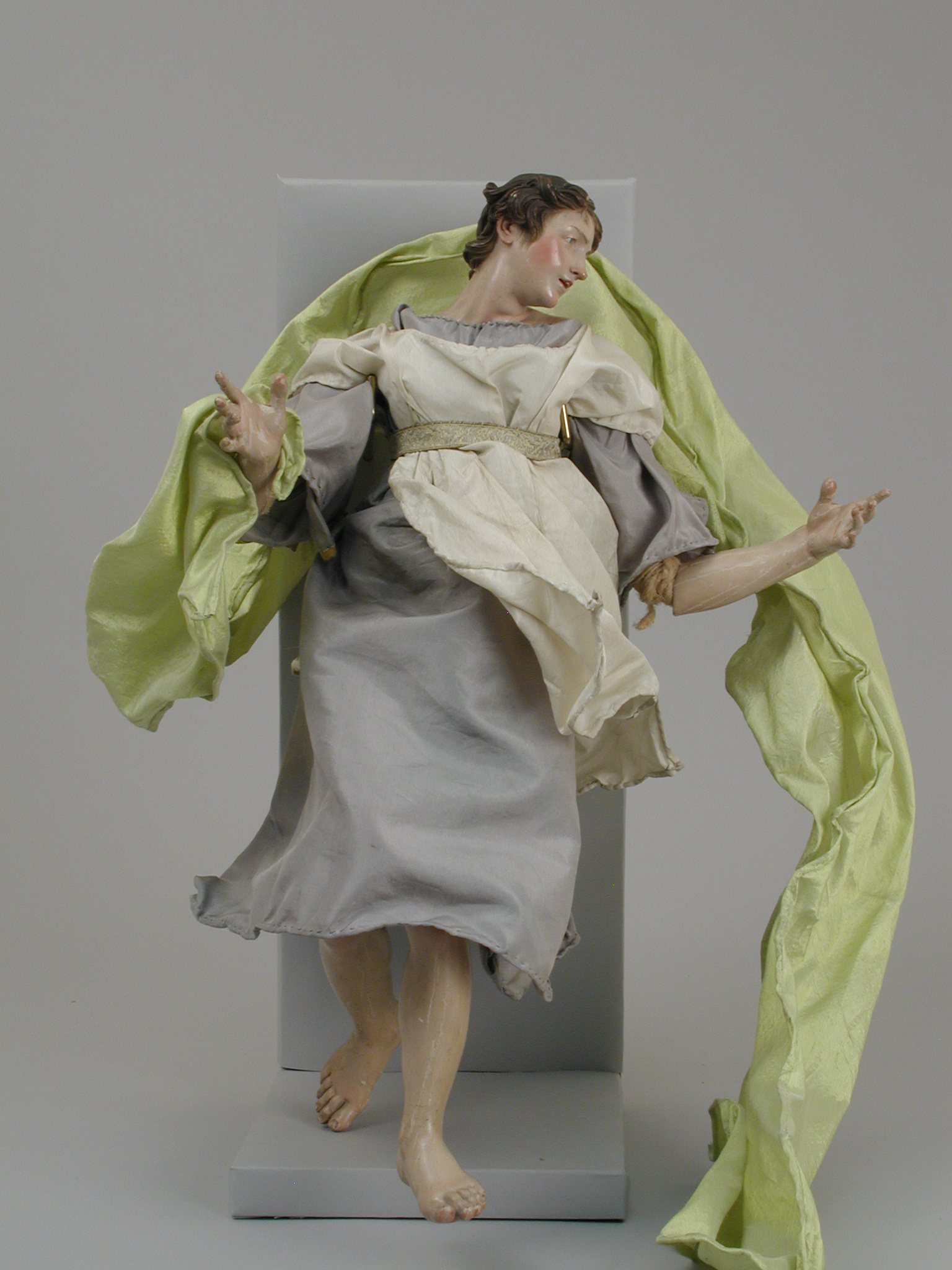
Angel: A Study in Polychromed Terracotta and Textile Assemblage
Within the broader arc of sculptural practice, the figure known simply as Angel occupies a singular position. It is not a monument, nor a devotional object destined for a fixed architectural setting, nor a fragment detached from a larger narrative cycle. It is a standalone study—an autonomous meditation on the human form as a site of convergence between durable and ephemeral materials. Its origin is described as Global Heritage, a designation that resists narrow geographic attribution and instead situates the work within a transhistorical lineage of image-making. What emerges is a hybrid object: a polychromed terracotta head, wooden limbs and wings, a body constructed of wire wrapped in tow, and a surface articulated through various fabrics. Each material carries its own temporal logic, and the tension between them is the work's central drama.
The Head: Polychromed Terracotta as Affective Anchor
The head is the most materially permanent element of the composition. Fired clay is among the oldest sculptural media known to human civilization, and its association with votive and funerary traditions across cultures is well documented. Here, the terracotta is polychromed—painted in multiple colours—which reintroduces a layer of fragility that firing had ostensibly overcome. Pigment on clay is susceptible to flaking, fading, and abrasion; it is a surface that records its own exposure to time. The polychromy is therefore not merely decorative but indexical: it bears witness to the conditions of the object's survival.
Because the head is the locus of physiognomy, it carries the greatest burden of expression. In a figure assembled from disparate materials, the face must perform the work of coherence. The viewer's eye returns to it repeatedly, seeking confirmation that the entity before them is a unified subject rather than a collection of parts. The polychromed terracotta head thus functions as an affective anchor, stabilizing a composition that might otherwise read as provisional or unfinished.
The Limbs and Wings: Wooden Armature and the Suggestion of Flight
Wooden limbs and wings introduce a different order of material reasoning. Wood is organic, anisotropic, and responsive to humidity and temperature; it moves, however minutely, across seasons. Carved limbs possess a grain that runs with or against the direction of the form, and the sculptor's negotiation with that grain is legible in the finished surface. Unlike cast metal, which implies replication, carved wood asserts singularity. Each limb is a discrete act of removal—subtraction rather than addition.
The wings are especially significant. In the iconography of angels, wings denote passage between realms, the capacity to traverse the boundary between the mundane and the transcendent. Rendered in wood, they acquire a weight that contradicts the idea of flight. This is not a failure of representation but a deliberate material paradox: the promise of transcendence is carried by a substance that is earthbound and gravitational. The angel, in this reading, is not a being who has escaped matter but one who remains fully embedded within it.
The Body: Wire, Tow, and the Aesthetics of the Provisional
The body—wire wrapped in tow—is the most conceptually charged component. Tow is the coarse, short fibre separated during the processing of flax or hemp; it is a by-product, a residue, a material that ordinarily disappears into rope, sacking, or paper. To build a torso from tow is to elevate the discarded into the structural. The wire provides the armature, the tow provides the volume, and together they produce a form that is at once skeletal and fleshy, rigid and yielding.
This technique belongs to a long tradition of mixed-media assemblage, in which the hierarchy of materials is deliberately unsettled. The precious and the base are placed in dialogue. A polychromed terracotta head—a material with millennia of prestige behind it—sits atop a body of industrial wire and agricultural waste. The result is not parody but a serious inquiry into what constitutes a body, and by extension, what constitutes a person. If the body can be assembled from the overlooked and the provisional, then dignity is not a function of material permanence.
Fabrics: The Surface as Accumulated History
The application of various fabrics completes the work and complicates it further. Textiles are the most intimate of materials; they touch the skin, absorb moisture, retain scent, and record wear. When draped over a constructed body, they perform a double function: they conceal the armature and they reintroduce the human scale of clothing. The angel is dressed, and dressing is a cultural act. The choice of fabrics—their colours, weaves, and conditions—situates the figure within a world of social meaning.
Because the fabrics are described as various rather than uniform, the surface reads as accumulated history rather than singular design. Layers may have been added, removed, or replaced over time. The garment becomes a palimpsest, and the angel becomes a record of the hands that have tended it. This is consistent with the object's status as a standalone study: it is not frozen at a moment of completion but continues to evolve through conservation, display, and interpretation.
Conclusion: The Angel as Material Argument
What does Angel argue, as a standalone study within a global heritage framework? It argues that the sacred is not confined to durable substances. It argues that the body is a construction, assembled from whatever materials are at hand, and that this assembly is not a diminishment but a condition of existence. Terracotta, wood, wire, tow, and fabric—each contributes a distinct temporal register, from the geological to the seasonal to the industrial to the domestic. The angel that emerges is neither purely transcendent nor purely material, but a figure suspended between the two, held together by the same provisional logic that holds together any human life. In the context of Katherine Fashion Lab's inquiry into dress, form, and meaning, this work stands as a foundational case study: a reminder that what we wear, and what we are made of, are never entirely separable questions.