Heritage Analysis: The Comtesse de La Tour-Maubourg as Strategic Ancestral Asset
Introduction: A Portrait Beyond Portraiture
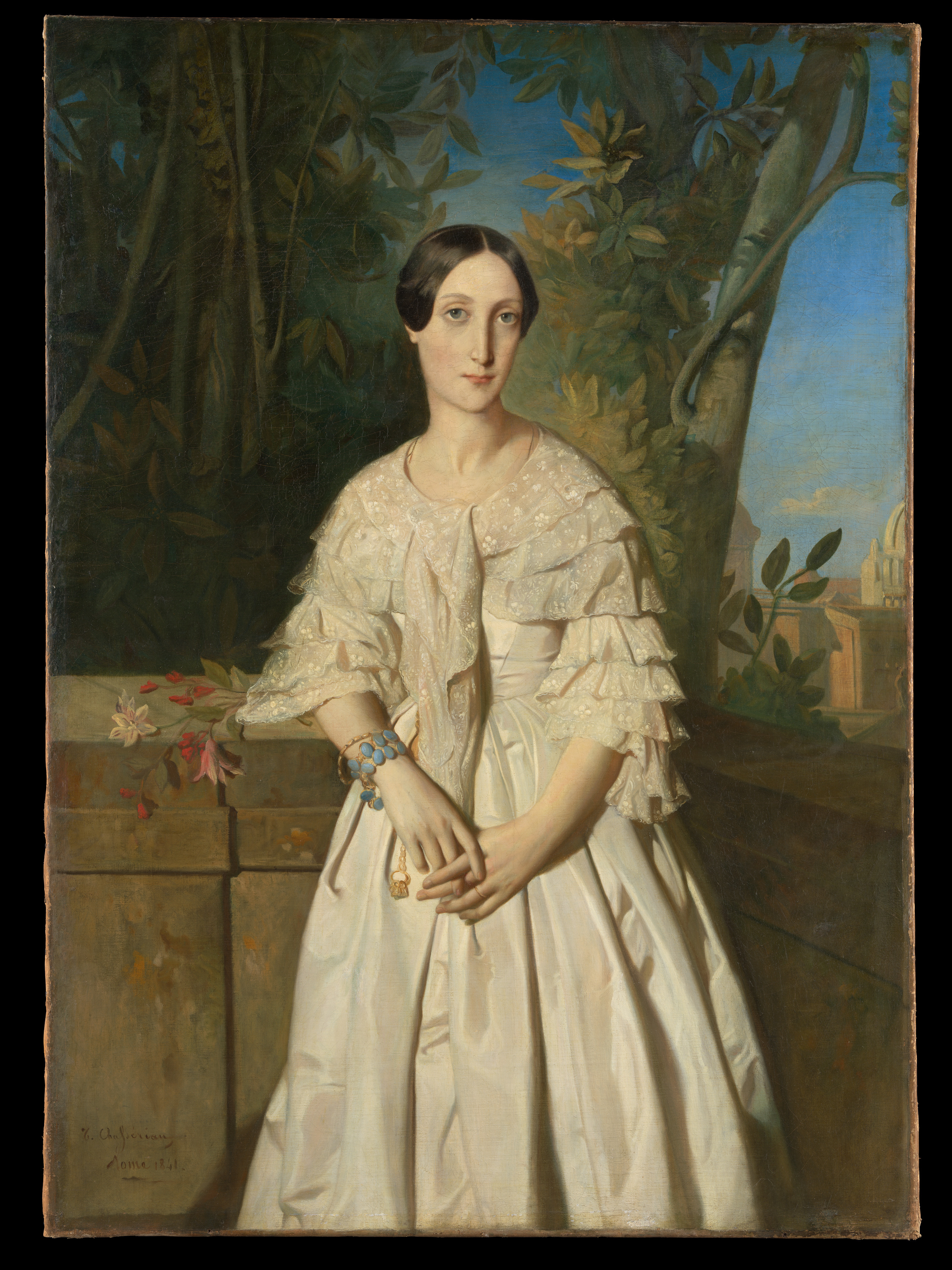
The 1840s oil on canvas portrait of Marie-Louise-Charlotte-Gabrielle Thomas de Pange, Comtesse de La Tour-Maubourg (1816–1850), functions as more than a record of aristocratic likeness. It operates as a compressed archive of symbolic capital: lineage, piety, restraint, and dynastic continuity encoded in pigment and posture. For Katherine Fashion Lab, this portrait represents a strategic standalone research asset — a case study in how pre-industrial European nobility converted spiritual authority into visual authority, and how that conversion logic remains commercially viable in the 2026 luxury landscape.
This analysis examines the work through four lenses: symbolic power, historical adornment, spiritual meaning, and forward-looking luxury strategy. The objective is not antiquarian appreciation but actionable brand intelligence.
Symbolic Power: The Semiotics of Inherited Authority
Posture, Gaze, and the Economics of Restraint
Portraiture of the French legitimist aristocracy under the July Monarchy and early Second Republic served a defensive function. Following the 1830 revolution, families such as the La Tour-Maubourgs — with deep military and parliamentary roots — deployed portraiture to assert continuity against political displacement. The Comtesse's representation participates in this program through calculated understatement.
Symbolic power here is not performed through excess but through omission. The absence of overt regalia, the subdued palette, and the controlled frontal gaze signal a class position so consolidated it requires no explanation. This is the visual grammar of assurance — a quality directly transferable to contemporary luxury positioning, where the most valuable brands increasingly communicate through what they decline to display.
The Countenance as Dynastic Document
The Comtesse's features are rendered with restrained idealization, consistent with the period's conventions for female aristocratic subjects. The face becomes a genealogical instrument: it must appear virtuous, fertile in promise, and spiritually composed. In 2026 terms, this corresponds to the "quiet face" strategy adopted by heritage maisons — understated campaign imagery that signals confidence rather than aspiration.
Historical Adornment: Material Culture as Strategic Code
Dress, Lace, and the Politics of Fabric
The Comtesse's attire — likely dark silk or velvet with fine lace detailing — reflects post-1830 aristocratic dress reform. After the fall of the Bourbon Restoration, legitimist families deliberately moderated conspicuous consumption. Dress became a coded language: quality without ostentation, craftsmanship without display.
This is the ancestor of contemporary "stealth wealth" and the quiet luxury movement now central to 2026 high-end strategy. The lace at collar and cuff functions as a signature — a small, repeatable, hand-executed detail that identifies the wearer's access to atelier networks. For Katherine Fashion Lab, this validates the strategic value of micro-details as brand identifiers: the cuff, the button, the stitch as proprietary marks.
Jewelry and Absence
Notably, the portrait minimizes jewelry. Where earlier aristocratic portraits deployed diamonds and orders as status markers, this composition favors restraint. The implication is theological as much as social: the Comtesse's true adornment is interior. This inversion — wealth demonstrated through refusal — is precisely the mechanism luxury brands now exploit when they discontinue logos in favor of archival monograms and tactile finishes.
Spiritual Meaning: Piety as Brand Ethos
Legitimist Catholicism and Visual Devotion
The La Tour-Maubourg family belonged to the devout Catholic legitimist milieu that regarded the 1830 revolution as both political and spiritual catastrophe. Portraiture in this context carried devotional weight. The Comtesse's composure evokes the Virgin as model — a Marian typology common in Restoration and post-Restoration female portraiture.
Spiritual meaning in this work is not decorative but structural. It organizes the sitter's expression, her dress, her stillness. For luxury strategy, this offers a template: brands that anchor identity in a coherent ethical or spiritual worldview generate deeper loyalty than those built on aesthetics alone. The 2026 consumer, particularly in high-net-worth segments, rewards conviction.
Mortality and Memorial Function
The Comtesse died in 1850 at thirty-four. Portraits of this type frequently acquired memorial function, circulating within family networks as objects of remembrance and lineage transmission. This dual life — as status object and memorial artifact — increases heritage value exponentially. Katherine Fashion Lab should treat such works as dual-purpose assets: brand symbols and archival anchors.
2026 Luxury Strategy: From Portrait to Product Architecture
Translating the Portrait into Brand Codes
The Comtesse de La Tour-Maubourg offers four actionable strategic pillars for 2026:
1. Restraint as Signal. Develop product lines that communicate through material quality and construction rather than visible branding. The portrait's power lies in what it withholds.
2. Micro-Detail as Signature. Elevate a single repeatable detail — lace edge, cuff finish, button construction — into a recognizable house mark, mirroring the portrait's coded adornment.
3. Ethical Anchoring. Build narrative around conviction, continuity, and stewardship. The Comtesse's spiritual composure models the "purpose-led heritage" positioning now demanded by luxury consumers.
4. Memorial Longevity. Position archival pieces and limited editions as objects of transmission — items intended to be inherited, not merely owned. This reframes luxury consumption as custodianship.
Competitive Positioning
Most heritage brands draw on royal courts, imperial courts, or artistic bohemia. The legitimist aristocratic tradition — devout, restrained, politically displaced, aesthetically disciplined — remains underexploited. Katherine Fashion Lab can claim this territory with authenticity and scholarly rigor, distinguishing itself from both the Versailles-oriented luxury mainstream and the minimalist Scandinavian design vocabulary.
Conclusion: The Portrait as Strategic Instrument
The Comtesse de La Tour-Maubourg portrait is not a passive historical document. It is a functioning strategic instrument — a demonstration of how symbolic power, adornment codes, and spiritual conviction can be composed into a single, durable visual identity. For Katherine Fashion Lab, the work provides both historical legitimacy and a forward-compatible design philosophy. In a 2026 luxury market defined by discernment, restraint, and narrative depth, the Comtesse offers an ancestral blueprint for premium positioning that is at once culturally grounded and commercially precise.
The task now is translation: converting nineteenth-century aristocratic composure into twenty-first-century brand architecture. The portrait has already done the hard work of encoding the values. The house must now decide whether it possesses the discipline to inherit them.