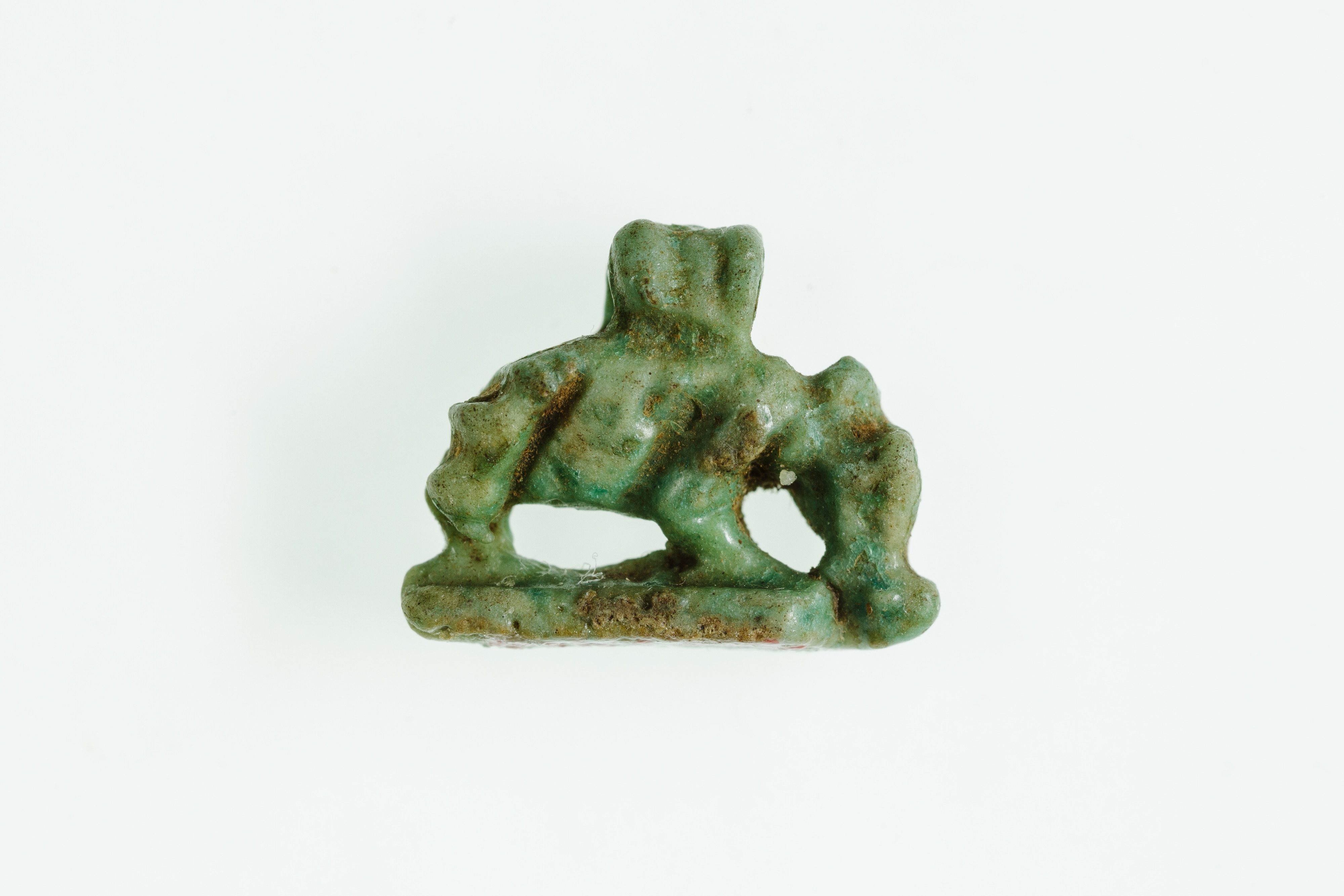
Executive Summary: The Sow Amulet as a Strategic Heritage Asset
Within the competitive landscape of high-end luxury, the ability to authenticate and monetize deep cultural narratives is a defining differentiator. This analysis examines the Sow Amulet—a faience artifact originating from Ancient Egyptian civilization—as a candidate for Katherine Fashion Lab's 2026 heritage-driven product strategy. The sow, an animal rarely associated with contemporary luxury, offers a counterintuitive yet potent symbolic reservoir. By decoding its historical adornment function, spiritual meaning, and material significance, this paper proposes a framework for translating an ancient protective device into a modern talisman of resilience, abundance, and esoteric luxury.
Historical Adornment and Materiality: The Faience Advantage
The Sow Amulet emerged prominently during Egypt's Middle Kingdom and maintained currency through the Late Period. Unlike the more common scarab or wedjat eye, the sow was a specialized device. Its medium—Egyptian faience—is critical to its luxury positioning. Faience is a non-clay ceramic composed of crushed quartz or sand, coated with a vitreous alkaline glaze that typically fired to a luminous blue-green. This material was not merely utilitarian; it was considered a manufactured stone of light, symbolizing rebirth, imperishability, and the radiance of the sun god Ra. For Katherine Fashion Lab, faience's technical narrative—sintered quartz, copper-based glazes, and controlled kiln transformation—offers a direct parallel to the brand's own commitment to material innovation and artisanal mastery.
Functionally, the Sow Amulet was worn as a pendant or incorporated into bead-net dresses and broad collars. Its placement against the body was not decorative alone. These amulets were often perforated longitudinally for stringing, suggesting they were worn directly on the skin or over linen. This intimate placement underscores a core luxury principle: adornment as a continuous, private ritual. The amulet was not displayed for public spectacle alone; it was a tactile, personal interface with the divine.
Symbolic Power: The Sow as Nurturer, Protector, and Celestial Vessel
Contrary to modern Western associations of the pig with excess or impurity, the Ancient Egyptian sow carried a tripartite symbolic load. First, she was the archetypal mother. The sow's prolific fertility and aggressive defense of her piglets linked her to Nut, the sky goddess who swallowed the sun each evening and gave birth to it at dawn. Amulets depicting a sow with suckling piglets were explicitly apotropaic—designed to protect mothers and infants during childbirth, the most perilous moment in the ancient lifecycle.
Second, the sow was a guardian against chaos. In the Coffin Texts and Book of the Dead, the sow is associated with the goddess Isis in her form as the "Lady of the West," a psychopomp who guided souls through the underworld. To wear a sow amulet was to carry a personal passkey to the afterlife—a spiritual insurance policy.
Third, and most strategically for luxury strategy, the sow embodied abundance without greed. She was a provider of sustenance in a pre-monetary economy. Her fat, her milk, and her fecundity were literal wealth. Yet she was also a liminal creature—nocturnal, omnivorous, and earth-bound—making her a bridge between the ordered world of the living and the untamed forces of nature. This duality—nurturing yet wild, domestic yet chthonic—creates a rich emotional tension that modern luxury consumers, particularly those seeking talismanic objects, find compelling.
Spiritual Meaning: From Apotropaic Device to Personal Sovereignty
The Sow Amulet's spiritual function was not passive. It was an active technology of the self. In a society where infant mortality exceeded thirty percent and maternal death in childbirth was common, the amulet represented a deliberate investment in survival. It was worn by the living to ward off malevolent entities such as the demoness Lamashtu (a later Mesopotamian cognate) and by the dead to ensure rebirth. This dual use—protection in life and transformation in death—positions the amulet as a continuous companion across thresholds.
For Katherine Fashion Lab, this translates into a narrative of sovereign resilience. The modern luxury consumer, particularly in the post-2024 economic and ecological climate, seeks objects that confer not just status but ontological security. A sow amulet, recontextualized, becomes a symbol of the wearer's ability to nurture their own ambitions, protect their inner circle, and emerge renewed from periods of darkness. It is not a passive charm; it is a declaration of agency.
2026 High-End Luxury Strategy: From Artifact to Icon
To translate the Sow Amulet into a 2026 luxury proposition, Katherine Fashion Lab must avoid literal archaeological reproduction, which risks museum-shop kitsch. Instead, the strategy should follow three pillars:
1. Material Subversion. Retain faience's chromatic identity—the copper-turquoise and manganese-violet glazes—but execute in technical ceramics or recycled glass composites. The goal is to evoke the ancient while satisfying modern durability and ethical sourcing standards. A limited-edition "Faience Reborn" series can anchor a high-margin capsule collection.
2. Symbolic Minimalism. The sow's form should be abstracted, not illustrated. A single curved line suggesting the back and snout, or a cluster of three spheres representing suckling piglets, allows the wearer to choose their level of esoteric disclosure. This supports the "if you know, you know" dynamic that drives luxury community engagement.
3. Ritualized Storytelling. Each piece should be accompanied by a provenance card detailing the amulet's original excavation context—ideally a specific museum accession number or tomb reference—and a modern interpretation of its protective function. This transforms the purchase into an act of cultural custodianship.
By 2026, the luxury market will reward brands that offer narrative depth over logo recognition. The Sow Amulet, with its three-thousand-year history of guarding mothers, guiding souls, and embodying abundance, provides Katherine Fashion Lab with a defensible heritage asset. It is not merely a pretty object from antiquity. It is a strategic instrument for a consumer who wants to wear their resilience, their fertility of ideas, and their connection to the eternal. The sow, long overlooked, may prove the most potent talisman of all.