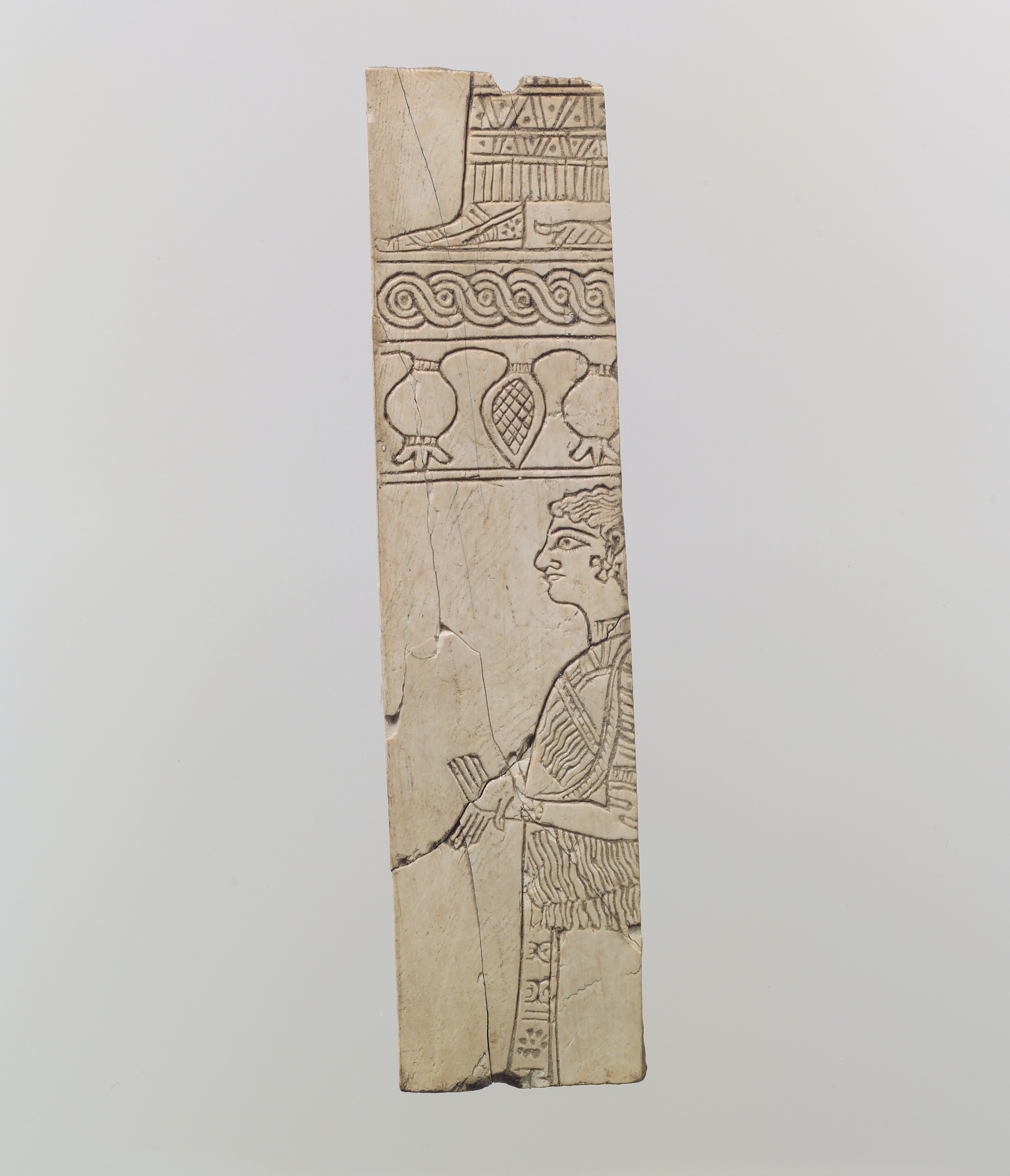
Heritage Asset Analysis: Assyrian Incised Ivory Furniture Plaque
Object Overview and Materiality
The artifact under examination is an incised ivory furniture plaque of Assyrian origin, dated broadly to the Neo-Assyrian period (circa 9th–7th century BCE). The plaque is organized into two horizontal registers, each containing a single anthropomorphic figure rendered in profile—a compositional convention that signals both narrative sequence and hierarchical ordering. Ivory, as a medium, was not merely decorative in the ancient Near East; it was a material of strategic scarcity, sourced from Syrian elephants and later imported from African and Indian trade networks. Its acquisition required capital, diplomatic access, and specialized craft labor. The plaque's original function—applied ornamentation on elite furniture—positions it at the intersection of domestic luxury and public display, a duality that remains commercially instructive for Katherine Fashion Lab's 2026 positioning.
Symbolic Power and the Iconography of Two Registers
The division into two registers is not incidental. In Assyrian visual grammar, registers function as a technology of hierarchy: upper fields typically denote divine or royal authority, while lower fields depict subordinate figures, attendants, or tributaries. The two-figure composition therefore encodes a relationship—dominance and service, protection and supplication, or ritual sequence between mortal and sacred spheres. For a luxury brand, this structural logic offers a precise metaphor: the architecture of value creation, in which a visible product (the lower register) is legitimized by an invisible system of craft, provenance, and meaning (the upper register).
The incised technique—cutting lines directly into the ivory surface rather than carving in high relief—implies controlled precision and economy of gesture. Incision rewards the trained hand and punishes hesitation. This is a craft signature of mastery, and it is precisely the attribute that contemporary high-end consumers associate with authenticity. In an era of algorithmic design and rapid prototyping, the incised plaque represents an opposing value system: irreversible artisanal decision-making.
Historical Adornment and the Furniture as Status Object
Assyrian ivory plaques were typically mounted on wooden furniture—thrones, beds, and ceremonial chairs—that circulated within palace and temple economies. The furniture itself has perished; the ivory survives. This asymmetry is analytically significant. What endures from a luxury object is rarely its functional substrate but its symbolic surface. The plaque is, in effect, a heritage fragment that has outlived its original utility, much as a brand's iconography outlives any single product cycle.
Adornment in this context was never ornamental in the modern sense. It was declarative. To sit on a chair bearing incised ivory figures was to occupy a position within a cosmic and political order. The plaque did not decorate power; it constituted it. For Katherine Fashion Lab, this reframes the role of embellishment in 2026 collections: surface is not secondary to structure but is itself the mechanism of authority.
Spiritual Meaning and Apotropaic Function
Neo-Assyrian ivory figures frequently served apotropaic purposes—guarding thresholds, warding off malevolent forces, and mediating between human and divine realms. The two registers may depict a deity and a devotee, or a protective spirit and a mortal, establishing a contract of protection. The spiritual economy of the object is therefore transactional: devotion in exchange for safeguarding.
This transactional spirituality maps onto contemporary luxury consumption with uncomfortable precision. High-end clients do not merely purchase objects; they purchase protection—from anonymity, from impermanence, from the erosion of taste. A heritage-led brand strategy must acknowledge this psychological contract. The plaque's spiritual meaning is not a decorative footnote; it is the original brand promise.
Strategic Implications for 2026 High-End Luxury
Three strategic conclusions emerge for Katherine Fashion Lab.
First, register logic as collection architecture. The two-register composition offers a merchandising framework: an upper tier of narrative, provenance, and ritual meaning, and a lower tier of accessible product. The upper register legitimizes the lower; the lower funds the upper. This is not a new idea, but the Assyrian plaque articulates it with unusual clarity.
Second, incision as authenticity signal. In a market saturated with digital perfection, the visible trace of the maker's hand becomes a premium asset. Katherine Fashion Lab should treat incised, hand-finished surfaces as a signature—not as nostalgia, but as evidence of irreversible human judgment.
Third, apotropaic positioning. The most durable luxury brands sell protection, not decoration. The Assyrian plaque guarded a chair; a 2026 collection can guard identity, memory, and status. The medium changes; the contract does not.
Conclusion
The incised Assyrian ivory plaque is a compact case study in how symbolic power, material scarcity, and spiritual function converge in a single object. Its two registers encode hierarchy; its incision encodes mastery; its original furniture context encodes status; its apotropaic role encodes protection. For Katherine Fashion Lab, the strategic value lies not in reproducing Assyrian motifs but in internalizing the plaque's operating logic: meaning above, product below, and the hand always visible. Heritage, properly curated, is not a backward glance but a forward contract.