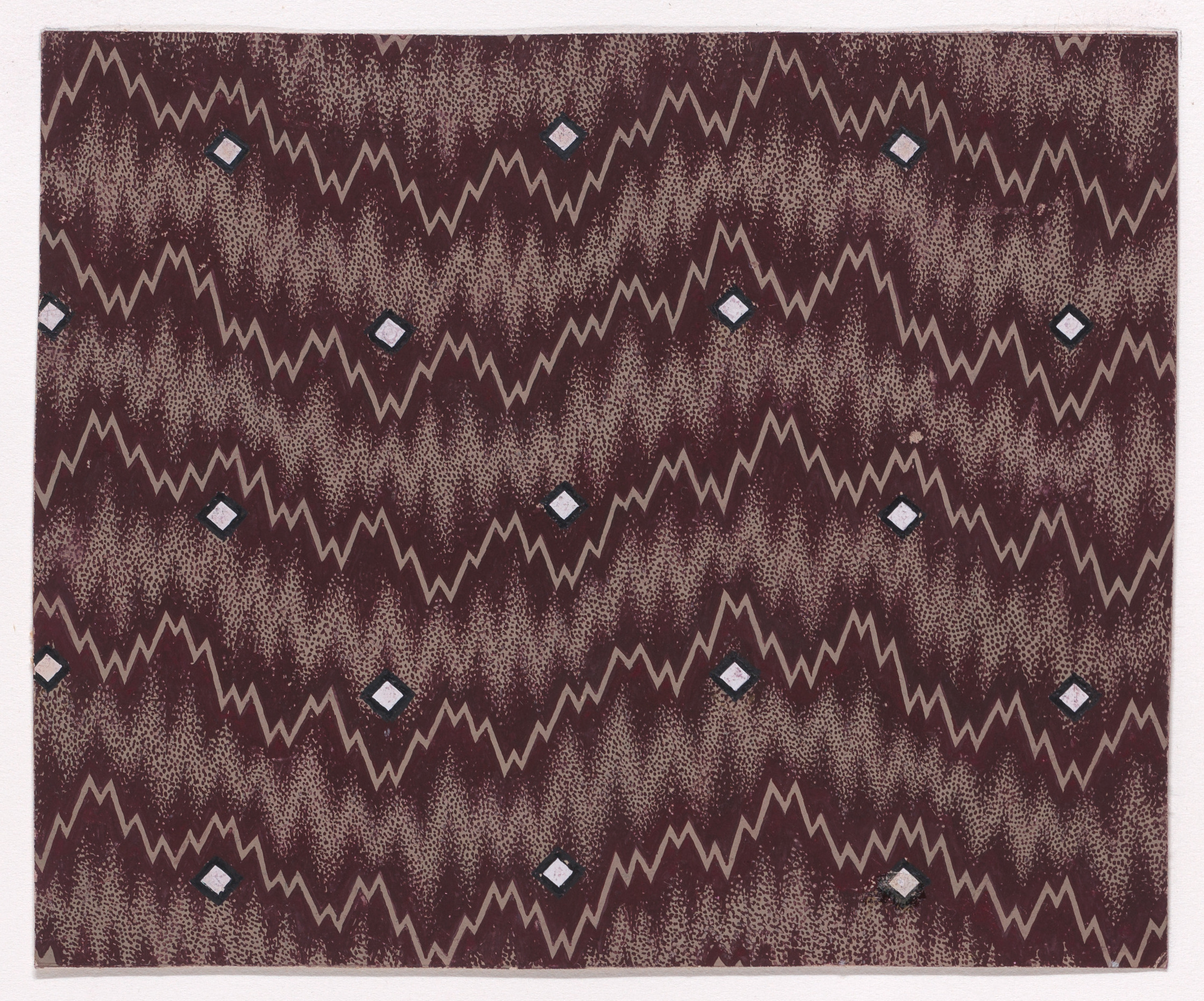
Formal Analysis of an Undulating Zig-Zag Textile Study
The artifact under consideration is a standalone gouache study depicting a textile pattern composed of undulating horizontal zig-zagging lines interspersed with alternating rows of lozenges. Executed on paper in an opaque water-based medium, the study functions less as a finished textile and more as a design proposition—a specimen of pattern thinking that bridges geometric abstraction and material application. Within the broader discourse of global heritage textile traditions, such studies occupy a liminal position: they are simultaneously documents of cultural memory and forward-looking design instruments. This analysis situates the work within its formal, technical, and cross-cultural contexts, arguing that its structural logic reveals a sophisticated negotiation between rhythm, symmetry, and spatial ambiguity.
Formal Structure and Visual Rhythm
The composition is governed by a horizontal band system in which two motif families alternate: a continuous zig-zag line that undulates across the field, and discrete rows of lozenge shapes that occupy the interstitial zones. The zig-zag is not rigidly angular; its vertices are softened, producing a wave-like oscillation that reads as both linear and rhythmic. This undulation creates a lateral pulse—a visual cadence that the eye follows left to right, then repeats vertically through stacked bands.
The lozenge rows introduce a contrasting logic. Where the zig-zag is continuous and flowing, the lozenges are discrete, self-contained, and bilateral in symmetry. Their diamond geometry echoes the angles of the zig-zag vertices, establishing formal rhyme across the pattern. The alternation of these two families produces a figure-ground oscillation: at one moment the zig-zag dominates as the primary structure; at another, the lozenge rows assert themselves as the organizing grid. This perceptual flip-flop is central to the study's visual interest and prevents it from resolving into mere stripe or mere lattice.
Color, Gouache, and Material Intelligence
Gouache is a revealing choice for a textile study. Its opacity allows the designer to simulate the flat, saturated color fields of woven or printed cloth without the transparency shifts of watercolor. In this study, the medium's matte surface and crisp edges approximate the appearance of dyed yarn or block-printed pigment on a ground. The palette—likely composed of earth-derived tones alongside one or two saturated accents—reflects a heritage sensibility, yet the precision of the linework indicates a modern design discipline.
The material intelligence of the study lies in its translation logic. A textile designer reading this gouache would immediately consider weave structure: could the zig-zag be achieved through a twill or herringbone variation? Could the lozenges correspond to supplementary weft floats or resist-dyed motifs? The study thus operates as a technical hypothesis, not merely a decorative image. Its flatness is deliberate; it anticipates the loom, the print table, or the embroidery frame.
Global Heritage Contexts and Cross-Cultural Resonances
The pattern's vocabulary resonates across multiple textile traditions. Undulating zig-zag lines appear in Andean weaving as stepped diagonals and wave motifs, often encoding water, snake, or mountain symbolism. In West African strip-weaving, alternating geometric bands create comparable horizontal rhythms. Southeast Asian ikat and batik traditions employ lozenge and diamond forms as cosmological markers—thresholds between worlds, or protective amulets. The Nagas of Northeast India and the hill tribes of Laos and Thailand similarly use zig-zag and diamond registers to structure ceremonial cloth.
What distinguishes this study is not the invention of new motifs but their synthesis. The designer has abstracted these global vernaculars into a neutral, repeatable system. The result is a pattern that belongs to no single culture yet speaks to many—a hallmark of contemporary heritage-inspired design. This is not appropriation in the extractive sense; it is a formal conversation, a recognition that geometric pattern is a shared human language.
Symmetry, Repetition, and the Mathematics of Pattern
From a structural standpoint, the study exhibits translation symmetry along the horizontal axis and alternating repetition along the vertical. The lozenge rows do not simply repeat; they alternate in position relative to the zig-zag, creating a staggered or offset rhythm. This offset is crucial: it prevents the pattern from becoming a static grid and introduces a subtle diagonal drift across the field.
The lozenges themselves may be analyzed as rhombi with internal subdivisions—perhaps a smaller lozenge within, or a central dot—though the study's resolution suggests a simplified rendering. This simplification is analytically important. It indicates that the study is a design shorthand, a notation intended for later elaboration in yarn, dye, or thread. The gouache is therefore a score, not a performance.
Conclusion: The Study as Design Instrument
As a standalone study, this work exemplifies the role of the textile designer as both archivist and innovator. It documents a global heritage of geometric pattern while proposing a new configuration. Its undulating zig-zags and alternating lozenge rows are not merely decorative; they are structural propositions about rhythm, symmetry, and material translation. In the context of Katherine Fashion Lab's curatorial focus, the study serves as a reminder that couture begins not with the garment but with the line—and that the line, when drawn in gouache, already carries the memory of the loom.
The piece ultimately resists closure. Its bands could extend infinitely; its palette could shift with each iteration; its motifs could be scaled, inverted, or interlocked. This openness is its greatest strength. It is a pattern in potential—a heritage-informed, materially intelligent, and formally rigorous contribution to the language of textile design.