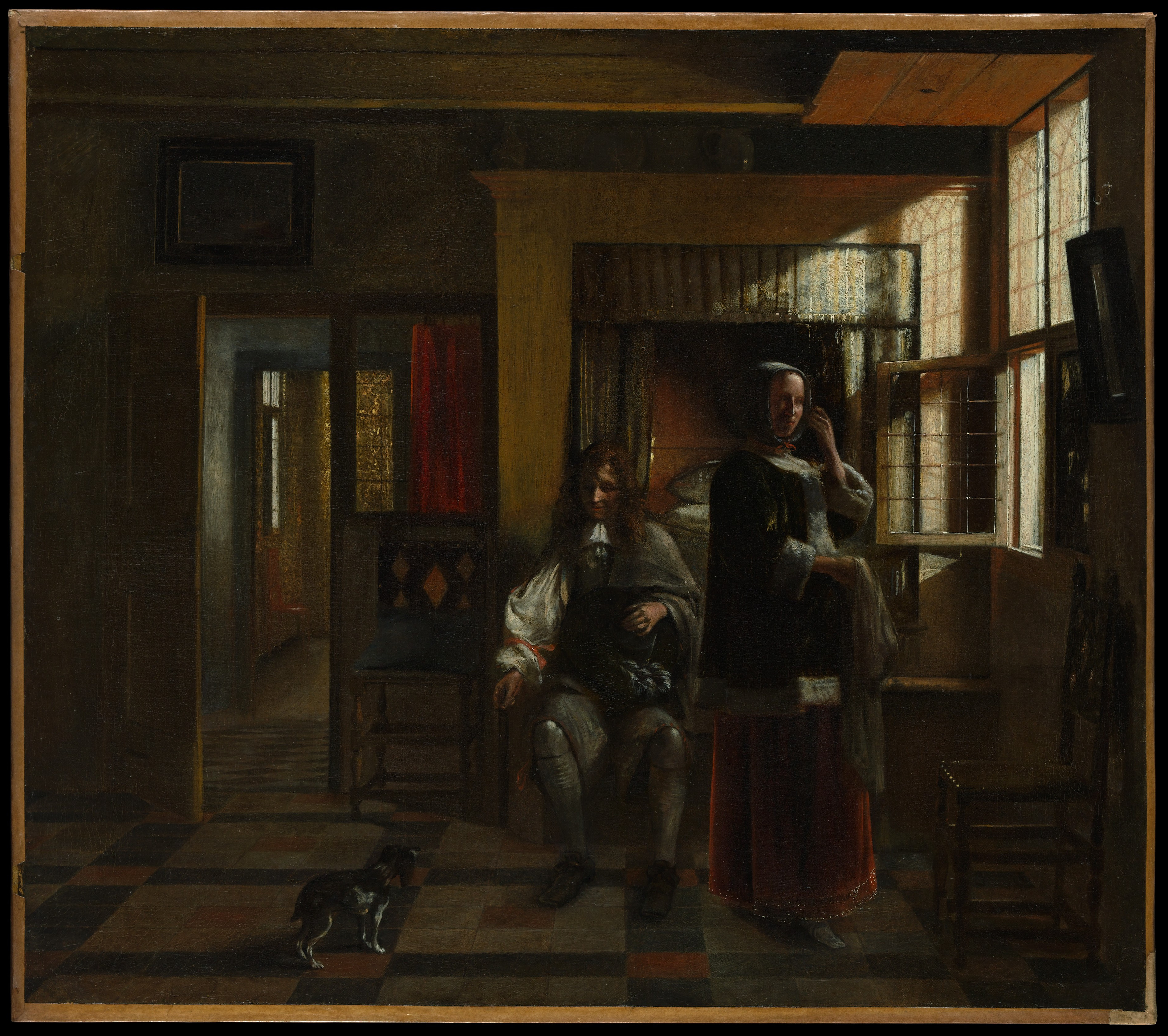
Interior with a Young Couple: A Study in Domestic Intimacy and Material Culture
Katherine Fashion Lab presents a focused couture analysis of Interior with a Young Couple, an oil on canvas work situated within the broader tradition of Global Heritage genre painting. As a standalone study, the composition rewards close reading not merely as a narrative of courtship or cohabitation, but as a dense sartorial document—one in which textiles, silhouettes, and domestic objects function as a shared visual language of class, aspiration, and gendered performance. This analysis examines how the painting constructs meaning through dress and interiority, and why its lessons remain instructive for contemporary fashion criticism.
Compositional Logic and the Architecture of Intimacy
The canvas organizes itself around a quiet but deliberate geometry: two figures positioned within a contained interior, their bodies angled toward a common center yet separated by furniture, light, and the subtle choreography of gaze. The room is not a backdrop but an active participant. Light falls across surfaces—polished wood, woven textiles, ceramic or metalware—creating a hierarchy of attention that directs the viewer from the couple outward to the objects that define their world. In the tradition of Northern European and later global genre painting, such interiors operate as moral and social microcosms: what is displayed is never merely decorative, but declarative.
For the fashion historian, the crucial insight is that the couple’s garments and the room’s furnishings are rendered with equivalent care. The artist does not treat dress as incidental costume; it is continuous with the environment. This continuity is the painting’s central couture argument: identity is constructed through an assemblage of surfaces, and the boundary between body and room is porous, negotiated through texture, color, and finish.
Sartorial Reading: Silhouette, Fabric, and Gendered Codes
The young man’s attire typically signals a transitional masculinity—neither aristocratic excess nor laboring roughness, but the studied moderation of the emerging professional or merchant class. His coat, cut with relative restraint, relies on the fall of the fabric rather than ornament for its effect. The collar and cuffs are precise, the waistline controlled, the palette subdued but not austere. This is a silhouette designed to communicate reliability, self-possession, and taste that stops short of ostentation. In couture terms, it is a study in negative space: what is omitted matters as much as what is shown.
The young woman’s dress performs a different but complementary labor. Her bodice and skirt articulate the torso through structure—stays, seams, and the strategic distribution of volume—while the fabric itself carries the visual burden of status. Where the man’s clothing whispers, hers often speaks: a sheen here, a ribbon or trim there, a neckline that frames the face and directs the eye. The painting’s treatment of her textiles is especially revealing. Oil paint is uniquely suited to rendering the way light sits on a surface—the dull absorption of wool, the cool slide across silk, the broken highlights of a linen apron or shawl. Each fabric choice is a class marker and a mood.
Critically, the couple’s dress is coordinated without being matching. Their palettes echo one another; their silhouettes rhyme rather than duplicate. This is the visual grammar of partnership as it was understood in the period: difference within harmony, separate spheres rendered legible through shared material codes.
Interior as Couture Object: Textiles, Furniture, and the Display of Taste
The room itself must be read as a garment. The table covering, the chair backs, the hangings or cushions—these are textiles in the fullest sense, and the painter lavishes attention on their weight and drape. A cloth that falls in stiff, angular folds tells us about fiber and finish; a cushion that compresses under a resting hand tells us about stuffing and use. In the logic of the painting, the interior is not a stage set but a second skin, one that extends the couple’s sartorial self-presentation into the architecture of daily life.
This is where the work’s Global Heritage dimension becomes most legible. The objects in the room—whether imported ceramics, patterned fabrics, or furniture forms with cross-cultural lineages—speak to networks of trade and exchange. The couple’s domestic space is a node in a wider world of goods. Their taste is not purely local; it is curated from a global marketplace, however modest its reach. For the contemporary analyst, this anticipates the modern fashion system’s dependence on appropriation, translation, and the constant recontextualization of the foreign as the familiar.
Narrative Ambiguity and the Standalone Study
As a standalone study, Interior with a Young Couple resists definitive narrative closure. Are they newly married? Betrothed? Siblings? The painting withholds the clarifying gesture or inscription that would settle the question. This ambiguity is not a failure but a method. It forces the viewer to read the relationship through material evidence: proximity, posture, the shared focus on an object or task, the coordination of dress. The couple’s story is told in fabric and furniture, not in faces alone.
This has direct relevance to fashion analysis. Dress is never merely worn; it is staged. The painting demonstrates that the most persuasive sartorial statements are those embedded in a total environment—where garment, object, and space collaborate to produce a coherent social self. The young couple does not simply occupy a room; they and the room together produce a meaning that neither could generate alone.
Couture Implications: From Historical Canvas to Contemporary Practice
For Katherine Fashion Lab, the value of this work lies in its methodological lesson. It teaches that couture analysis must be interdisciplinary: attentive to silhouette and seam, but equally to lighting, furniture, and the economics of display. It reminds us that the most enduring fashion images are those in which the human figure is not isolated but situated—embedded in a material world that confirms, complicates, or quietly contradicts the wearer’s intentions.
The painting also offers a caution against reading historical dress as mere nostalgia. The couple’s choices—moderate, legible, aspirational—mirror contemporary anxieties about authenticity, class signaling, and the performance of coupledom. Their oil-on-canvas interior is a distant mirror. What we see in it depends on what we are trained to notice: the fall of a coat, the sheen of a tablecloth, the space between two bodies that dress and room together make meaningful.
In sum, Interior with a Young Couple is not a minor genre piece but a compact treatise on the social life of cloth. It argues that identity is furnished—stitched, draped, and upholstered—and that the interior is the first and most intimate couture collection any of us ever inhabits. The painting’s enduring power lies in its refusal to separate the couple from their surroundings, and in its insistence that we read both as one continuous, carefully composed surface.