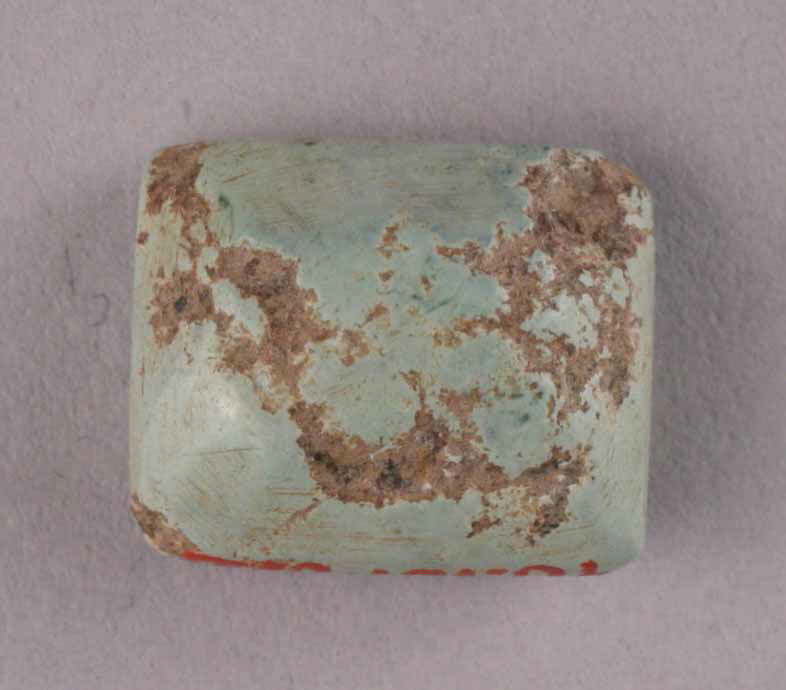
Stone: The First Material of Adornment
Before metal was smelted, before fiber was woven, stone was pierced. The earliest known beads—shell and stone perforated with deliberate intent—predate agriculture, pottery, and the written word. To pierce stone is to impose human will upon geological time. It is among the oldest gestures of adornment, and it remains one of the most conceptually potent. In this standalone study, Katherine Fashion Lab examines stone not as a decorative accent but as a primary material of couture, one whose aesthetic authority derives from its paradoxes: permanence and fragility, mass and lightness, the geological and the intimate.
The act of piercing is the critical intervention. A stone left whole belongs to nature; a stone pierced belongs to culture. The hole transforms the object from a specimen into a component, from a curiosity into a system. This distinction matters enormously in couture, where every material must be made to serve the body. Stone, by nature, resists the body—it is heavy, rigid, cold. Piercing is the technical solution that renders it wearable, but it is also a symbolic one: the aperture is where the human enters the mineral, where the artifact becomes a vessel for meaning.
Global Heritage and the Grammar of Stone
Stone adornment is a genuinely global inheritance, and its diversity resists any single narrative. In the Andean highlands, lapis lazuli was pierced and strung into pectorals that signaled both cosmological knowledge and political authority. In the Sahel, carnelian and agate beads moved along trans-Saharan routes for centuries, their perforations evidence of a trade in beauty as much as in goods. In the Pacific Northwest, argillite and slate were carved and drilled into forms that encoded lineage. In the Indus Valley, steatite beads were fired and pierced with such precision that modern analysis suggests drill technologies of remarkable sophistication.
What unites these traditions is not a shared style but a shared logic: stone is chosen for its color, its hardness, and its provenance, then pierced to enter the realm of the wearable. The hole is the point of translation. It converts a material of the earth into a material of the body, and in doing so it converts geology into biography.
Material Properties and Couture Discipline
For the couturier, stone presents a set of constraints that are also opportunities. Its density demands structural consideration: a pierced stone necklace must distribute weight across the clavicle, not concentrate it at a single point. Its hardness requires specialized tooling—diamond drills, ultrasonic perforation, water-jet techniques—each of which leaves a distinct surface signature. Its thermal conductivity means it feels cool against skin, a sensory fact that designers can either mitigate with backing or exploit for deliberate effect.
Stone also imposes a discipline of scale. Unlike beads of glass or resin, pierced stone cannot be infinitely reduced without losing presence. Each piece carries the visual weight of its origin, and a couture composition must respect that. The most successful stone work in high fashion treats the material as an architectural element rather than a surface embellishment: it provides structure, rhythm, and contrast. It is the punctuation, not the prose.
The Aesthetics of the Aperture
The pierced hole is not merely functional. It is an aesthetic event. A clean, centered perforation reads as precision; an off-center or irregular hole reads as organic. The interior of the hole—often overlooked—is a surface in its own right, and in fine work it is polished to match the exterior. This attention to the unseen is a hallmark of couture: the interior finish that only the wearer knows.
There is also a philosophical dimension. A pierced stone is a stone that has been wounded and healed into a new form. It carries the trace of the tool, the mark of human intention. In an era of digital reproduction, this trace is increasingly valuable. It is evidence of the hand, of time, of a decision made once and not repeated. Couture has always traded in such evidence.
Conclusion: Stone as Standalone Study
To study stone in isolation is to recognize that adornment does not begin with precious metals or gemstones in the modern sense. It begins with the decision to pierce a material that was never meant to be pierced, to make it serve the body and carry meaning. Stone is the first material of couture because it is the first material that required couture-level skill to wear. Its global heritage is not a single tradition but a constellation of local genius. Its material properties demand respect. Its pierced aperture is the smallest and most consequential detail in the entire history of dress. Katherine Fashion Lab treats stone not as a trend but as a foundational language, one that continues to speak with geological patience and human precision.