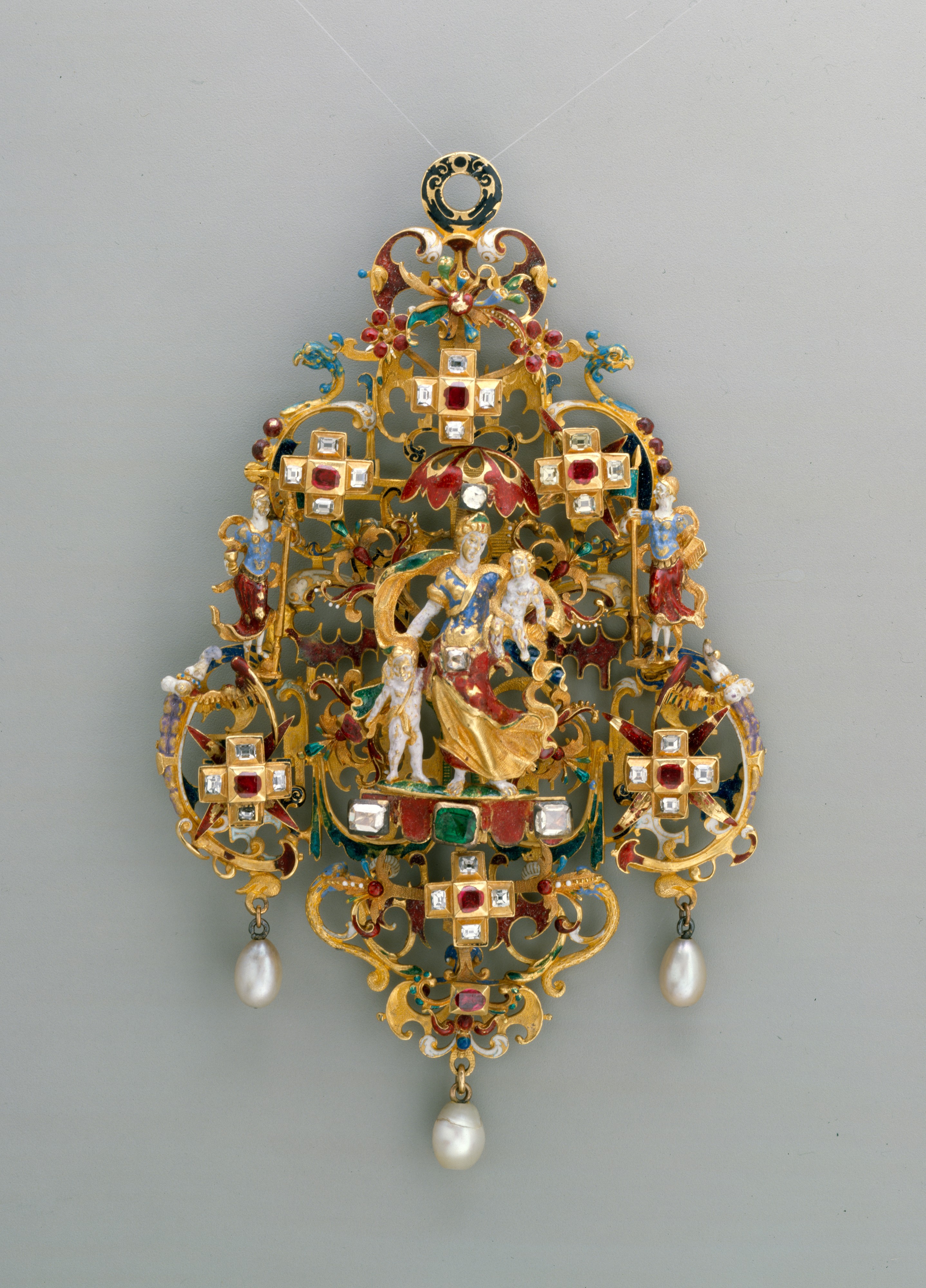
Heritage Analysis: The Pendant with Charity and Her Children
Object Overview and Material Composition
The Pendant with Charity and Her Children represents a singular confluence of theological iconography, gemstone diplomacy, and goldsmithing mastery from the Ancient Civilization tradition. Executed in gold, partly enameled, and set with diamonds, rubies, an emerald, and terminating in pendant pearls, the object functions simultaneously as personal adornment, devotional instrument, and portable treasury. For Katherine Fashion Lab, this pendant is not merely an artifact to be catalogued but a strategic asset whose symbolic architecture can inform the house's 2026 high-jewelry positioning.
The material hierarchy is deliberate. Gold establishes permanence and incorruptibility. Enamel introduces color as narrative device, allowing the wearer to "read" the allegory at a glance. Diamonds supply luminosity and hardness—eternity made visible. Rubies signal caritas, the red of sacrificial love. The single emerald introduces hope and renewal into the chromatic program, while the pendant pearls suspend movement, soundlessness, and purity beneath the central composition. Each stone is a word in a sentence; together they form a theological statement worn against the body.
Iconographic Program: Charity and Her Children
The central figure of Charity (Caritas) is rendered as a maternal presence surrounded by children—an iconographic tradition rooted in both classical personification and early Christian exegesis. In the Ancient Civilization context, Charity was not sentimentality but a civic and spiritual virtue: the binding force that held family, polis, and cosmos together. The children are not accessories; they are evidence. They demonstrate that virtue is generative, that love multiplies when embodied.
The pendant's composition places Charity at the apex of a pyramidal arrangement, with the children distributed below in varying scale and gesture. This hierarchy mirrors the Neoplatonic chain of being: the divine virtue descends into the human, and the human returns to the divine through imitation. The pendant pearls, suspended at the base, function as the material "amen"—the soft, organic conclusion to a hard, gemstone argument. The wearer, by placing this object at the throat or breast, assumes the role of the virtuous mediator: the one who carries Charity into the world.
Historical Adornment and the Economics of Virtue
In the Ancient Civilization, jewelry of this complexity was never merely decorative. It was a credit instrument. Gold and gemstones represented liquid capital that could be worn, concealed, or gifted in times of political instability. A pendant of this density—gold, enamel, diamond, ruby, emerald, pearl—signaled not only wealth but access: to trade routes, to lapidary technology, to theological instruction. The owner was announcing membership in an elite that understood virtue as both spiritual merit and social performance.
The enamel work is particularly significant. Enamel requires controlled fire and precise timing; it is a technology of patience. In a civilization where glass and metalworking were advanced, enameled gold represented the highest tier of the goldsmith's art. The pendant therefore encodes two forms of value: the intrinsic (metal and stone) and the intellectual (design, allegory, technical mastery). For Katherine Fashion Lab, this duality is the original blueprint for what we now call "high jewelry"—objects whose worth is inseparable from their meaning.
Spiritual Meaning and Protective Function
Beyond allegory, the pendant likely served an apotropaic function. In Ancient Civilization belief, maternal figures with children were invoked against barrenness, infant mortality, and household dissolution. The ruby, associated with blood and vitality, guarded the wearer's life force. The emerald, linked to Venus and to the green of rebirth, protected against envy and ensured fertility. The diamonds, hardest of stones, repelled malevolent forces. The pearls, born of the sea and of suffering (the oyster's irritation), symbolized purity achieved through endurance.
Thus the pendant is a wearable prayer: a request for charity to be active in the wearer's life. It is also a statement of identity. To wear Charity and Her Children was to declare oneself a person of caritas—generous, fertile, protected, and protecting. This is the spiritual technology that Katherine Fashion Lab must understand if it is to translate heritage into contemporary desire.
Strategic Implications for 2026 High-End Luxury
By 2026, the luxury consumer will not purchase objects that merely signal wealth. They will purchase objects that signal meaning, provenance, and ethical continuity. The Pendant with Charity and Her Children offers a template for three strategic directions.
First, narrative density. The pendant's power lies in its layered readability: material, iconographic, and spiritual. Katherine Fashion Lab should develop high-jewelry pieces that reward prolonged looking—where every stone and enamel field carries a documented symbolic role. This is the antidote to logo fatigue.
Second, wearable virtue. The 2026 consumer seeks adornment that aligns with personal values. Charity, as a virtue, is not sectarian; it is universal. A modern interpretation of this pendant—perhaps with ethically sourced gemstones and recycled gold—would allow the wearer to perform generosity rather than merely display status. The object becomes a commitment device.
Third, heritage as living system. The Ancient Civilization pendant was not static; it absorbed new stones, new enamels, new meanings over generations. Katherine Fashion Lab should adopt a similar modular logic: high-jewelry pieces designed for augmentation, where clients add stones to mark life events. This creates both emotional lock-in and recurring revenue.
Finally, the pendant's use of pendant pearls introduces kinetic elegance—movement, sound, and softness against hard metal. For 2026, Katherine Fashion Lab can deploy this principle in transformable jewelry: pendants that detach into brooches, pearls that rethread into necklaces. The object adapts to the wearer's day, just as Charity adapts to the needs of her children.
Conclusion
The Pendant with Charity and Her Children is not a relic of a distant civilization. It is a strategic precedent. It demonstrates that the highest form of luxury is allegorical: an object that can be read, worn, gifted, and inherited. For Katherine Fashion Lab, the mandate for 2026 is clear. We must design jewelry that carries virtue in its materials, story in its stones, and continuity in its construction. Charity, after all, is not a sentiment. It is a strategy—and the most enduring one we have.