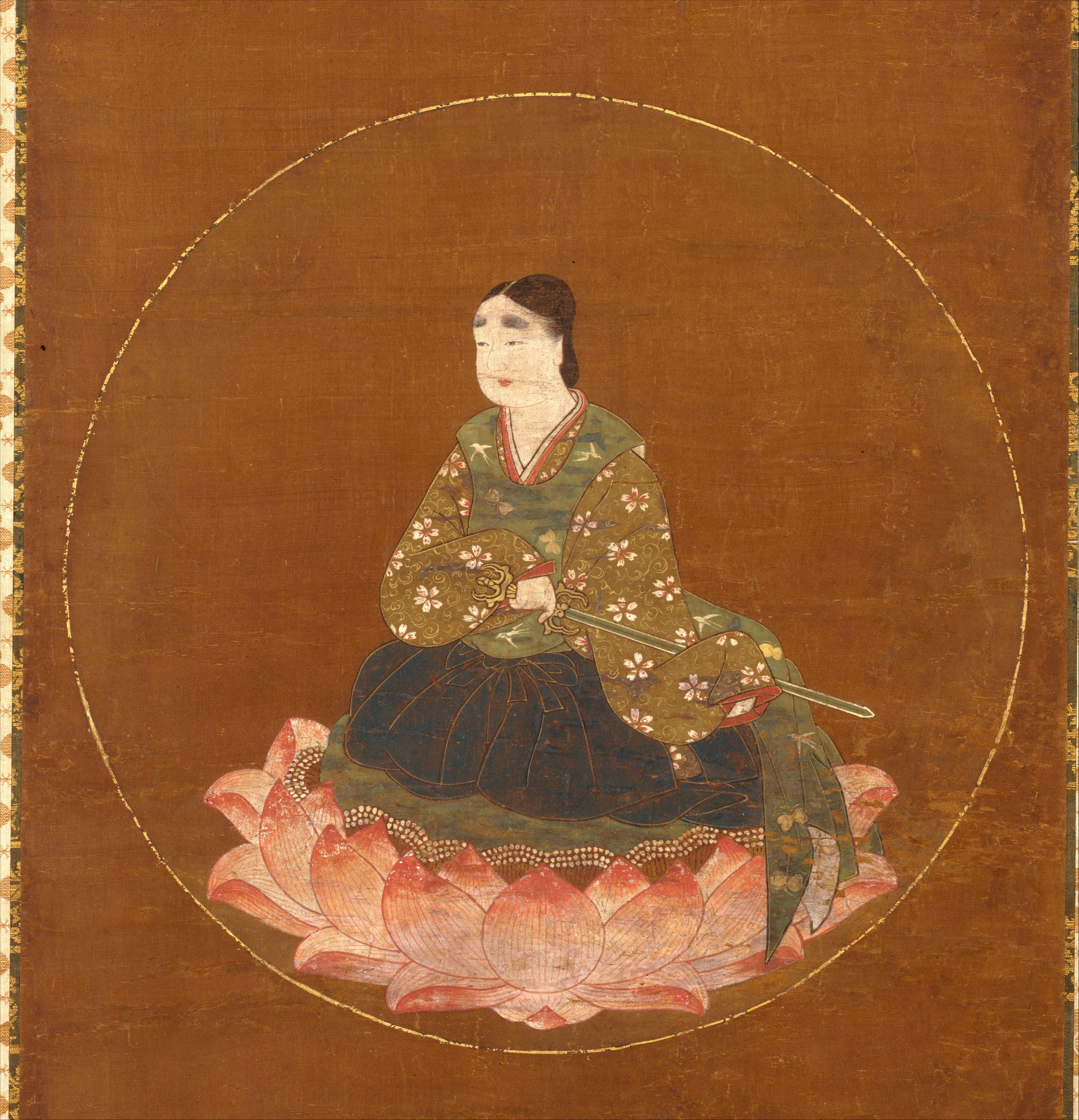
Mandala of Wakamiya of Kasuga Shrine: A Study in Sacred Synthesis
The Mandala of Wakamiya of Kasuga Shrine (Kasuga wakamiya mandara) stands as a singular artifact of medieval Japanese religious art, a hanging scroll executed in ink, color, gold, and cut gold (kirikane) on silk. Unlike the large-scale mandala sets that proliferated in esoteric Buddhist contexts, this work functions as a standalone devotional image. Its subject is not a cosmic Buddha or a wrathful deity, but a sacred landscape—the Wakamiya sub-shrine of Kasuga Taisha in Nara—rendered as a theophany. The scroll invites the viewer into a layered visual theology where Shinto kami, Buddhist deities, and courtly aesthetics converge. For the couture analyst, the mandala offers a masterclass in material hierarchy, compositional restraint, and the translation of spiritual authority into textile and pigment.
Materiality as Devotional Language
Silk, Gold, and the Economics of Sanctity
The choice of silk as the support is neither neutral nor merely practical. In medieval Japan, silk was a luxury substrate reserved for high-status commissions—courtly, monastic, or aristocratic. Its smooth, lustrous surface allowed for fine brushwork and the subtle absorption of mineral pigments. The application of cut gold (kirikane), a technique in which thin gold leaf is sliced into minute strips and applied with glue to create linear highlights, elevates the scroll from illustration to relic. Each gold line—whether outlining the shrine’s roof tiles, the folds of a deity’s robe, or the petals of a lotus—catches candlelight during ritual viewing, producing a flickering, almost kinetic effect. This is not decoration for its own sake; it is an index of sacred presence. The gold does not merely depict light; it is light, a material sign of the kami’s luminous body.
Pigment Hierarchy and Visual Grammar
The palette is disciplined: mineral greens, azurite blues, vermilion, and shell white, all bound in animal glue. These colors are not applied naturalistically. Instead, they follow a hierarchical logic. The central shrine structure—the Wakamiya—is rendered in precise architectural detail, its pillars and eaves defined by ink outlines and gold accents. Surrounding it, deer (sacred messengers of Kasuga) appear in soft washes, while flowering branches of wisteria and cherry are painted with a delicate, almost calligraphic touch. The eye is led from the gold-encrusted shrine outward to the natural world, then back again. This centripetal composition mirrors the mandala’s function: to draw the devotee from the periphery of mundane perception into the core of sacred reality.
Iconography: Shinto-Buddhist Syncretism
The Wakamiya as Theophany
Wakamiya, literally “young shrine,” was established in 1135 as a sub-shrine of Kasuga Taisha, dedicated to the child deity Ame-no-Oshikumone-no-Mikoto. By the medieval period, this kami was identified with Kannon (Avalokiteshvara) and, in some lineages, with Monju (Manjushri). The mandala does not depict the kami in anthropomorphic form. Instead, the shrine building itself becomes the deity’s body. The roof’s curvature, the vermilion pillars, the sacred fence (tamagaki)—all are rendered with such precision that the architecture functions as a mandalic center. This is a visual argument: the kami is not confined to a statue or painting but is immanent in the built environment. The silk scroll becomes a portable shrine, allowing devotees to carry the sacred site with them.
Deer, Wisteria, and the Kasuga Landscape
The presence of deer is not incidental. In Kasuga belief, deer are messengers of the kami, and their depiction here—some grazing, others recumbent—creates a narrative frame. The wisteria (fuji), the clan flower of the Fujiwara, who patronized Kasuga Shrine, appears in cascading clusters. These botanical and animal elements are not background; they are heraldic devices that tie the mandala to specific lineages of patronage. The gold accents on the wisteria and deer antlers suggest that even the natural world participates in the sacred economy of light. The viewer is not looking at a landscape; they are looking at a genealogy of holiness.
Compositional Strategy: The Mandala Without a Circle
Traditional mandalas use geometric symmetry—circles, squares, grids—to map the cosmos. The Kasuga wakamiya mandala abandons that geometry for a topographical asymmetry. The shrine sits slightly off-center, surrounded by trees and paths that meander rather than radiate. This is a landscape mandala, where the sacred center is not a diagram but a place. The silk’s vertical format encourages a downward gaze: from the shrine’s roof, past the deer, to the lower edge where a stream or path might disappear. The effect is one of descent into presence. The viewer does not ascend through realms; they arrive, as a pilgrim would, at the shrine’s gate.
Cut Gold as Ritual Technology
The kirikane technique deserves special attention. Unlike gold paint, which can appear flat, cut gold strips create micro-shadows that change with viewing angle. In a dimly lit temple, a candle’s flame would cause the shrine’s outlines to sparkle and shift. This is not a static image; it is an interactive surface. The mandala’s spiritual efficacy depends on this material dynamism. The gold is not a symbol of the kami’s radiance; it is a participatory medium, allowing the devotee to experience that radiance through the senses.
Conclusion: The Mandala as Couture Object
For Katherine Fashion Lab, the Mandala of Wakamiya of Kasuga Shrine is a case study in sacred couture. Every material choice—silk, mineral pigment, cut gold—is a decision about hierarchy, light, and touch. The composition rejects symmetry for a lived topography, inviting the viewer to walk rather than calculate. The iconography fuses Shinto and Buddhist semiotics without collapsing either into the other. And the gold does not merely decorate; it performs. This hanging scroll is not a picture of a shrine. It is a portable theophany, a textile argument that the sacred is not elsewhere but here, woven into silk and caught in the flicker of a flame. In an age of digital reproduction, the mandala reminds us that true luxury is not abundance but precision of presence—the ability of a single gold line to hold a god.