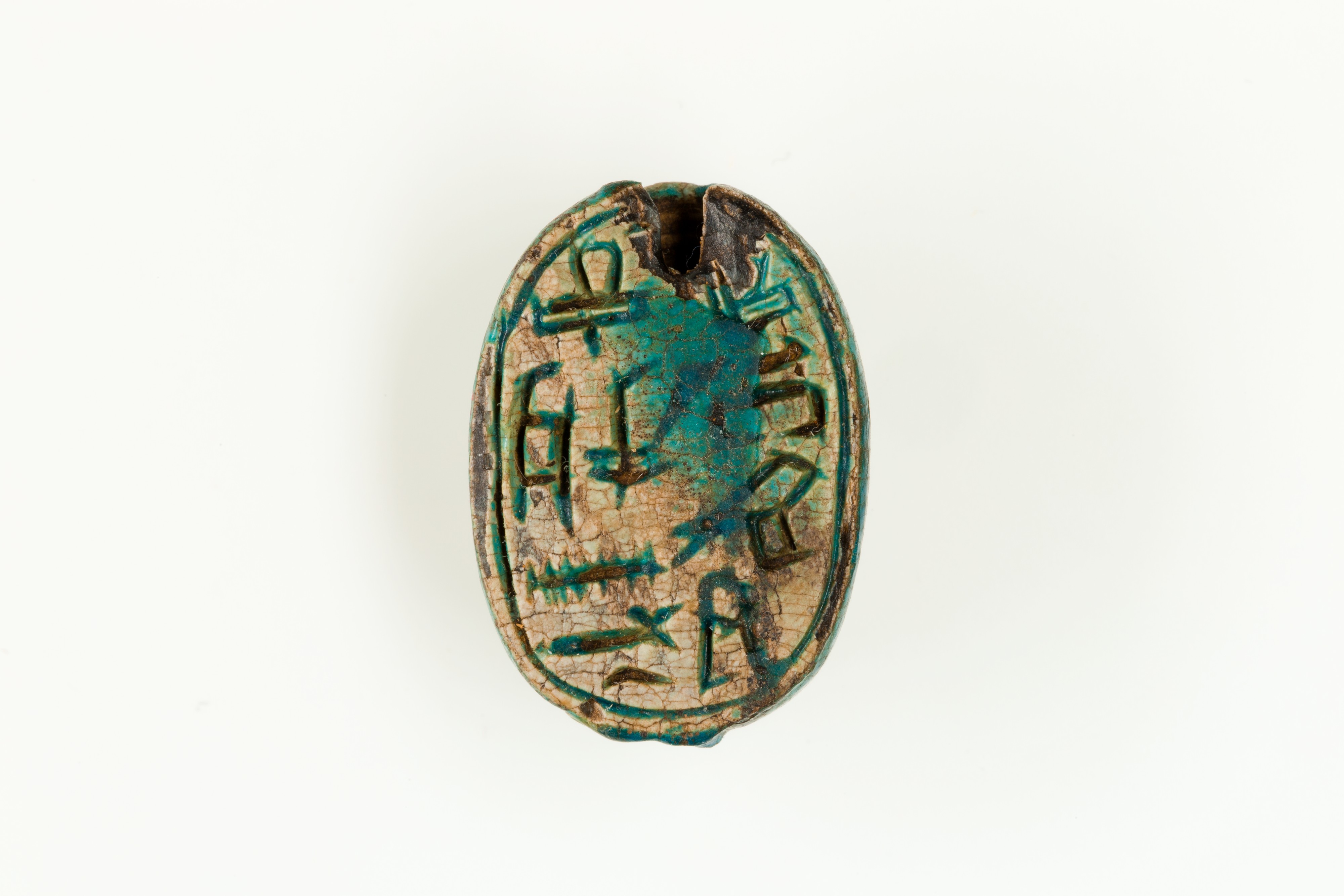
Executive Summary: The Scarab of an Official as a Strategic Heritage Asset
The Scarab of an Official, rendered in blue glazed steatite, represents one of the most commercially viable yet under-leveraged heritage archetypes available to Katherine Fashion Lab. This analysis examines the object across four strategic dimensions: symbolic power, historical adornment, spiritual meaning, and 2026 high-end luxury application. The scarab is not merely an artifact; it is a compressed system of authority, protection, and transformation that maps directly onto contemporary luxury consumer psychology. For Katherine Fashion Lab, the scarab offers a rare opportunity to build a standalone heritage pillar that speaks to power dressing, talismanic desire, and authenticated provenance—without the saturation risks associated with more widely commercialized Egyptian motifs.
Symbolic Power: The Scarab as Administrative Seal and Status Marker
In the administrative machinery of ancient Egyptian governance, the scarab amulet served a dual function: personal ornament and official seal. Officials of the Middle and New Kingdoms employed scarabs inscribed with titles, cartouches, and protective formulae as portable instruments of authority. The blue glazed steatite—achieved through copper oxide faience or glaze over carved steatite—was not decorative preference but a deliberate material signal. Blue, in Egyptian cosmology, invoked the primordial waters of Nun, regeneration, and the celestial realm. An official wearing a blue scarab was not simply accessorizing; he was broadcasting alignment with divine order, Ma'at, and the pharaonic state.
Strategically, this positions the scarab as an early example of what modern luxury calls "power branding." The object functioned as a wearable signature, authenticating documents and identity simultaneously. For Katherine Fashion Lab, this historical precedent legitimizes a product narrative built on authority, verification, and institutional trust—values that resonate strongly with C-suite and legacy-wealth clientele in 2026.
Historical Adornment: From Amulet to Regalia
The scarab's journey from practical seal to high adornment mirrors the evolution of luxury itself. By the Amarna period and into the Ramesside era, scarabs were set in gold rings, strung on elaborate necklaces, and incorporated into pectorals worn by elites. The blue glazed steatite variety occupied a specific tier: more accessible than lapis lazuli or turquoise, yet materially distinct from common faience. This middle stratum of luxury is instructive. It demonstrates that prestige adornment has always operated across price tiers without diluting symbolic capital.
For a 2026 luxury strategy, this suggests a tiered collection architecture. A core line of blue glazed ceramic or enamel scarab pendants, cufflinks, and signet rings can capture aspirational consumers, while a halo line in lapis, sapphire, or 18k gold with hand-carved steatite inlay serves ultra-high-net-worth clients. The historical record supports both without contradiction. The scarab was never singular in its material expression; it was consistent in its symbolic function.
Spiritual Meaning: Protection, Transformation, and the Eternal Return
The scarab beetle, Khepri, symbolized the rising sun and self-creation. The image of the beetle rolling a ball of dung was interpreted as the sun god pushing the solar disk across the sky—a metaphor for daily rebirth and cosmic order. Placed on the chest of the deceased, the heart scarab was inscribed with Chapter 30B of the Book of the Dead, a spell to prevent the heart from testifying against its owner during judgment. This is not passive superstition; it is an active technology of spiritual assurance.
In contemporary luxury, spiritual meaning has become a primary driver of value. Consumers in 2026 seek objects that carry metaphysical weight—talismans, amulets, and "intention pieces" that promise protection, transformation, or alignment. The scarab of an official delivers this narrative authentically. It is not a new-age invention; it is a three-thousand-year-old artifact with documented ritual use. Katherine Fashion Lab can position the scarab as a "seal of self-sovereignty," a wearable affirmation of personal authority and renewal. This framing avoids the pitfalls of cultural appropriation by grounding every claim in archaeological and textual evidence.
2026 High-End Luxury Strategy: Positioning the Scarab Pillar
The luxury market in 2026 is defined by three forces: provenance transparency, experiential retail, and the collapse of traditional seasonal calendars. A standalone scarab pillar aligns with all three. Provenance transparency demands that Katherine Fashion Lab publish its research lineage—museum comparanda, excavation records, and material analysis—as part of the product story. Experiential retail suggests that scarab launches should occur in immersive environments: darkened galleries with blue-lit vitrines, tactile steatite samples, and narrated rituals of "sealing" a purchase with a personalized inscription.
The collapse of seasonal calendars favors a permanent heritage collection rather than ephemeral drops. The scarab is not a trend; it is a continuous archetype. Katherine Fashion Lab should therefore establish a permanent "Seal of the Official" collection, refreshed annually with limited editions tied to specific historical reigns or administrative titles. This creates scarcity without artificiality.
Competitive analysis reveals that major luxury houses have mined Egyptian motifs inconsistently. Most rely on Cleopatra, Nefertiti, or ankh symbols—highly saturated and often divorced from functional history. The official's scarab occupies a defensible niche: administrative power, material specificity (blue glazed steatite), and spiritual utility. It is a B2B heritage asset disguised as a B2C ornament.
Recommended actions for Katherine Fashion Lab include: (1) commission a scholarly monograph on the official's scarab to anchor brand authority; (2) develop a signature blue glaze with a proprietary copper-oxide formulation; (3) partner with a museum for a co-branded capsule that includes a digital certificate of provenance; and (4) train client advisors in the object's symbolic grammar—Ma'at, Khepri, heart scarab theology—so that every sale is an act of cultural transmission, not mere transaction.
The Scarab of an Official is not a relic to be admired from a distance. It is a strategic instrument. Handled with research rigor and narrative discipline, it can become the defining heritage pillar of Katherine Fashion Lab's high-end portfolio for 2026 and beyond.