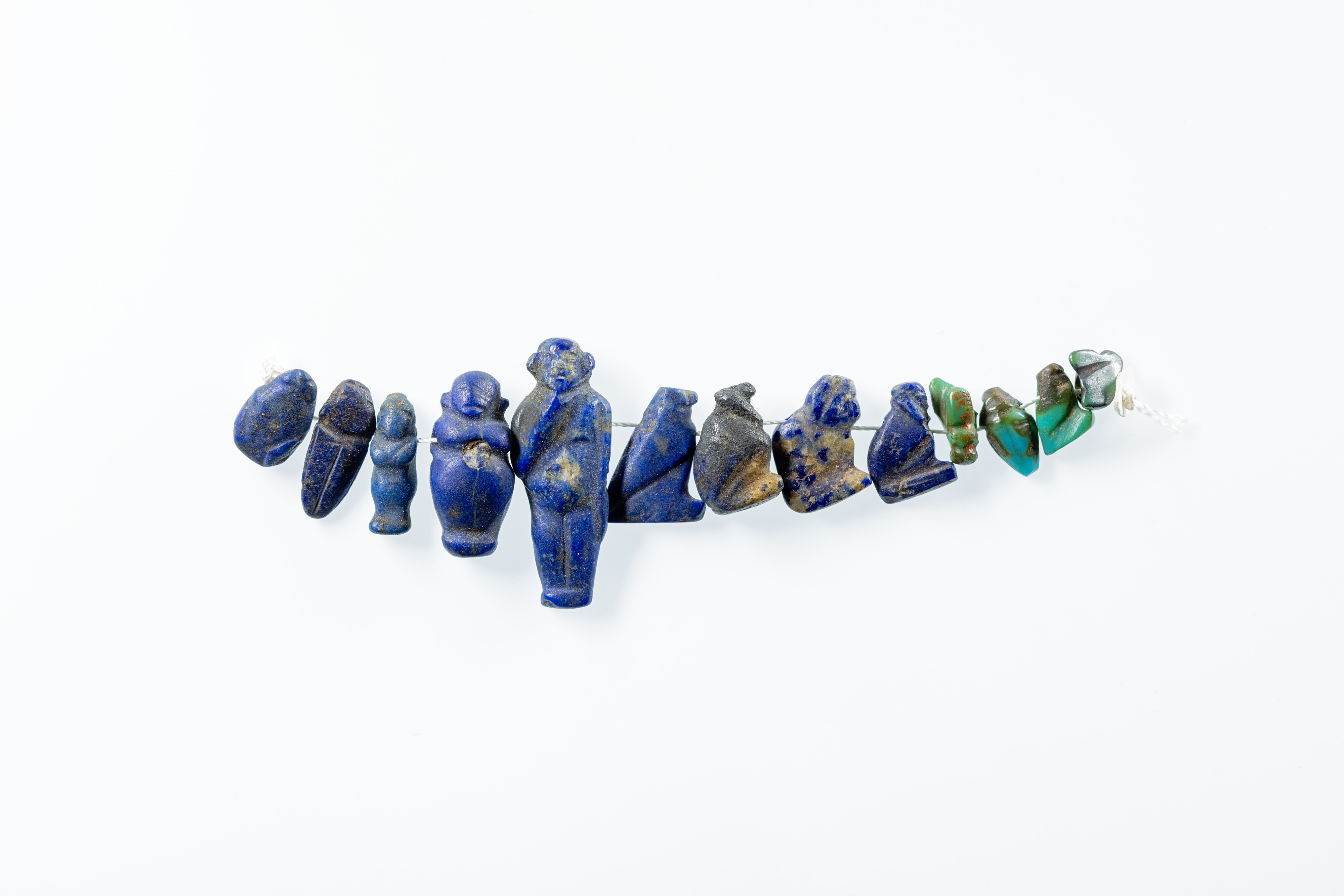
Heritage Analysis: Amulet in the Form of a Bird — Lapis Lazuli in Ancient Civilization
Executive Summary
This paper examines the Amulet in the Form of a Bird, carved from lapis lazuli within an Ancient Civilization context, as a strategic heritage asset for Katherine Fashion Lab. The artifact is not merely an ornament; it is a compressed system of symbolic power, spiritual insurance, and social signaling. For a 2026 luxury strategy, the bird amulet offers a rare convergence of material provenance, metaphysical narrative, and wearable scale. The following analysis positions this object as a template for high-end adornment that operates simultaneously as talisman and status marker — a duality that contemporary luxury consumers increasingly demand.
Material Provenance: Lapis Lazuli as Strategic Luxury
Lapis lazuli was never a neutral material. In Ancient Civilizations — most notably Mesopotamia, Egypt, and the Indus Valley — lapis was sourced from the Sar-e-Sang mines of Badakhshan (modern Afghanistan) and transported across thousands of kilometers through trade networks that predate the Silk Road. Its scarcity, extraction difficulty, and geographic remoteness made it a strategic resource on par with gold and silver. Unlike gold, however, lapis carried an additional valence: it was the color of the heavens, of the night sky, of the divine. The stone's natural inclusions of calcite and pyrite — golden flecks against deep ultramarine — were read as stars embedded in a celestial field.
For Katherine Fashion Lab, the strategic lesson is clear: material provenance is narrative capital. A 2026 luxury object must be able to articulate its origin not as a supply chain fact but as a cosmological claim. Lapis lazuli was believed to be a stone of the gods, worn by royalty and priests to secure favor, protection, and authority. The bird amulet, carved from this material, therefore arrives pre-loaded with a dual legitimacy — earthly rarity and celestial symbolism.
Symbolic Power: The Bird as Intercessor and Messenger
In Ancient Civilization iconography, the bird occupies a liminal position between the human and the divine. It is a creature of the air, unbound by gravity, capable of traversing the boundary between the earthly realm and the heavens. As an amulet, the bird form was not decorative; it was functional. It served as a vehicle for the wearer's prayers, a messenger to the gods, and a protective agent against malevolent forces. In Egyptian contexts, the ba — often depicted as a human-headed bird — represented the soul's mobility after death. In Mesopotamian and Levantine traditions, bird amulets were associated with divine protection, fertility, and the retrieval of lost vital essence.
The symbolic power of the bird amulet is therefore threefold. First, it is apotropaic: it wards off harm. Second, it is intercessory: it carries petitions to higher powers. Third, it is transformative: it signals the wearer's aspiration to transcend ordinary human limitation. This tripartite function maps directly onto the psychological needs of the contemporary luxury consumer, who seeks not only beauty but also meaning, protection, and a sense of personal elevation.
Historical Adornment: Wearability and Social Signaling
Amulets in the form of birds were typically small — often under five centimeters — and perforated for suspension. They were worn on cord, leather, or gold chain, positioned at the throat or chest, close to the heart and the breath. This placement is significant. The amulet was not a brooch or a belt ornament; it was a proximal object, in direct contact with the body's most vital centers. In burial contexts, bird amulets have been recovered from the neck and hands of the deceased, suggesting an intimate, lifelong relationship between wearer and object.
For high-end luxury strategy, this historical wearability is a competitive advantage. The bird amulet is not a display piece for a vitrine; it is a personal artifact designed for daily or ritual use. Its scale, weight, and tactility make it suitable for contemporary jewelry design that emphasizes intimacy over spectacle. The 2026 luxury market rewards objects that can be worn continuously, that develop patina, and that carry a private narrative for the wearer rather than a public logo for the observer.
Spiritual Meaning: The Amulet as Portable Sanctuary
The spiritual meaning of the lapis bird amulet lies in its capacity to function as a portable sanctuary. In Ancient Civilization, the temple was the primary site of divine contact, but the amulet extended that contact into the everyday world. The wearer carried a fragment of the sacred on their person, transforming the body itself into a site of devotion. This is a profound proposition for luxury: the object does not merely adorn; it consecrates.
Lapis lazuli amplified this effect. The stone was associated with the goddess Inanna/Ishtar, with the Egyptian goddess Hathor, and with the concept of divine truth. Its color — deep, saturated, and stable — was believed to repel evil and attract favor. A bird amulet in lapis was therefore a compound talisman: the form provided mobility and intercession, the material provided protection and divine alignment. The wearer was doubly armed.
2026 High-End Luxury Strategy: From Heritage to Market
For Katherine Fashion Lab, the strategic imperative is to translate this heritage into a 2026 luxury proposition without reducing it to pastiche. Three principles emerge.
First, narrative specificity over generic mysticism. The bird amulet's power derives from its precise cultural context — its role in Ancient Civilization as a messenger, protector, and soul-vehicle. Marketing must anchor the object in that specificity, not in vague "ancient wisdom." Consumers of high-end luxury are increasingly literate; they reward rigor.
Second, material integrity as ethical and aesthetic strategy. Lapis lazuli sourcing must be transparent, traceable, and respectful of the communities and geologies that produce it. The 2026 luxury consumer equates provenance with value. A lapis bird amulet that can document its journey from Badakhshan to the atelier is a stronger asset than one that cannot.
Third, wearability as ritual. The amulet should be designed for daily wear — small, tactile, comfortable against the skin. It should invite the wearer to establish a personal ritual: touching it before a meeting, wearing it during travel, passing it to a child. This is how heritage becomes living culture rather than museum display.
Conclusion
The Amulet in the Form of a Bird in lapis lazuli is a strategic heritage asset of exceptional density. It combines rare material, symbolic power, historical wearability, and spiritual meaning in a single, portable form. For Katherine Fashion Lab, it offers a model for 2026 luxury that is intimate rather than ostentatious, narrative rather than logo-driven, and sacred rather than merely decorative. The bird amulet does not shout; it whispers — and in the high-end market, the whisper is what endures.