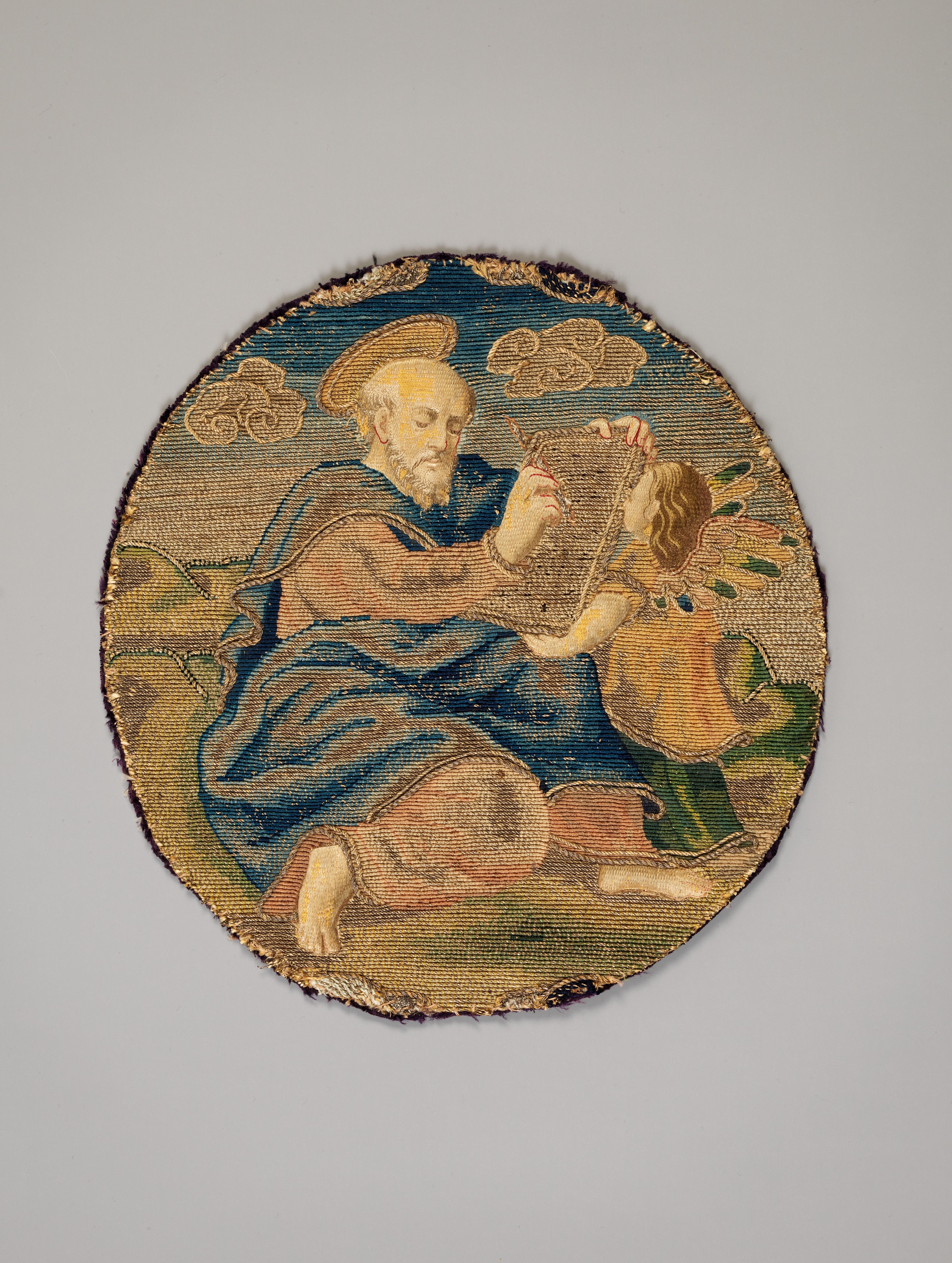
Saint Matthew: A Standalone Study in Silk, Metal-Wrapped Thread, and Canvas
Within the broader visual tradition of the four Evangelists, the figure of Saint Matthew occupies a distinctive position. As a former tax collector called from the customs house into apostolic service, Matthew embodies a narrative of radical transformation—a theme that has long attracted the attention of master embroiderers and textile artists working within the global heritage of liturgical and devotional art. This standalone study, executed in silk and metal-wrapped thread on canvas, presents Matthew not as a component of a larger altarpiece or Gospel cycle, but as a self-contained meditation on vocation, authorship, and the materiality of sacred representation.
The choice to isolate Matthew in a single panel reflects a deliberate curatorial and artistic decision. Where full Evangelist cycles emphasize theological balance and the fourfold witness to Christ, a standalone study permits deeper investigation into the saint's individual iconography. Here, the embroiderer treats Matthew as both historical figure and symbolic vessel, layering scriptural allusion with technical virtuosity. The result is an object that rewards close material analysis as much as iconographic reading.
Iconographic Framework and the Evangelist Tradition
Saint Matthew is conventionally represented with a winged man or angel, the creature drawn from the vision of Ezekiel and the Revelation of Saint John. This symbol signals Matthew's Gospel opening with the human genealogy of Christ—the descent from Abraham and David that anchors the Incarnation in tangible history. In this study, the winged figure is rendered in fine silk threads, its feathers articulated through graduated tonal shifts rather than hard outlines. The angel hovers near Matthew's shoulder, not as mere attribute but as active interlocutor, suggesting divine inspiration descending upon the writing hand.
Matthew himself appears in the act of composition, quill or stylus poised above a scroll or codex. This is the evangelist as author, a motif that carries particular weight in the context of textile art. The embroiderer, like the evangelist, works through patient accumulation—stitch upon stitch, thread upon thread—to produce a text of the body rather than of the page. The parallel is not incidental. In positioning Matthew as writer, the artist invites the viewer to consider embroidery itself as a form of inscription, a material gospel worked in silk and metal rather than ink.
The global heritage dimension of this study is evident in its synthesis of visual conventions. The facial type and drapery suggest engagement with Byzantine and later Gothic models, while the handling of the metal thread—employed for the halo, the angel's wings, and the borders of Matthew's mantle—recalls the opulent surface effects of medieval Opus Anglicanum and its continental counterparts. At the same time, the clarity of the canvas ground and the relatively restrained palette point toward a more modern sensibility, one that values legibility and compositional economy over dense ornamental excess.
Materiality: Silk, Metal-Wrapped Thread, and Canvas
The technical foundation of this work deserves sustained attention. Silk, prized for its luster and tensile strength, serves as the primary chromatic medium. Its natural sheen interacts with light in ways that flat pigment cannot replicate, causing the drapery to shift in tone as the viewer moves. This kinetic quality is especially effective in the folds of Matthew's robe, where light and dark silks are blended to suggest volume and movement without recourse to heavy shading.
Metal-wrapped thread introduces a second register of visual experience. Typically composed of a silk or linen core wound with flattened metal strip—often silver or silver-gilt—this thread is inherently reflective and, in candlelight, capable of producing a shimmering, almost numinous effect. Its use here is strategic rather than decorative. The halo surrounding Matthew's head is worked in dense metal thread, establishing a clear hierarchy of sanctity. The angel's wings are similarly treated, their metallic surface catching light in a manner that distinguishes the celestial from the earthly. The border elements, meanwhile, frame the composition with a restrained but unmistakable assertion of value and permanence.
Canvas, the support, provides a structured but relatively neutral ground. Unlike the tightly woven linen grounds of earlier ecclesiastical embroidery, canvas offers a grid-like regularity that facilitates counted-thread techniques and precise placement of stitches. This regularity also imposes discipline: the embroiderer must work within the grain of the fabric, allowing the support to shape the rhythm of the stitching. In this study, the canvas is not merely a substrate but a participant in the composition, its texture subtly visible beneath the silk and metal, reminding the viewer of the manual labor underlying the finished image.
Composition, Scale, and the Standalone Format
As a standalone study, the work is freed from the constraints of architectural setting and narrative sequence. It does not need to harmonize with three companion panels or fit within a predella. This autonomy allows for a more intimate scale and a tighter focus on the figure. Matthew occupies the central field, his body angled slightly toward the viewer while his gaze remains fixed on the writing surface. The angel is positioned in dynamic counterpoint, creating a diagonal axis that energizes the composition.
The background is deliberately shallow, even flattened, a common strategy in devotional textiles where the figure is meant to be encountered rather than situated. This shallow space also enhances the tactile presence of the embroidery. Without deep recession, the viewer's attention remains on the surface—on the actual threads, the actual stitches, the actual metal catching the light. The standalone format thus becomes a form of theological and aesthetic concentration: one saint, one moment of inspiration, one continuous act of making.
Conclusion: The Study as Devotional and Technical Object
This Saint Matthew study exemplifies the enduring vitality of silk and metal-wrapped thread embroidery within global heritage traditions. It draws on centuries of iconographic convention while asserting its own material logic. The choice of canvas as a ground, the disciplined use of metal thread for hierarchical emphasis, and the isolation of the Evangelist from a larger cycle all contribute to a work that functions simultaneously as object of devotion and as demonstration of technical mastery.
For Katherine Fashion Lab, such a study offers more than historical interest. It models a way of working in which material, image, and meaning are inseparable—where the choice of thread is also a theological statement, and where the patience of the stitch becomes a form of exegesis. Saint Matthew, the tax collector turned evangelist, is rendered here not in ink but in silk and metal, his Gospel inscribed on canvas through the steady, cumulative labor of the embroiderer's hand. The result is a text one can see, touch, and, in the right light, almost hear.