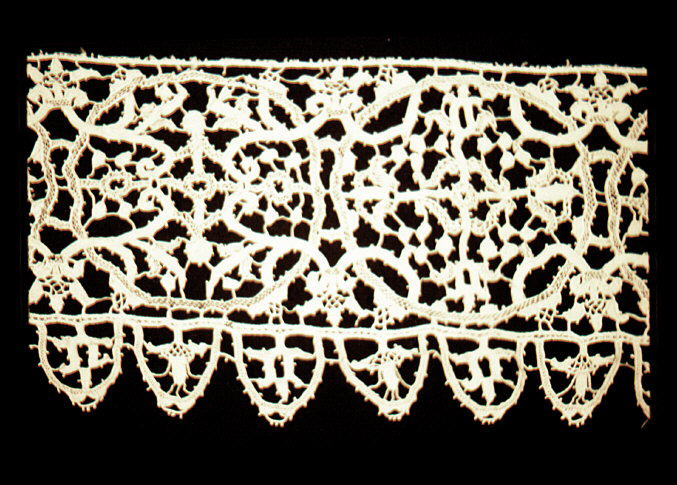
Heritage Asset Analysis: Strip — Needle Lace and Punto in Aria in the Ancient Mediterranean World
Within the Katherine Fashion Lab heritage portfolio, few material traditions carry the strategic depth of strip as expressed through punto in aria and its antecedents in needle lace. This analysis positions the strip — the linear band of openwork, the ornamental border, the liminal textile edge — as a civilizational artifact whose symbolic power, spiritual function, and aesthetic authority offer a defensible foundation for 2026 luxury strategy. The subject is examined as a standalone research asset, independent of seasonal collection cycles, to establish proprietary heritage IP.
Origins in Ancient Civilization: The Strip as Sacred Boundary
The strip emerges in ancient civilization not as decoration but as a functional and metaphysical threshold. In Egyptian, Mesopotamian, and Aegean material culture, narrow woven and knotted bands demarcated the edges of garments, the hems of ritual cloth, and the borders of temple veils. These strips performed a dual role: they physically reinforced textiles against fraying, and they symbolically contained the wearer's body within a protective perimeter. The strip was, in effect, a portable boundary — a line drawn between the sacred and the profane, the living and the ancestral, the self and the world.
Needle lace, the technique underlying punto in aria — literally "stitch in air" — represents the apotheosis of this logic. Rather than weaving a strip into an existing ground, the lacemaker constructs the strip from nothing but thread and negative space. The result is a border that exists without a body, a boundary that defines itself. For ancient civilizations, this was not merely craft; it was a demonstration of order imposed upon void, a visual theology of creation.
Symbolic Power and Historical Adornment
The symbolic power of the strip lies in its capacity to concentrate meaning at the margins. In ancient adornment systems, edges were never neutral. The hem of a priest's robe, the border of a bridal veil, the trim of a chieftain's mantle — each strip encoded status, lineage, and spiritual protection. Punto in aria intensified this encoding by introducing transparency. The strip no longer merely covered; it revealed. It created a lattice through which the body, the light, and the gaze could pass, transforming the wearer into a site of mediated visibility.
Historically, this transparency carried erotic, devotional, and political charge simultaneously. A strip of needle lace at a neckline could signal modesty and allure in the same gesture. At an altar, it could frame the divine. At court, it could announce access to rare skill and imported materials. The strip was never one thing; it was a compressed narrative of the culture that produced it.
Spiritual Meaning: The Stitch in Air as Prayer and Protection
In the spiritual imaginary of the ancient world, the strip functioned as an amuletic band. Knots — the structural basis of needle lace — were widely understood as bindings, capable of trapping malevolent forces or securing blessings. A strip of knotted openwork worn at the wrist, throat, or waist was thus a wearable prayer, a continuous line of intention. The very act of making punto in aria — hours of repetitive, meditative stitching — infused the strip with the maker's disciplined attention, a form of embodied devotion.
This spiritual dimension is strategically significant. It distinguishes the strip from purely ornamental trims. It positions the strip as a talismanic object, one that carries the residue of ritual labor and metaphysical intent. For a luxury house, this is not folklore; it is provenance with psychological depth.
2026 Luxury Strategy: From Heritage Asset to Commercial Architecture
For Katherine Fashion Lab, the 2026 strategic opportunity lies in repositioning the strip not as trim but as signature architecture. Three pillars define the approach.
First, proprietary technique. Revive punto in aria as a house code, but translate it into contemporary scale — strips that structure garments rather than finish them. A needle-lace strip can become a spine, a shoulder line, a waistband, a hem that reads as a horizon. The technique becomes recognizable across categories, from ready-to-wear to leather goods to fragrance packaging.
Second, symbolic storytelling. Each strip should carry a documented narrative: its ancient referent, its spiritual function, its maker's hand. This is not marketing veneer; it is the intellectual property of the house. In a market saturated with minimalism and logo fatigue, the strip offers narrative density — a small surface that holds centuries.
Third, scarcity and craft authority. Needle lace cannot be mass-produced without losing its soul. The 2026 luxury consumer, particularly at the high end, rewards visible human time. Limited editions of hand-worked strips, authenticated and archived, create collectible heritage objects. They also justify price architecture and protect the brand from downward pressure.
In summary, the strip — as expressed through punto in aria and its ancient antecedents — is not a decorative footnote. It is a civilizational technology of boundary, protection, and revelation. For Katherine Fashion Lab, it represents a rare convergence: spiritual meaning, historical adornment, and a commercially viable signature for 2026. The strip is the line between heritage and future. The house that owns that line owns the conversation.