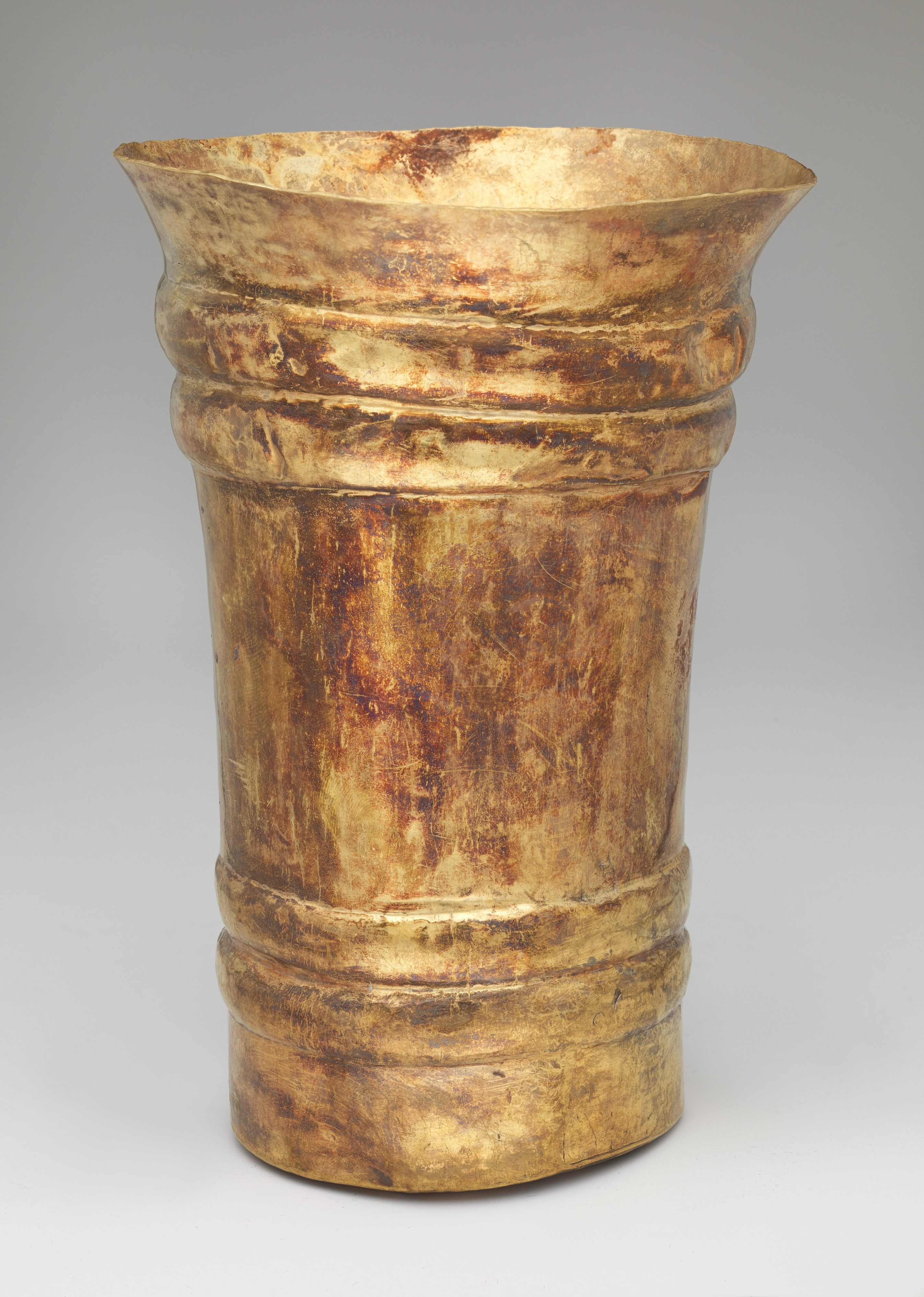
Beaker (Lambayeque / Sicán), Gold: A Couture Analysis of Surface, Structure, and Symbolic Capital
In the Katherine Fashion Lab archive, certain objects function less as artifacts than as propositions—arguments about how a surface should behave, how an edge should be finished, and how an ornament should carry meaning without surrendering to decoration. The Lambayeque (Sicán) gold beaker is one such proposition. It arrives not as a vessel in the utilitarian sense, but as a controlled essay in metallic drape, reflective discipline, and narrative tension. Its shared DNA with the archive’s Mirror with Split-Leaf motif is unmistakable: on one side, a burnished silver-mirror plane inlaid with gold in a dense, interlocking foliate pattern; on the other, the cold lithic severity of a sarcophagus panel where relief carving narrates life, lineage, and transition. The beaker sits at the intersection of those two regimes—optical seduction and funerary inscription—and it is precisely this duality that makes it couture rather than merely archaeological.
Material Honesty: Gold as Textile, Not Metal
The first couture lesson of the Sicán beaker is its treatment of gold as a textile. In high fashion, the distinction between fabric and metal is often collapsed: lamé behaves like liquid, chain mail behaves like knit, and sequins behave like embroidery. This beaker performs the same collapse. The gold is not left as a raw, inert substance; it is worked into thin, responsive sheet and then articulated through repoussé, chasing, and inlay so that the wall of the vessel reads as a supple skin rather than a rigid shell. The silhouette is restrained—likely a gently flaring cylinder or slightly convex form—because the makers understood that when the material is this assertive, the cut must be quiet. This is the discipline of the structural minimalism that couture prizes: the shape does not compete with the surface; it provides a stage for it.
Equally important is the beaker’s relationship to the body. A beaker is held, lifted, and drunk from; it is an object of intimacy. In couture terms, it is a garment for the hand and the mouth. The rim must be finished with absolute precision—no burr, no unevenness—because the wearer’s lips will register any failure. The Sicán metalsmiths, working without modern magnification, achieved rims and joins that satisfy this haptic requirement. The result is a piece that is simultaneously ceremonial and wearable, monumental and personal.
The Split-Leaf Motif: Ornament as Grammar
The archive’s shared DNA—the split-leaf pattern in gold inlay on a silver-mirror ground—is the beaker’s central visual argument. The motif is not a single leaf but a split-leaf: a form that divides, repeats, and interlocks, creating a field that is at once symmetrical and dynamic. In couture, this is the logic of the repeat—the engineered print, the guipure lace, the embroidered trellis—where a single unit generates an entire surface through modular multiplication. The Sicán goldsmiths deploy the split-leaf as a grammar: each unit is a phrase, and the interlocking field is a syntax of abundance.
Critically, the motif is executed in gold against a silver-mirror ground. This is not mere color contrast; it is a material hierarchy. The silver mirror is cool, neutral, and reflective—it absorbs the viewer’s gaze and returns it. The gold is warm, symbolic, and assertive—it interrupts the reflection with meaning. In fashion terms, this is the difference between a base fabric and an applied embellishment: the silver is the ground, the gold is the broderie. The split-leaf inlay therefore functions as a couture embellishment in the truest sense—it is not printed, not painted, but constructed, with each gold element set into the silver surface so that the two metals share a single plane. The effect is a surface that changes with the light: at one angle, a mirror; at another, a garden of golden leaves.
The Sarcophagus Counterpoint: Relief as Narrative
The beaker’s second face—its conceptual counterpoint—is the cold stone sarcophagus panel with its low-relief life narrative. This is the archive’s other inheritance: the narrative relief that tells of lineage, ritual, and passage. Where the mirror side is optical and abstract, the sarcophagus side is literal and sequential. The beaker mediates between them. It carries the split-leaf ornament of the mirror, but it also carries the beaker’s own narrative function: it is a vessel for liquid, for offering, for communion. In couture, this is the difference between a défilé look that exists for the photograph and a garment that exists for the life of the wearer. The beaker is both: a ceremonial object that performs in ritual and a designed object that performs in the hand.
The relief narrative on the sarcophagus also informs the beaker’s temporal dimension. A beaker is used in time—filled, raised, emptied, passed. The split-leaf motif, with its endless interlocking, suggests continuity; the relief narrative suggests a story with a beginning and an end. The beaker holds both: the eternal repeat and the mortal sequence. This is the couture equivalent of a garment that can be worn to a wedding and then inherited—its surface is timeless, its use is biographical.
Conclusion: The Beaker as Couture Proposition
The Lambayeque (Sicán) gold beaker is not a minor vessel. It is a masterclass in surface engineering, material hierarchy, and symbolic layering. Its split-leaf inlay on a silver-mirror ground is a lesson in how ornament can be structural rather than applied; its gold sheet is a lesson in how metal can behave as textile; its dialogue with the sarcophagus relief is a lesson in how an object can carry both eternal pattern and mortal narrative. For the Katherine Fashion Lab, the beaker is a reminder that couture is not defined by rarity of material alone, but by the intelligence of its construction—by the ability to make gold feel like cloth, to make a mirror feel like a garden, and to make a drinking vessel feel like a cosmology. The beaker is, in the end, a garment for the hand: cut with restraint, finished with precision, and embroidered with a grammar of leaves that has never stopped speaking.